Night Photography
by Michael Frye | Feb 12, 2015 | Night Photography
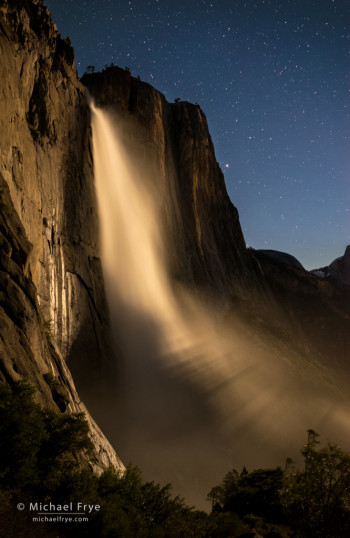
Upper Yosemite Fall illuminated by the rising moon, Monday night
After photographing Horsetail Fall on Monday evening I was thinking about heading home, but it occurred to me that this might be the perfect night to make a photograph I had been thinking of, with Upper Yosemite Fall backlit by the rising moon. The moon was due to rise about 11:00 p.m. Consulting PhotoPills, it seemed like the angle and phase of the moon were about right. And with the waterfalls so full, plus cloud-free skies, it seemed unlikely that I’d ever find better conditions.
So I decided to go for it. I had dinner at the Food Court at Yosemite Lodge, then connected to the Lodge wi-fi and answered emails for awhile. About 8:30 I headed up the trail.
Hiking the Upper Yosemite Falls Trail in the dark was a strange, surreal experience. I’d been up this trail at night before, but under a full moon. Prior to the moonrise Monday night it was very dark, with the only light coming from the stars. I had to use my headlamp to negotiate the rocky trail, and the bright light ruined my night vision. When I came around the bend where you typically get your first view of the upper fall, I could hear it, and feel the spray, but couldn’t see it at all. I had to turn off my headlamp and let my eyes adjust for a minute, and then I could just make out a tall, skinny triangle of less-than-pure-blackness ahead of me – the waterfall.
I didn’t get as wet as expected going past the base of the fall; I’ve been soaked at this spot before, but the water level apparently wasn’t as high this time. But the waterfall was loud. I arrived at my spot early, and had time to try out different compositions before the moon rose.
(more…)
by Michael Frye | Dec 2, 2014 | Night Photography
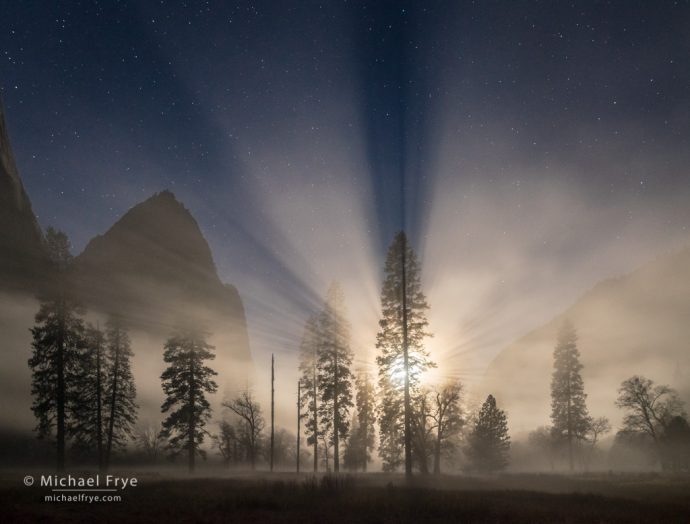
Moon setting on a misty night, El Capitan Meadow, Yosemite
Sunday night at around 11 o’clock I was, naturally, thinking about going to bed. But I decided to check the satellite images online to see if it might be worth getting up early. The skies had been overcast in the afternoon, with some light showers. Now the satellite images showed skies clearing.
It occurred to me to check the moon. I knew the moon was waxing (getting closer to full every day), but wasn’t sure exactly what stage it was in. Looking at PhotoPills told me the moon was at 71% (about three-quarters full), and due to set at 1:42 a.m. The angle of the moonset – 273 degrees – was interesting, as it was similar to the angle of the setting sun in late March, which is a good time of year for late-afternoon photographs from Tunnel View.
Hmm… A quick look outside revealed some interesting, low-hanging clouds. If I moved quickly I could reach the valley before the moon went down. And if there were clouds, and some mist from the rain, I could perhaps make a nighttime version of this late-March photograph, using the setting moon, instead of the setting sun, to illuminate Cathedral Rocks and Bridalveil Fall. There wouldn’t be much water in the fall, but still, it might be interesting, and worth a try.
(more…)
by Michael Frye | Nov 25, 2014 | Night Photography
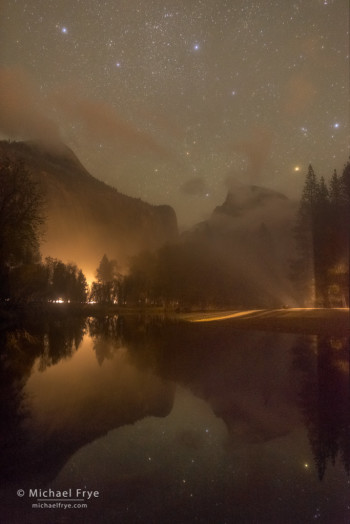
Half Dome, North Dome, and the Merced River at night, with illumination by car headlights, Yosemite
It rained here on Friday night and Saturday morning. The storm cleared Saturday afternoon, so once again I drove up to Yosemite Valley. Unfortunately clouds closed in and muted the light at sunset, but I decided to wait. I remembered a dusk photograph I made from Tunnel View a couple of years ago (the top image in this post), and thought the same light might occur again.
Well lightning didn’t strike twice, and the dusk light wasn’t that interesting. But again I decided to wait. I knew there wouldn’t be any moonlight, but interesting mist was floating around the valley, and I thought starlight might be enough to illuminate some scenes, with perhaps some additional help from car headlights.
(more…)
by Michael Frye | Oct 5, 2014 | Night Photography
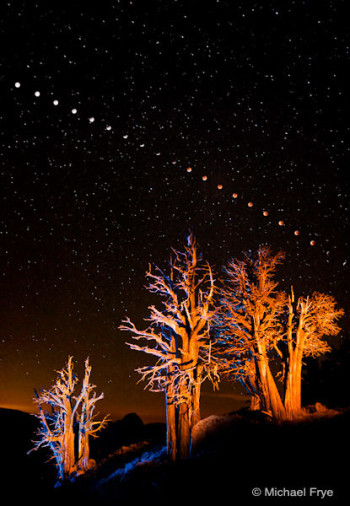
Lunar Eclipse Sequence, 1:23 a.m. to 4:49 a.m., August 28, 2007, Yosemite National Park, California
Lunar eclipses are spectacular events to see and photograph. I’ve been lucky enough to capture several lunar eclipse sequences over the years, including this one from Yosemite in August 2007.
We’re all going to get another chance at photographing an eclipse soon: a total lunar eclipse will be visible throughout North America early Wednesday morning, October 8th.
In the western half of the U.S. the entire eclipse sequence will be visible, from full moon, to partial eclipse, to total eclipse, and back to full again. In California the moon will be high in the sky to the west-southwest at the beginning of the sequence, then sink near the horizon to the west by the end of the sequence. The moon’s path will actually be somewhat of similar to path in this photograph, except that the eclipse will be higher in the sky and a bit further to the right, and the angle of the moon’s path will be steeper.
On the east coast the moon will set when its fully eclipsed, so it won’t be visible as its coming out of the eclipse. But that means the moon will be near the horizon when its fully eclipsed, where you might be able to photograph it next to an interesting foreground object as the dawn lightens the sky. It should be just north of due west as it sets.
For precise guidance about the moon’s position in relation to the landscape, I recommend consulting PhotoPills or The Photographer’s Ephemeris. Here’s the timing for the eclipse:
(more…)
by Michael Frye | Sep 22, 2014 | Night Photography
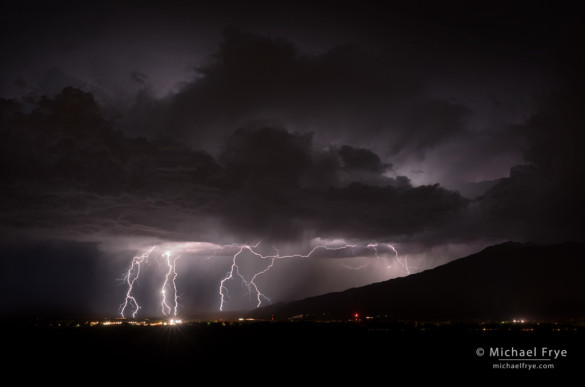
Lightning over Bishop and the Owens Valley, CA, USA
Over the weekend Claudia and I made our annual pilgrimage to the Millpond Music Festival in Bishop, over on the eastern side of the Sierra. This is the 15th consecutive year we’ve attended this festival. Hanging out with friends, listening to music underneath the high peaks of the Sierra, made for a wonderful, relaxing, fun weekend. And as a bonus, I got to photograph some interesting weather.
The land around Bishop is semi-desert, so it doesn’t get much rain. We’ve been sprinkled on a couple of times at Millpond, but had never experienced any serious rain – until Saturday.
A weak low-pressure system pulled some remnants of Hurricane Odile up from the south. Clouds and thunderstorms developed over the mountains, but missed Bishop and the Owens Valley until Saturday evening. As the second-to-last act of the day was performing, a few raindrops fell. I looked at radar images on my phone, and saw some serious-looking storm cells moving right up the valley from the south. I estimated that we had an hour or two before we got dumped on. Figuring that the last performance would be cancelled anyway, I decided to try and get some lightning photographs.
(more…)
by Michael Frye | Sep 9, 2014 | Night Photography
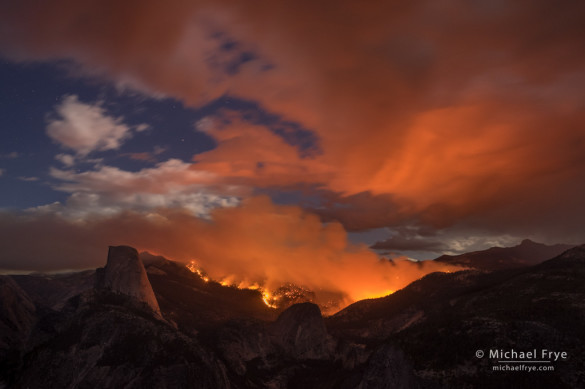
Meadow Fire burning in Little Yosemite Valley at night, with Half Dome on the left, Yosemite; 9-7-14, 8:44 p.m.
Sunday afternoon Claudia and I saw dramatic images on the Yosemite webcams of a fire in Little Yosemite Valley. We’ve had many fires around here the last two summers, and I’ve made plenty of fire photographs. But how often can you photograph a fire next to Half Dome? We decided to head up to Washburn Point (near Glacier Point) to take a look.
The origin of this fire is officially under investigation. The park service has been letting the lightning-caused Meadow Fire burn for awhile, and it’s likely that embers from the Meadow Fire were picked up and blown into an area with heavy fuels, then were fanned by the wind. But it’s also possible that this is a new fire with an unknown cause.
In either case, the winds caused this fire to blow up suddenly Sunday at about 12:30 p.m., closing all the trails in and around Little Yosemite Valley, and forcing the park service to evacuate 50 hikers from the top of Half Dome by helicopter! A big news story, as you can imagine. As of yesterday, the fire was estimated at 2,600 acres. They’re using helicopters, air tankers, and ground crews to contain it. All the park roads and facilities are open, and fortunately no one has been injured by the fire.
There were quite a few photographers at Washburn Point Sunday night, and no wonder – the fire was a spectacular sight. Moonlit clouds kept streaming in from the south, and several times we saw lightning in the distance. Two separate rain showers just missed us, but passed directly over the fire. The first shower seemed to noticeably dim the flames. After the second, heavier shower, a large bank of fog rose up, obscuring the fire and Half Dome. The fog may actually have been steam, created by water hitting the fire. These brief showers didn’t put the fire out, but they probably slowed it down.
(more…)