In the Moment:
Michael Frye's Landscape Photography Blog
by Michael Frye | Feb 25, 2011 | Critiques

“Another Lousy Sunset” by Ken Hornbrook
The critique is finally here—thanks for your patience!
Light
This week’s photograph was made by Ken Hornbrook at Bandon Beach along the Oregon coast. There’s some wonderful sunset color in the sky, plus blue and orange reflections in the water, creating great color contrasts throughout much of the frame. Any photographer standing at this beach that evening would be excited about the possibilities. But what do you do with that light, that color?
Composition
Ken found a great camera position to take advantage of the colorful sunset and interesting shapes of the rocks. It looks like he moved into a small cove or gap between cliffs or sea stacks. This created a nice window, with dark shapes on the sides framing the view of the stacks beyond. The curving, colorful V-shape of the water in the foreground leads our eyes smoothly from bottom to top. It even has a bit of an S-curve. I’ve pointed out problems with foregrounds in previous critiques, but I think this one really works, and adds a lot to the photograph.
(more…)
by Michael Frye | Jan 28, 2011 | Critiques

“Badwater Lake” by Grant Kaye
This week’s photograph was made by Grant Kaye at Badwater in Death Valley National Park, California. The water in this place may be bad to drink, but it’s good for photography. It’s always interesting to see water in the desert, and this spot often has great reflections, especially with clouds at sunrise or sunset, like the ones Grant captured in this image. It’s easy to see why Badwater attracts lenses.
Composition
With reflection images, horizon placement is a key decision. It’s usually better to avoid putting the horizon across the middle of the frame, as this cuts the photograph in half, and often creates the feeling of two different photographs stuck together. (I pointed out this problem in another recent critique.)
But there are exceptions to any rule. With reflections, putting the horizon in the middle emphasizes the symmetry between the elements above the horizon and their reflections below, and can be an effective way of expressing calm and serenity, or simply creating repetition and a unified composition. Placing the horizon above or below the center can also work: pointing the camera down emphasizes the reflection; pointing the camera up emphasizes the actual objects above the water.
In this photograph Grant chose put the horizon above center and highlight the foreground and the reflection. I often like this approach, as reflections have richer color than the real objects they’re reflecting. Here this arrangement also accentuates the converging lines of the clouds—they all seem to point to a spot behind the peaks in the center of the image. Overall the composition is simple and direct, with a strong radiating design.
(more…)
by Michael Frye | Jan 14, 2011 | Critiques

“Ptarmigan Lake” by Chris Alexander
Composition
This week’s photograph was made by Chris Alexander in Glacier National Park, Montana. That’s the second time recently that I’ve critiqued a photo from this park. Obviously—and no surprise to anyone who’s been there—a beautiful place!
This composition works very well. The bottom two-thirds of the photograph has sweeping, repeating, U-shaped curves that help tie everything together and frame the background peaks. The lake and mountains provide focal points: my eyes work in a triangle around the frame, going from the lake to the prominent peak on the right, over to the peaks on the left, then back to the lake, sometimes detouring around the lower basin to look at the snow patches and trail. The overall design is simple and strong.
If I could quibble with something, it would be the bright spots along the edges that tend to draw my eyes out of the frame, including the snow patch in the lower-left corner, another snow patch near the upper-right corner, and of course the sky.
(more…)
by Michael Frye | Dec 16, 2010 | Announcements, Digital Darkroom
 It’s easy to find information about Photoshop, Lightroom, or just about any other aspect of the digital darkroom. But too often this information consists of random tips and tricks.
So I asked myself how I could help people put it all together. How could I help photographers develop a simple, powerful workflow, learn to make good decisions about how their photographs should look, and convey their original inspiration?
And that’s when I had the idea for this book.
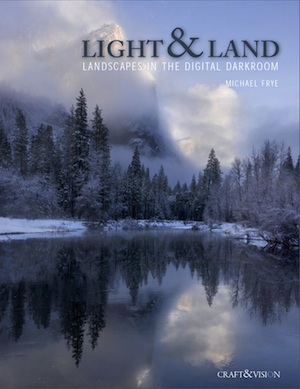
In Light & Land: Landscapes in the Digital Darkroom I’ll take you step-by-step through each decision as I process five different images in Adobe Lightroom. You’ll see my workflow in action, and I’ll explain why I use particular techniques in a particular order. But more importantly, you’ll come to understand the esthetic judgements behind each decision—how a certain amount of contrast conveyed my vision, or why too much saturation muddied the color rather than enhanced it. As you look over my shoulder you’ll gain insights about how to convey your own unique vision, and how to squeeze every ounce of beauty, emotion, and inspiration out of your photographs.
While I use Lightroom for these examples, the basic principles apply to any software. Learning how to make good decisions and find the right balance is more important than learning any particular tool or technique.
This eBook is published in conjunction with Craft & Vision, David duChemin’s great photography eBook site. Like all their eBooks, Light & Land is normally only five dollars. But for the next four days you can get it for only four dollars. Just use the code LAND4 at checkout. Or use the code LAND20 to get 20 percent off if you buy five or more Craft & Vision eBooks.
Click here to order your copy!
by Michael Frye | Dec 15, 2010 | Critiques
“Rabbitbrush and Storm” by David Thomas
First, my new eBook, Light & Land: Landscapes in the Digital Darkroom, will actually be released tonight at 1:00 a.m. PST, not today as I said previously. I’ll have more details in my next post tomorrow morning.
On to the critique…
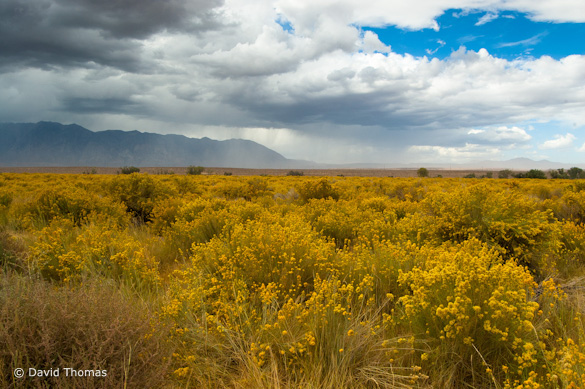
This week’s photograph was made by David Thomas near Bishop, California, on the eastern side of the Sierra Nevada.
Light
David said that he and his dad were driving north on Highway 395 when he noticed a storm gathering over the Sierra crest beyond this dense field of rabbitbrush, “perfectly arranged, waiting to be composed.” The clouds, falling rain, and patch of blue sky provide a dramatic background, and the yellow flowers add an eye-catching foreground. There’s actually not much sun in the scene, but that works well here, especially on the rabbitbrush, where sunlight would have created harsh shadows and visual confusion. The soft light brings out the yellow color of the bushes and helps simplify the scene. The combination of blue sky and yellow flowers creates a nice warm-cool color contrast.
(more…)