In the Moment:
Michael Frye's Landscape Photography Blog
by Michael Frye | Jun 26, 2012 | Vision and Creativity, Workshops
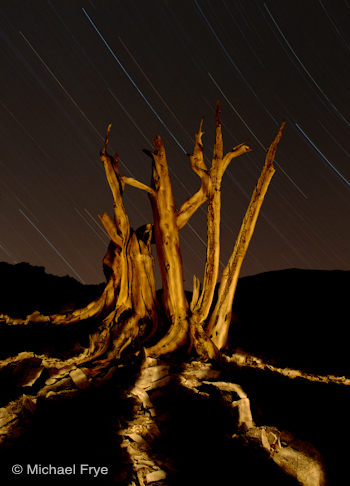
Bristlecone pine snag at night with star trails, White Mountains
Night photography offers wonderful opportunities to be creative. The low light allows you to use long exposures to record movement, like star trails or moonlit clouds. And since the natural light is so dim, you can easily overpower it with a flash or flashlight and add your own light to a scene.
That aspect of night photography—light-painting—has intrigued me for a long time. Adding your own light to a nighttime scene gives it a new dimension; it instantly transforms the landscape into something different, something we never see in real life, and adds a mysterious, surreal element to the photograph.
The accompanying image has both movement, in the form of star trails, and light-painting. I used a flashlight to trace the branches of this bristlecone pine snag, then painted zig-zag lines over the rocky foreground. I made this photograph with medium-format film back in September of 2000. Some test exposures with a Polaroid back helped me get the light-painting right, then I switched to real film (probably Provia), did the light-painting again, and then left the shutter open for another 90 minutes to record the star trails. You can see more examples of my light-painting techniques in my nighttime portfolio.
I learned light-painting with film, which was a slow trial-and-error (mostly error) process. Digital cameras make the learning curve much easier, because you can experiment and see the results immediately. If you’ve never tried night photography before this might be a fun summertime project—a way to stretch yourself a little and exercise your imagination. Summer is a great season for photographing landscapes at night, since the Milky Way is prominent, and the warm nighttime temperatures make it more comfortable to stay out late.
Whether you’re an experienced night photographer or a beginner, I recommend reading Lance Keimig and Scott Martin’s excellent book Night Photography: Finding Your Way in the Dark. Also, you can find tips about focus and exposure for moonlit landscapes in my post about photographing lunar rainbows.
And if you prefer hands-on learning there’s still space in my Full Moon Night Photography workshop later this summer (July 31st and August 1st). This is a great way to get personalized instruction and learn night photography in a fun, supportive group atmosphere. Rooms have been set aside for this workshop in Yosemite Valley and are still available if you register soon.
—Michael Frye
Related Posts: Under the Full Moon; Tips for Photographing Lunar Rainbows; Also, see images made by participants in last year’s night photography workshop in this Flickr group
Michael Frye is a professional photographer specializing in landscapes and nature. He is the author and photographer of The Photographer’s Guide to Yosemite, Yosemite Meditations, and Digital Landscape Photography: In the Footsteps of Ansel Adams and the Great Masters, plus the eBooks Light & Land: Landscapes in the Digital Darkroom, and Exposure for Outdoor Photography. He has written numerous magazine articles on the art and technique of photography, and his images have been published in over thirty countries around the world. Michael has lived either in or near Yosemite National Park since 1983, currently residing just outside the park in Mariposa, California.
by Michael Frye | Jun 20, 2012 | Vision and Creativity
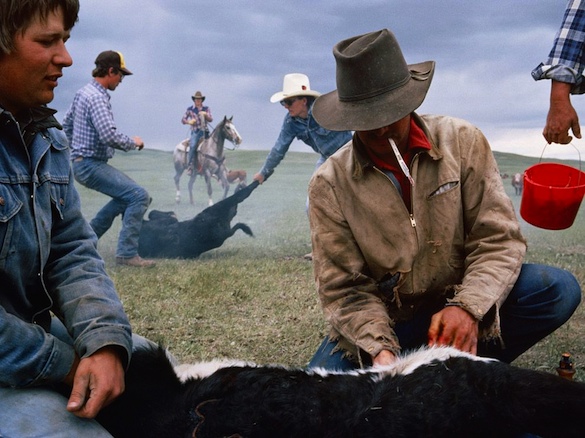
Sam Abell’s classic image of cowboys castrating cattle in Montana
It’s not often that you get to hear a master photographer explain how he made one of his greatest images, so I was thrilled to find this short video of Sam Abell describing how he made his classic photograph of cowboys branding cattle in Montana.
I love this statement: “What we’re all trying to do is make a layered, deep, complex, complicated photograph that doesn’t look complex or complicated.”
In talking about composition in my workshops and books I emphasize simplicity, since I think the single most common mistake people make is including too much in the frame. But my favorite images are rich and complex, without crossing the line into being busy and confusing. Obviously it takes years of experience to be able to make photographs like that – and Abell’s experience and mastery are on full display in this image.
(more…)
by Michael Frye | Jun 15, 2012 | Digital Darkroom
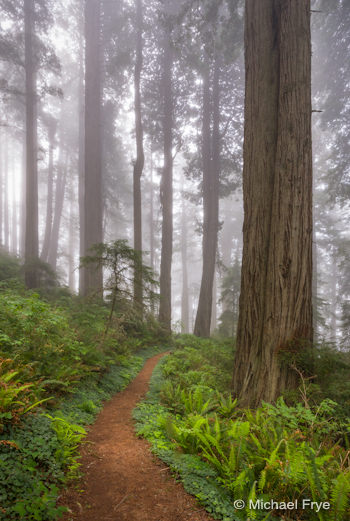
Path through foggy redwoods
I meant to post this earlier, but if you haven’t heard, Lightroom 4.1 was officially released about two weeks ago. So if you’ve been waiting to upgrade to Lightroom 4 until Adobe fixed the bugs, I think your wait is over, as the major problems should have been addressed. I know the point curve bug was fixed with the 4.1 RC (“release candidate”), so that shouldn’t be an issue any more.
Lightroom 4 is a big step forward in Raw image processing, but the advancements require a lot of horsepower to work properly. So check the system requirements before you take the plunge. Many people have had to upgrade their operating system to run Lightroom 4, and upgrading your OS can be a big undertaking, requiring that you update other applications as well.
Earlier I posted two videos about Lightroom 4, so if you haven’t watched those yet they can help you get up to speed in the new process. Here are links to Part 1 and Part 2.
The first image here, as well as all of the images from Monday’s post—including some pretty high-contrast scenes—were processed exclusively in Lightroom 4. In the comments for that last post JayM asked if I could make a tutorial on how I processed the first image. That’s a great suggestion, but for now you’ll find a screen shot below that shows the Basic Panel settings for that photograph. (I didn’t use the Tone Curve, which is not unusual for me these days with high-contrast images in Lightroom 4.)
(more…)
by Michael Frye | Jun 11, 2012 | Light and Weather
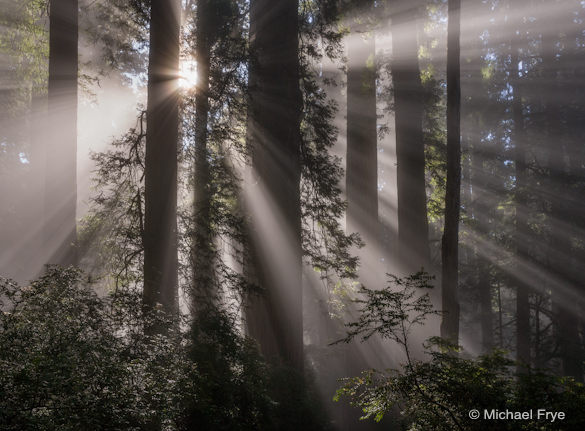
Sunbeams in the redwood forest
Last year I spent a magical day among foggy redwoods and rhododendrons along the northern California coast, and captured some of my favorite redwood photographs to date. You can see some of those photos here and here.
Claudia and I recently returned from another trip to the redwoods. On our first morning we went to the same area we visited last year, but the fog wasn’t as extensive, and not as many rhododendrons were blooming. We kept hiking, and finally reached some mist, and then something magical happened: the fog began to lift, and sunbeams started filtering through the trees. I captured the “Close Encounters” photograph below, then huffed up a steep trail to the top of a ridge and made the image at the top of this post, with classic godbeams radiating through the trees, then hurried back down, chasing the receding edge of the fog, where I found the scene in the second photograph below.
(more…)
by Michael Frye | May 30, 2012 | Advanced Techniques, Travels and Stories
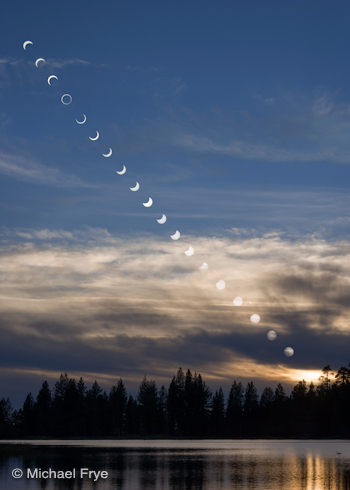
Annular eclipse sequence, Manzanita Lake, Lassen Volcanic NP, CA
Right after the annular solar eclipse on May 20th I went to the Google+ Photographers Conference in San Francisco. This was a really fun event—more about that later. But I mention this because I got involved in the conference, and then had a computer problem, and didn’t have a chance to look at my eclipse photos, much less process them, until now. So here, finally, is a photograph showing an eclipse sequence.
I felt completely unprepared for this eclipse. I’ve never photographed a solar eclipse before, so I didn’t know what to expect. I didn’t have a solar filter, and I wasn’t sure whether I could even photograph the eclipse without one. I’d read some dire warnings that photographing the eclipse without a solar filter could ruin your camera’s sensor, but this didn’t make sense to me. I’ve included the sun in hundreds of photographs and never had a problem. Exposures are short, and when the shutter is closed the light bounces off the camera’s mirror, up through the prism, and out through the back of the viewfinder. Staring through the viewfinder at the sun is not a good idea, just as it’s not a good idea to stare directly at the sun. But we have a natural defense mechanism for this known as pain: it hurts to look at the sun.
(more…)
by Michael Frye | May 17, 2012 | Yosemite Photo Conditions
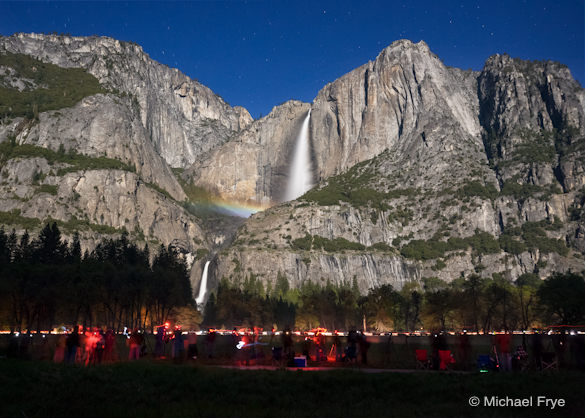
Photographers under the lunar rainbow in Cook's Meadow, May 5th
I hope that saying, “Better late than never” is true—at least this time! I’ve been really busy the since the full moon, but here, finally, are some photos of the lunar rainbow from May 4th and 5th.
Large numbers of photographers headed to Yosemite Valley that weekend to photograph dogwoods and the lunar rainbow. At times I joined four or five photographers pointing lenses at the same dogwood, and there were at least 200 people in Cook’s Meadow on Saturday evening (May 5th) watching and photographing the lunar rainbow. The photo at the top of this posts shows the moonbow and some of those attempting to photograph it.
The previous night my friend Jon McCormack and I grunted up the Yosemite Falls trail to a spot with a profile view of the upper fall. I’d photographed a lunar rainbow from this spot in 1996, but back then I didn’t have a wide enough lens on my Mamiya 645 to include Half Dome and the whole waterfall, so I thought it was time to try it again.
(more…)
by Michael Frye | May 1, 2012 | Yosemite Photo Conditions
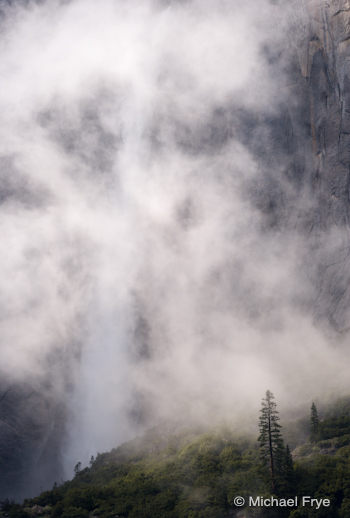
Upper Yosemite Fall through the mist, last Thursday afternoon
The moon will be full this weekend—on May 5th, at 8:36 p.m. to be precise. So that means I’ve been getting lots of questions about photographing lunar rainbows. First, the best way to find out where and when to photograph Yosemite’s lunar rainbows is astronomer Don Olson’s web site. Don and his team have figured out precise viewing times for lunar rainbows from the Lower Yosemite Fall bridge, and from Cook’s Meadow for Upper Yosemite Fall.
Temperatures are forecast to be relatively cool this weekend, which means that snow won’t be melting at a high rate, and water flow and spray will probably be below average for early May. The moonbow should be visible on the upper fall from Cook’s Meadow, but it won’t spread as wide as it did last year, nor will it be visible as long. For the lower fall, less spray is good (up to a point), because it’s easier to keep water drops off the lens from this often-damp location. I’m sure there will still be spray at the bridge below the lower fall, but it might be manageable. Whether you go to Cook’s Meadow or the Lower Yosemite Fall bridge you’ll have to share the spot with many other photographers—but there’s less room at the bridge.
(more…)
by Michael Frye | Apr 26, 2012 | Yosemite Photo Conditions
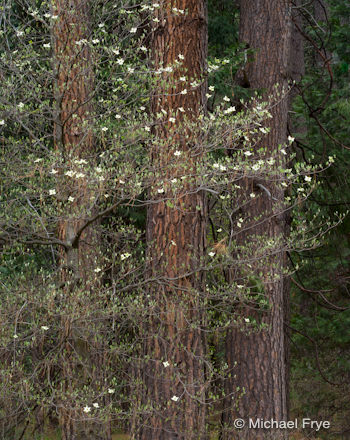
Dogwood and ponderosa pines near the Ahwahnee Hotel, yesterday morning
I’m teaching my Spring Yosemite Digital Camera workshop this week, but wanted to post a quick note to let you know that the dogwoods have suddenly popped out in Yosemite Valley. On Saturday I saw only a few green discs, but yesterday dozens of trees were in full bloom, and it seems like more are emerging every hour. The dogwoods are most photogenic when they first blossom, before too many leaves obscure the flowers, so the next week or so should be the best for photography, though the dogwoods will continue to bloom for a couple of weeks beyond that.
—Michael Frye
Michael Frye is a professional photographer specializing in landscapes and nature. He is the author and photographer of The Photographer’s Guide to Yosemite, Yosemite Meditations, and Digital Landscape Photography: In the Footsteps of Ansel Adams and the Great Masters, plus the eBooks Light & Land: Landscapes in the Digital Darkroom, and Exposure for Outdoor Photography. He has written numerous magazine articles on the art and technique of photography, and his images have been published in over thirty countries around the world. Michael has lived either in or near Yosemite National Park since 1983, currently residing just outside the park in Mariposa, California.
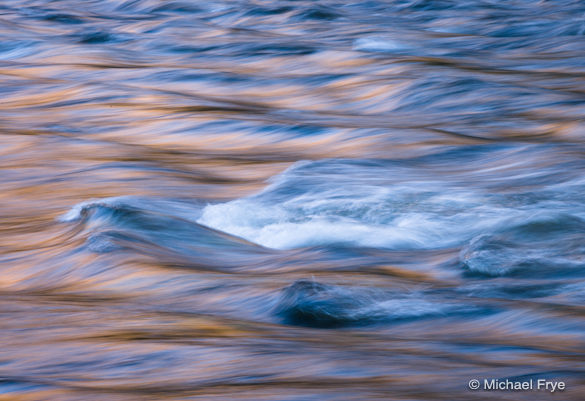
Reflections in the Merced River, Tuesday evening
by Michael Frye | Apr 20, 2012 | Uncategorized
(If you’re getting this post through email, click here to view the video.)
Here it is, my second video about the new process in Lightroom 4. In Part One I explained how the new tone controls work; here in Part Two I talk about how to use these new tools to process both low- and high-contrast images. Here are some of the main points:
– Where to begin? If you’ve read my eBook Light and Land, or watched one of my previous videos about curves, you know that in the old process I preferred starting with all the Basic tone controls set at zero, and the point curve linear. Does this still apply in the new process? (1:10)
– Curves or sliders? The new Basic Tone sliders are much better than the old ones; are they good enough to replace the Point Curve? (10:30)
– Does the order matter? Adobe suggests using the Basic tools in order from top to bottom, starting with Exposure, then Contrast, and working down to Highlights, Shadows, Whites, and Blacks—essentially working from the midtones out to the black point and white point. But this contradicts a long-standing tradition in digital imaging of setting the black point and white point first. Should you stand with tradition, or embrace the new order? (13:02)
– Processing a high-contrast image. (21:04)
This video is about 27 minutes long, so, as I said with Part 1, grab your favorite beverage, sit back, relax, and enjoy the show. Spending a little time with this video now will save time later when you’re processing photos. More importantly, I hope that this video will help you get the most out of your images so that they convey what you saw and felt when you pressed the shutter.
As I mention in the video, the best way to learn more about processing images in Lightroom is to take a workshop. There’s are still a couple of spots available in my October workshop, The Digital Landscape: Autumn in Yosemite. This is a comprehensive course covering the entire process from capture to print, with field sessions covering exposure, composition, and everything you do before pressing the shutter, and lab sessions where we process and print the images with Lightroom.
I hope you enjoy Part 2!
—Michael Frye
Related Posts: Lightroom 4: The New Tone Controls; Using Curves in Lightroom and Camera Raw
Michael Frye is a professional photographer specializing in landscapes and nature. He is the author and photographer of The Photographer’s Guide to Yosemite, Yosemite Meditations, and Digital Landscape Photography: In the Footsteps of Ansel Adams and the Great Masters, plus the eBooks Light & Land: Landscapes in the Digital Darkroom, and Exposure for Outdoor Photography. He has written numerous magazine articles on the art and technique of photography, and his images have been published in over thirty countries around the world. Michael has lived either in or near Yosemite National Park since 1983, currently residing just outside the park in Mariposa, California.
by Michael Frye | Apr 15, 2012 | Announcements
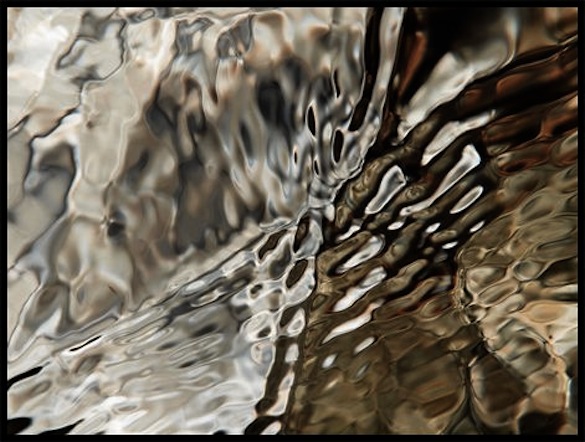
Unfiltered Object #4 by Jeff Grandy
Planning to visit Yosemite in the next few weeks for the waterfalls and dogwood bloom? While you’re there, stop by The Ansel Adams Gallery and see the current exhibit by Jeff Grandy, featuring prints from his exquisite Unfiltered Series. The show will be on display until May 10th.
Jeff is a long-time friend, and I’ve always loved his classic landscape images, but this new work of his is quite different. He’s focused on the colors and textures of water, and created a series of abstract and imaginative images. You can see some samples on Jeff’s website.
There will be reception for the artist April 21st from 3:00-5:00 and I plan to attend. Hope to see you there!
— Michael Frye
Michael Frye is a professional photographer specializing in landscapes and nature. He is the author and photographer of The Photographer’s Guide to Yosemite, Yosemite Meditations, and Digital Landscape Photography: In the Footsteps of Ansel Adams and the Great Masters, plus the eBooks Light & Land: Landscapes in the Digital Darkroom, and Exposure for Outdoor Photography. He has written numerous magazine articles on the art and technique of photography, and his images have been published in over thirty countries around the world. Michael has lived either in or near Yosemite National Park since 1983, currently residing just outside the park in Mariposa, California.