by Michael Frye | Dec 15, 2010 | Critiques
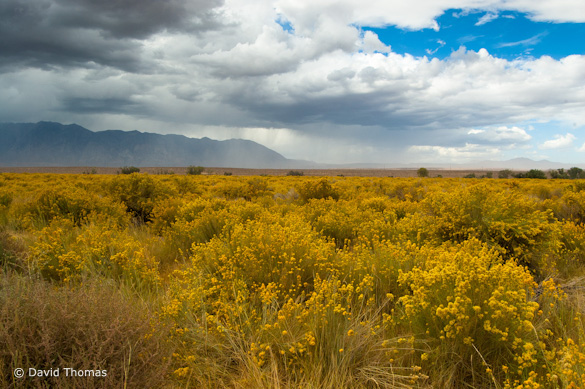
“Rabbitbrush and Storm” by David Thomas
First, my new eBook, Light & Land: Landscapes in the Digital Darkroom, will actually be released tonight at 1:00 a.m. PST, not today as I said previously. I’ll have more details in my next post tomorrow morning.
On to the critique…
This week’s photograph was made by David Thomas near Bishop, California, on the eastern side of the Sierra Nevada.
Light
David said that he and his dad were driving north on Highway 395 when he noticed a storm gathering over the Sierra crest beyond this dense field of rabbitbrush, “perfectly arranged, waiting to be composed.” The clouds, falling rain, and patch of blue sky provide a dramatic background, and the yellow flowers add an eye-catching foreground. There’s actually not much sun in the scene, but that works well here, especially on the rabbitbrush, where sunlight would have created harsh shadows and visual confusion. The soft light brings out the yellow color of the bushes and helps simplify the scene. The combination of blue sky and yellow flowers creates a nice warm-cool color contrast.
(more…)
by Michael Frye | Nov 7, 2010 | Yosemite Photo Conditions
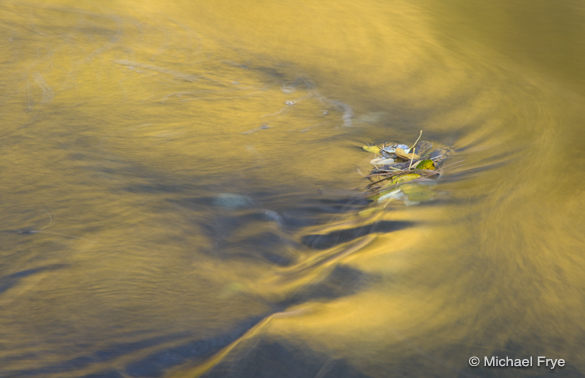
Cottonwood leaves and reflections in the Merced River, Yosemite
What a difference a week makes. Last Sunday, October 31st, the color in Yosemite Valley was progressing, but still not there yet. Yesterday I returned to the valley for a private workshop and found colorful leaves everywhere. All the deciduous trees—maples, dogwoods, cottonwoods, and oaks—are turning. Green leaves, abundant a week ago, are now in a small minority. All four species of deciduous trees are close to, or at, their peak autumn color.
Most years the maples and dogwoods turn before the oaks and cottonwoods, so the color is spread out over several weeks. It’s unusual for all these trees to be near peak at the same time, and I’ve seldom seen the valley look more beautiful than it did yesterday. I don’t know how long this will last. A significant storm arrived today, and forecasters are predicting one to two feet of snow above 6000 feet. While it probably won’t snow in Yosemite Valley, at 4000 feet, the rain will knock down some leaves—although surely not all of them. I’m planning to go up to the valley again tomorrow when the storm clears, so I’ll let you know what I find.
This storm has closed Tioga Pass. The pass closes for the winter after the first significant snowfall in November, so it will probably remain closed until spring. My favorite eastern Sierra locations, only a few hours away during the last five months, now require seven hours of driving to reach! I’ve always wanted to visit Mono Lake in winter, so maybe this will be the year, but if not then I’ll return when the pass reopens in May or June.
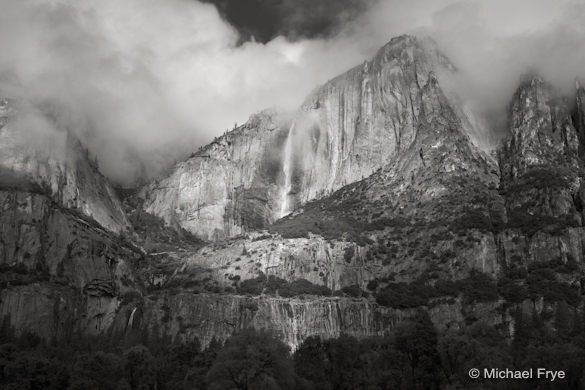
My five-day workshop, The Digital Landscape: Autumn in Yosemite, finished last week. While the autumn color had not yet reached its peak, we still found many colorful leaves to photograph, and saw some fantastic light and weather, as you can see from this view of Yosemite Falls as a storm was clearing. The group was diverse and interesting, with participants from Sweden, Belgium, New York, Texas, and Minnesota. I think this is the first time I’ve ever taught a Yosemite workshop with no California students! Anyway, thanks to everyone in the group for making this a fun class.
Clearing Storm Over Yosemite Falls
by Michael Frye | Nov 4, 2010 | Night Photography
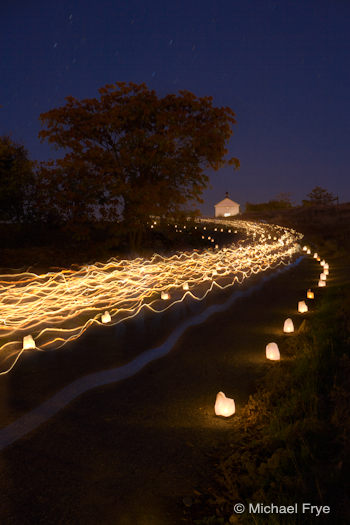
Day of the Dead procession, Hornitos, California
Last year Claudia and I attended theDay of the Dead (All Soul’s Day) celebration in Hornitos for the first time. Hornitos is a tiny town in the Sierra foothills near my home in Mariposa. During the 1850s over 15,000 people lived there; now the residents number less than a hundred. But every November 2nd the town’s population swells, and several hundred people form a silent, candlelit procession from the town up a hill to the old church and graveyard, where they participate in a ceremony honoring the departed.
As I wrote last year, Claudia and I both found the ceremony moving and inspiring, and knew we had to return. Tuesday night we attended the event for the second time. We loved it, again; in our noisy world it’s wonderful to see hundreds of people holding candles and walking silently, solemnly through the night to an old graveyard. Although neither of us are practicing Catholics, we can appreciate rituals that help connect us with some of the more essential and elemental aspects of life and death.
About the Photograph
Last year I made some good images, but it’s difficult to photograph something like this when you’ve never seen it before, don’t know what to expect, and only have one chance at it. This time I had a plan. I positioned myself where I could see the curving line of the procession walking up the hill toward the church. With the camera locked on a tripod I made an exposure at dusk to capture some of the ambient light, then made a further series of long exposures as the procession passed by. The pieces were assembled in Photoshop. The squiggly lines were made by candles that people held as they walked up the hill. The blue streak is actually the viewing screen of a video camera dangling from a man’s shoulder as he walked up the hill—a nice touch of color, and the line helps fill in an otherwise empty space in the composition.
Some photographs are created spontaneously; others require planning. This is obviously an example of planning, as is my photograph of Horsetail Fall by moonlight. But most of my best images were made by simply reacting to what I saw around me—fleeting light or weather, or maybe just aninteresting arrangement of elements that could make a compelling composition. Planning and flexibility are both essential tools in a photographer’s kit.
Next November 2nd I may leave the camera at home and actually join the procession. Then again, I might not be able to resist trying to capture an event with such rich photographic potential. Either way, I’ll be there.
by Michael Frye | Oct 15, 2010 | Yosemite Photo Conditions
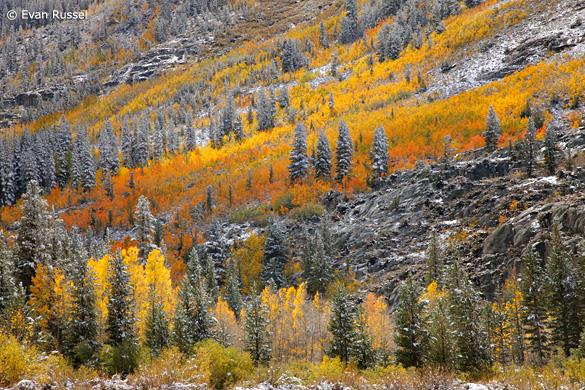
Aspens and snow in the Bishop Creek area, October 5th—Photograph by Evan Russel
After Tioga Pass closed last week I was stuck on the west side of the Sierra, but my friend Evan Russel, Ansel Adams Gallery staff photographer and one of my workshop assistants, made it over there a day earlier, and captured some some great images of snowy aspens after the storm on October 3rd and 4th. Here are a couple of examples. You can see more of Evan’s work on the Gallery’s Facebook page.
Meanwhile in Yosemite Valley autumn is progressing slowly. After some color suddenly appeared last week I thought that the leaves might turn quickly, but apparently the warm weather has slowed things down. I spent the last two days in the valley, and saw some trees that have partially changed, but none fully clothed in their fall colors. Claudia checked out the dogwoods along Highway 120 between the entrance station and Crane Flat and saw mostly green leaves, so it seems that even the higher-elevation trees haven’t changed yet.
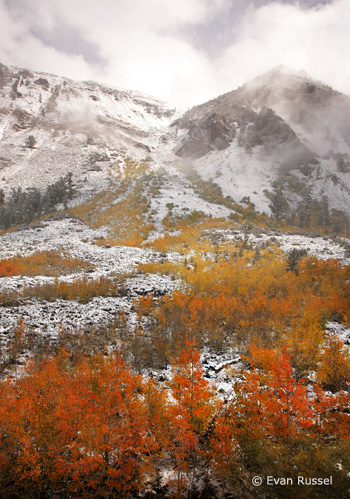
Aspens and snow in the Bishop Creek area, October 5th—Photograph by Evan Russel
While we may have to wait a bit for more color in the valley, this could also mean that all the deciduous trees will change at the same time. Usually the dogwoods and big-leaf maples turn earlier than the oaks and cottonwoods, and the color is spread out over several weeks. But occasionally all the trees turn together, creating some exceptional conditions.
On the eastern side of the mountains the color is not yet at its peak in the middle and lower elevations, but things are starting to change quickly, and color can be found in many of the medium-to-high-elevation aspen groves. I described some of the progress in my last two posts, but will add that on Tuesday I found some nice orange trees in the upper reaches of Lee Vining Canyon, along Highway 120. These aspens had shown very little color only three days earlier. The next two weeks could be great in places like Lundy Canyon, Lee Vining Canyon, June Lake Loop, and Conway Summit.
by Michael Frye | Oct 6, 2010 | Yosemite Photo Conditions
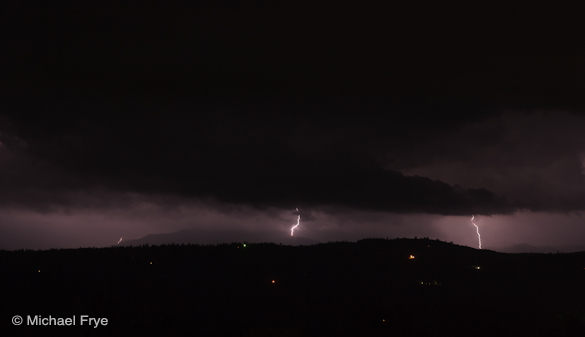
Lightning striking the Sierra foothills near Mariposa on Sunday night
October literally started with a bang, as thunderclaps rang through Yosemite Valley. It poured Saturday afternoon. Near Pohono Bridge the Merced River was brown, filled with silt, something I’ve seen only a few times in the last 27 years.
At about 11 o’clock Sunday night my wife and I got in our outdoor hot tub—a nightly ritual—and immediately noticed flashes behind the ridge to our west. We couldn’t hear anything, but knew it must be distant lightning. The frequency was impressive, a nearly constant flickering.
Even though we planned to head over Tioga Pass to Bishop the next morning, and needed to get up early, we decided to go out and take a look. We drove to a spot on Triangle Road, less than half a mile from our house in Mariposa, with a panoramic view to the south. From there we could see that flickering behind a ridge to the west, but also an even more intense thunderstorm to the south, near Fresno. This second cell put on a great light show, with nearly continuous flashes. It gradually moved closer, then slid by to the east, so we were able to watch it for over two hours.
Of course I tried to photograph the lightning, but unfortunately we saw few bolts hit the ground. Most of the show consisted of cloud-to-cloud lightning, and the streaks were usually hidden within the clouds. But I managed to capture a few good images, including the one at the top of this post.
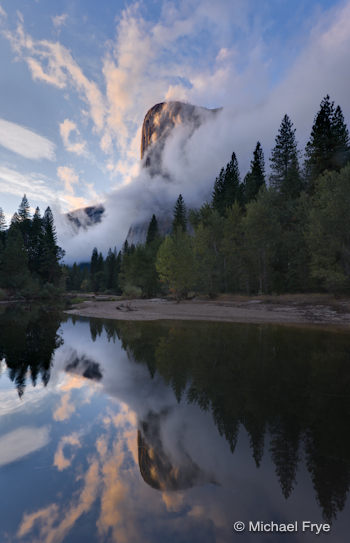
El Capitan at sunset, Tuesday evening
By the next morning rain had changed to snow at the higher elevations of the Sierra, and Tioga Pass was closed. We started driving north to Sonora Pass, but then learned that had closed too. Reluctantly we turned around rather than face a six or seven hour drive to Bishop.
I had to console myself by photographing a beautiful, seldom-visited location: Yosemite Valley. After receiving almost two inches of rain since Friday, skies cleared over the valley Tuesday, and I was able to photograph El Capitan at sunset surrounded by mist and clouds.
Since I never made it to the other side of the mountains, I can’t tell you first hand about the fall color over there, but Evan Russell, an Ansel Adams Gallery staff photographer and one of my workshop assistants, told me that the color is great west of Bishop around North Lake, South Lake, and Lake Sabrina. Or at least it was Monday. Tuesday it snowed up there, and many aspens lost their leaves. Typically a storm will strip most of the trees that are already turning, so it may be another week or two until the trees that are now green will change and provide another dose of fall color.
News like this—that some of the early season aspen spots may lose their leaves—often elicits anxious comments in forums, with people worried that they may have missed fall, and others adding fuel to the angst by saying that if you don’t go right now, or better still, yesterday, you’ll miss the most fantastic, wondrous, amazing fall color ever!
Let me assure you that fall isn’t over in the Sierra. Most of the aspens in classic eastern Sierra spots like McGee Creek, June Lake Loop, Lee Vining Canyon, and Lundy Canyon are still green, and probably weren’t adversely affected by the recent storms. While there are no guarantees—there are many little-understood factors that affect fall foliage—chances are good that these areas will produce wonderful color later in the month. I’ve made many of my best aspen photographs during the third week of October. Here’s one example.
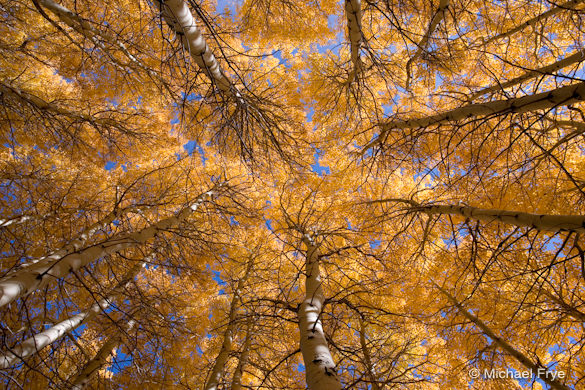
Aspen Grove, June Lake Loop, October 23rd, 2006
And if the aspens don’t produce more great color this year, there are always maples, dogwoods, oaks, and cottonwoods in Yosemite Valley. Peak fall foliage in the valley doesn’t usually occur until the end of October or beginning of November, but the rain and cold temperatures have set things in motion, and many maples and dogwoods have already started to change color. It looks like autumn might arrive early in the valley this year, but these things are always hard to predict.
I’m hoping to try again to get over to the east side later this week, so I’ll let you know what I find. In the mean time, a good resource for fall color reports is the Calphoto web site. Also, if you’ve been photographing aspens recently, or captured some of the storm activity in Yosemite, please use the comments to tell us what you found, and post links to photos!