by Michael Frye | Aug 28, 2016 | Night Photography
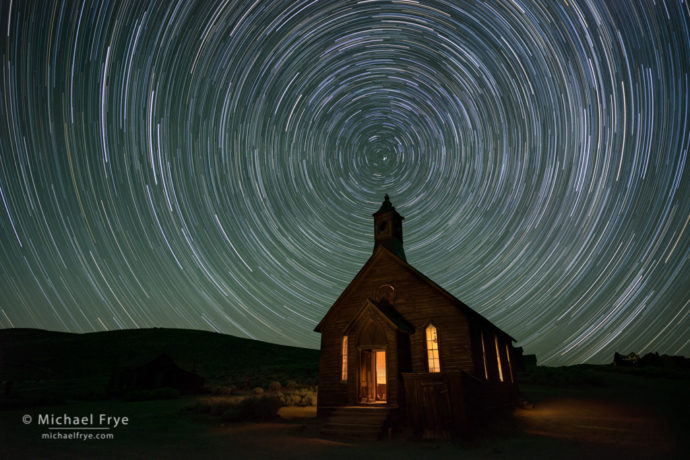
Star trails over the Methodist Church, Bodie State Historic Park, CA, USA
We’ve been able to take workshop groups into Bodie at night several times in recent years, which is always a lot of fun. But I’d never captured star trails there, mainly because star trails take a long time, and I’d wanted to spend my limited time there doing other things with the class. But during our last night session there a couple of the participants and I decided to try photographing what’s become a Bodie classic – star trails over the Methodist Church. The church works perfectly for this because you can line up the steeple with the North Star and create concentric circles overhead.
(more…)
by Michael Frye | Aug 21, 2016 | Composition, Vision and Creativity
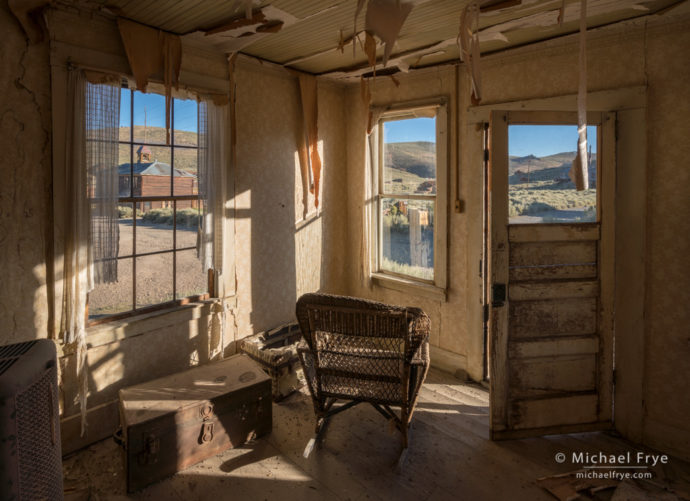
McMillan House interior, Bodie State Historic Park, California. The high contrast of this scene required using Lightroom’s HDR Merge. Also, I deliberately avoided having sunlit areas touch the borders of the image. A bright spot along the edge would pull the viewer’s eye out of the photograph.
As I’ve explored this place, I’ve realized that I’m not as interested in the abandoned mining equipment and machinery, as fascinating as some of those things are. I’m drawn more to the places where people once ate and slept and drank and socialized, and left behind the artifacts of their lives – furniture, cooking utensils, books, magazines, pictures, cans, bottles, a baby carriage, a bird cage, sewing machines, coats, pants, hats, shoes…
(more…)
by Michael Frye | Aug 16, 2016 | Night Photography
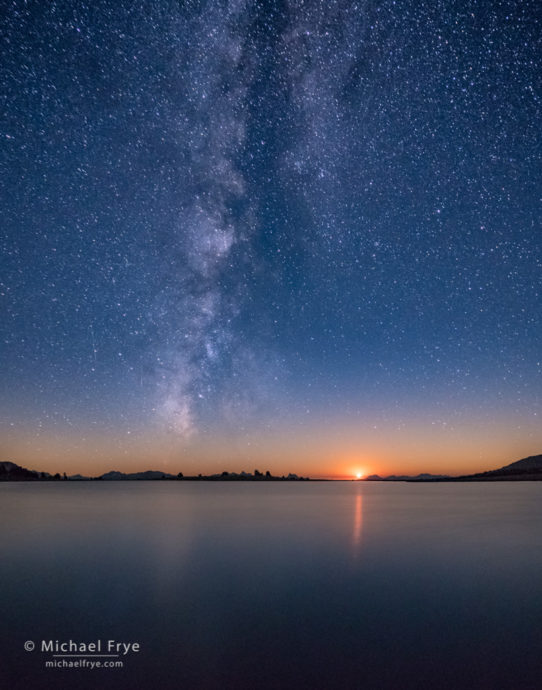
Moon setting over an alpine lake, Yosemite, 1:00 a.m. Friday morning
After our trip to the Alabama Hills Claudia and I drove back up to Yosemite, and on Thursday night we hiked up to an alpine lake to view the peak of the Perseid meteor shower. Knowing that the moon wouldn’t set until nearly 1:00 a.m., we didn’t start hiking until well after dark, and arrived at the lake around 12:30 a.m.
The moon setting over the lake was a beautiful sight. As the moon sank lower it turned orange, just like the setting sun. It also became dimmer, so the stars came out. The extreme contrast made photographing this scene difficult, but when the moon reached a point right above the horizon the contrast dropped just enough, and I was able to capture the image above. In many ways this looks just like a sunset photograph – except for the sky full of stars.
(more…)
by Michael Frye | Aug 14, 2016 | Night Photography
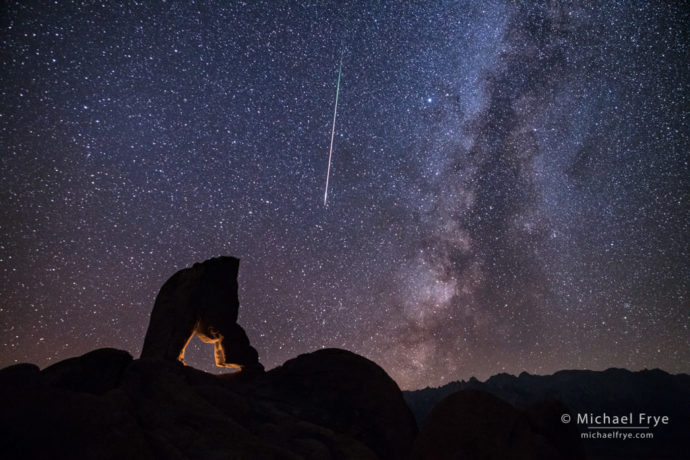
Arch, meteor, and the Milky Way, Alabama Hills near Lone Pine, California. 2:13 a.m. Thursday, August 11th.
After the workshops Claudia and I decided to head down to the Alabama Hills. I’ve been wanting to do some night photography there, and the Perseid meteor shower was nearing its peak. This is typically one of the best meteor showers of the year, but this year was supposed to be exceptionally good, with up to 200 meteors per hour during the peak time early Friday morning.
(more…)
by Michael Frye | Jul 31, 2016 | Composition
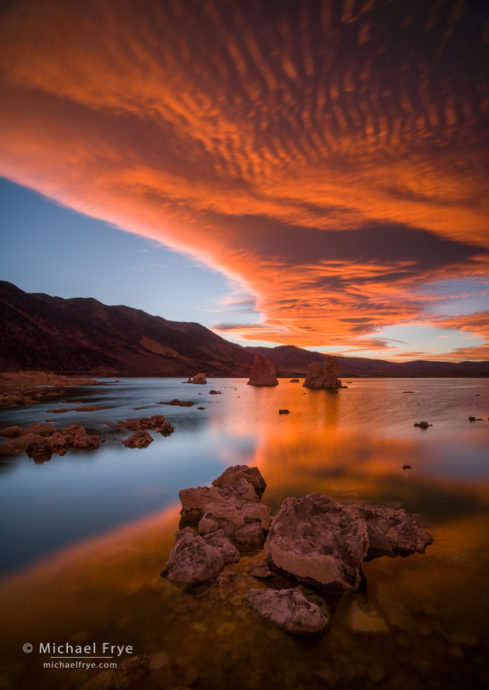
Fiery sunset over Mono Lake, CA, USA
Many books and articles about landscape photography advocate using a wide-angle lens and a low camera position. Certainly wide-angle lenses have their place in landscape photography (though they are not, by any means, the only choice). And getting a wide-angle lens low to the ground and close to some foreground objects can create an exaggerated near-far perspective that gives the photograph a sense of depth.
But a low camera position can also foreshorten the foreground and middle-ground, scrunching them together and merging objects that could and should be separated visually. A higher camera position can often create better separation and spacing between foreground and middle-ground objects, and a better flow to the composition.
Two photographs from Mono Lake might help show what I’m talking about. I made these earlier this summer when some clouds appeared out of nowhere in the middle of a stretch of clear, dry, cloudless weather. In the first of these images (above) there was a spectacular sunset going on above the lake. I might have preferred to have just water and reflections in the foreground, with no rocks, but that wasn’t an option: there were too many rocks, and no way to keep all of them out of the frame if I wanted any water at all in the picture. So I had to work with the rocks, and find a way to incorporate them into the composition.
(more…)