In the Moment:
Michael Frye's Landscape Photography Blog
by Michael Frye | Dec 17, 2017 | Composition
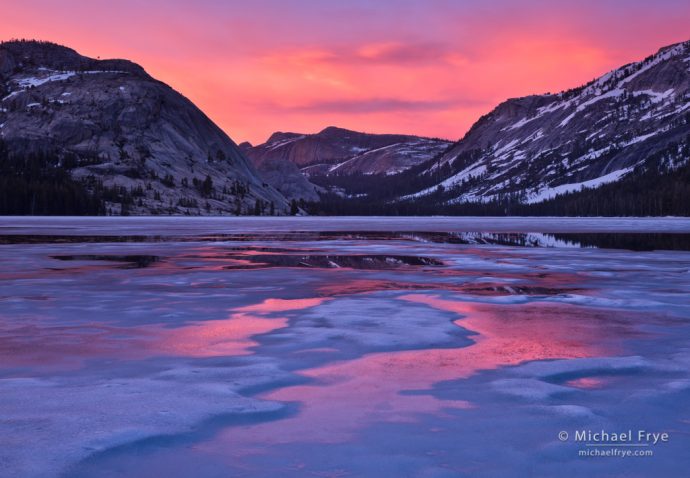
Sunset at Tenaya Lake, Yosemite. I had to work quickly to find a foreground design to go with this colorful sunset.
I’ve always been attracted to color. Color can be eye-catching, but more importantly to me, it’s a powerful tool for conveying a mood.
My attention is easily caught by colorful subjects like flowers, fall leaves, sunrise or sunset clouds, reflections, and so on. The colors don’t have to be bold; a subtle color palette can be just as compelling.
But while interesting colors always catch my eye, I know that color is not enough by itself. You can’t just point your camera toward something colorful and expect to make a great photograph. A frame filled with a random mishmash of autumn leaves won’t be compelling – it’ll just be a colorful mess. You need to find a design to go with that color. So I’m always looking for focal points and patterns that could help give structure to the color.
(more…)
by Michael Frye | Dec 10, 2017 | Composition
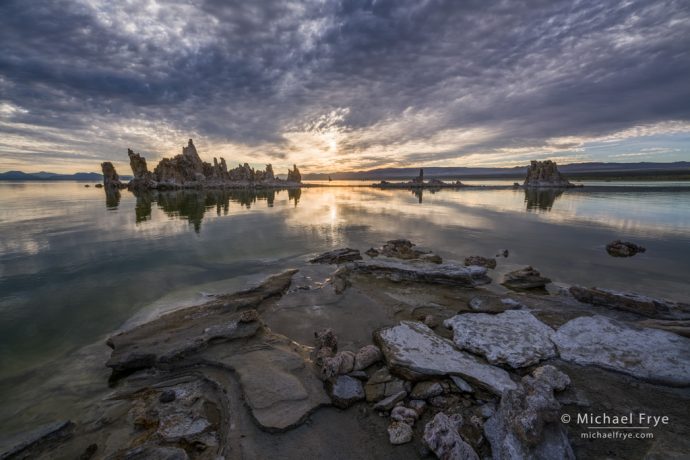
A: Morning light and clouds, Mono Lake. Can you guess what kind of lens I used for this photograph?
When I post a photograph, people often ask me which lens I used. I’m happy to tell them, but I don’t think you learn much when someone hands you an answer. I think it’s more instructive to try to guess yourself. Estimating what lens focal length a photographer used can help train your eye to see the world the way the camera sees, and learn how lenses control the sense of depth and perspective in a photograph. And those things will help you find compositions more readily, and make it easier to choose which lens to use in the field.
Wide-angle lenses often create a sense of depth, and immerse you into the landscape, while telephoto lenses flatten the perspective and isolate small parts of a scene. Telephotos are also great for creating patterns. Those traits aren’t always apparent, however, nor are they exclusive. You can show patterns with wide-angle lenses, and you can convey a sense of depth with telephoto lenses. And you can photograph intimate landscapes with wide-angle lenses, and show a vast, sweeping landscape with a telephoto.
(more…)
by Michael Frye | Nov 26, 2017 | Reviews
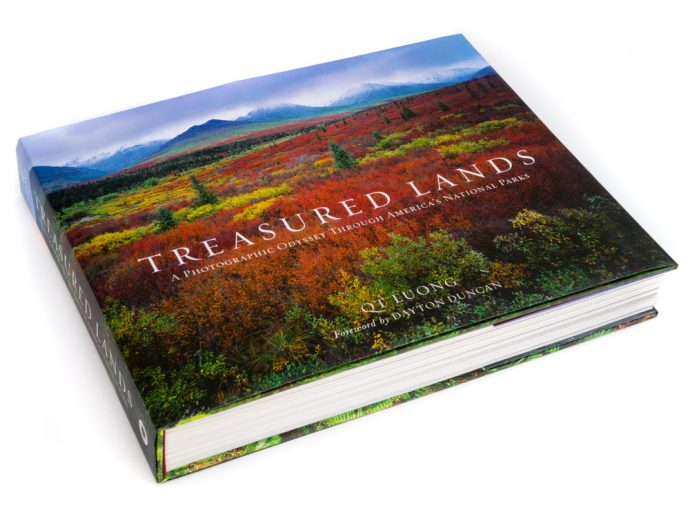
I don’t often post reviews here, but QT Luong’s Treasured Lands is a book I thought you should know about, and QT is currently having a sale on signed copies.
Treasured Lands is a big, beautiful, coffee-table book with photographs of all 59 U.S. national parks. Just visiting all 59 parks would be quite an achievement, but to make artistic photographs of all these places in different seasons and varying weather conditions is an amazing feat. It’s not surprising that it took QT twenty years to accomplish this.
(more…)
by Michael Frye | Nov 12, 2017 | Light and Weather, Travels and Stories
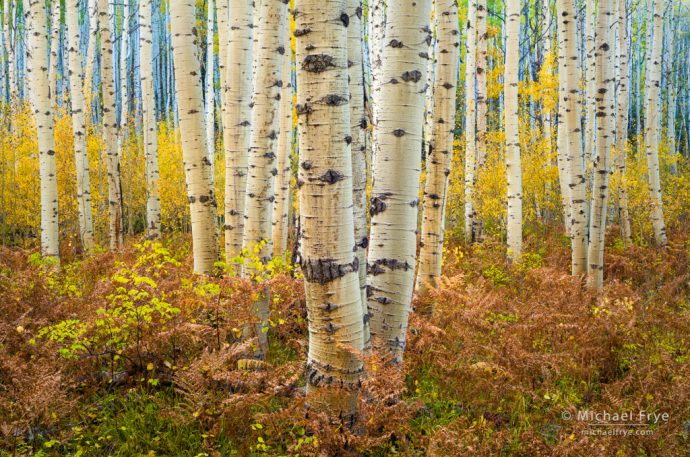
Aspens and ferns, autumn, Grand Mesa-Uncompahgre-Gunnison NF, CO, USA
Claudia and I had wonderful conditions on our autumn trip to Colorado. As I said before, it wasn’t the best year for fall color there, but the weather more than made up for that, with rain, snow, fog, and lots of interesting clouds.
We chased the weather and color all over Colorado – or so it seemed. We reached the San Juan Mountains in the southwest corner of the state on September 27th, but found little color at that time. So we headed east and ended up near Twin Lakes, where I photographed aspens with snow and fog. Then we drove over Independence Pass and spent a couple of days around Aspen and Carbondale, braving the crowds to capture a misty view of the Maroon Bells.
(more…)
by Michael Frye | Nov 5, 2017 | Advanced Techniques
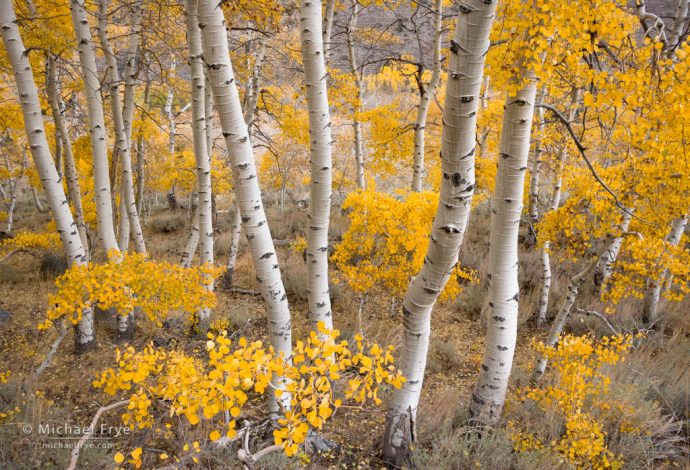
Late-October aspens near Silver Lake, June Lake Loop, Inyo NF, CA, USA. I used f/16 to get everything in focus in this 2008 photograph from the eastern Sierra. (The shutter speed was 1/6th second, the ISO 400.)
I sometimes post my camera settings here on the blog, and I’ve had many people ask me why I often use f/16. Is that the sharpest aperture on my lens? (No.) Don’t you get diffraction at f/16? (A little bit.) Is it for depth of field? (Bingo!)
As many of you know, most lenses are sharpest at middle apertures – generally around f/5.6 to f/11, depending on the lens.
Better lenses will perform decently at wide apertures like f/2.8 or f/4, but usually the corners are softer compared to the middle apertures. On the other end of the spectrum, at smaller apertures diffraction causes all lenses to get softer over the entire image (not just the corners).
(more…)