by Michael Frye | Nov 26, 2017 | Reviews
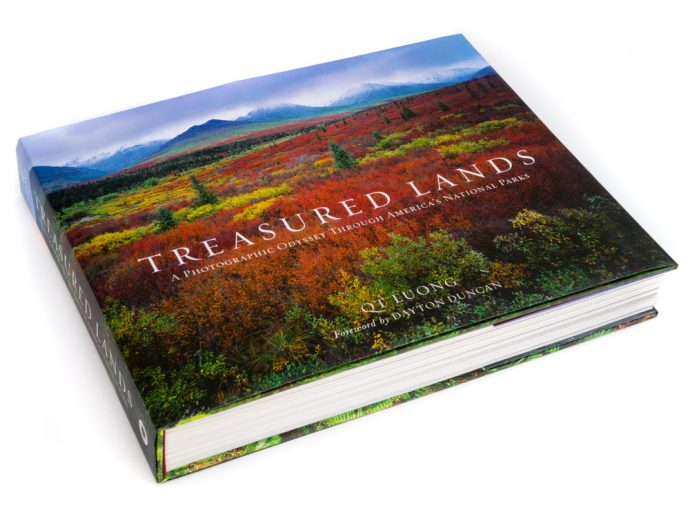
I don’t often post reviews here, but QT Luong’s Treasured Lands is a book I thought you should know about, and QT is currently having a sale on signed copies.
Treasured Lands is a big, beautiful, coffee-table book with photographs of all 59 U.S. national parks. Just visiting all 59 parks would be quite an achievement, but to make artistic photographs of all these places in different seasons and varying weather conditions is an amazing feat. It’s not surprising that it took QT twenty years to accomplish this.
(more…)
by Michael Frye | Nov 12, 2017 | Light and Weather, Travels and Stories
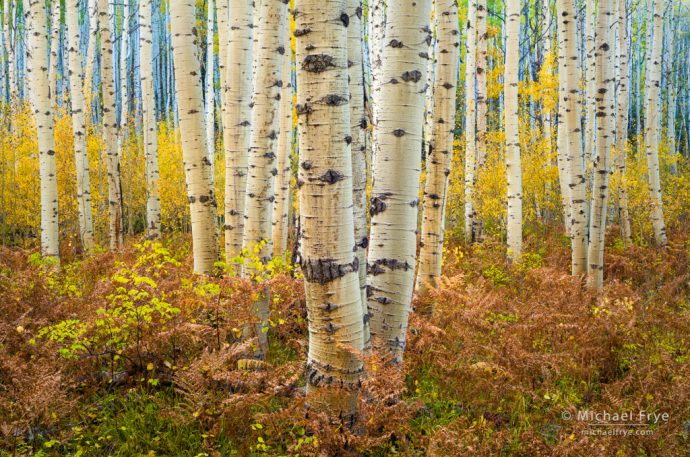
Aspens and ferns, autumn, Grand Mesa-Uncompahgre-Gunnison NF, CO, USA
Claudia and I had wonderful conditions on our autumn trip to Colorado. As I said before, it wasn’t the best year for fall color there, but the weather more than made up for that, with rain, snow, fog, and lots of interesting clouds.
We chased the weather and color all over Colorado – or so it seemed. We reached the San Juan Mountains in the southwest corner of the state on September 27th, but found little color at that time. So we headed east and ended up near Twin Lakes, where I photographed aspens with snow and fog. Then we drove over Independence Pass and spent a couple of days around Aspen and Carbondale, braving the crowds to capture a misty view of the Maroon Bells.
(more…)
by Michael Frye | Nov 5, 2017 | Advanced Techniques
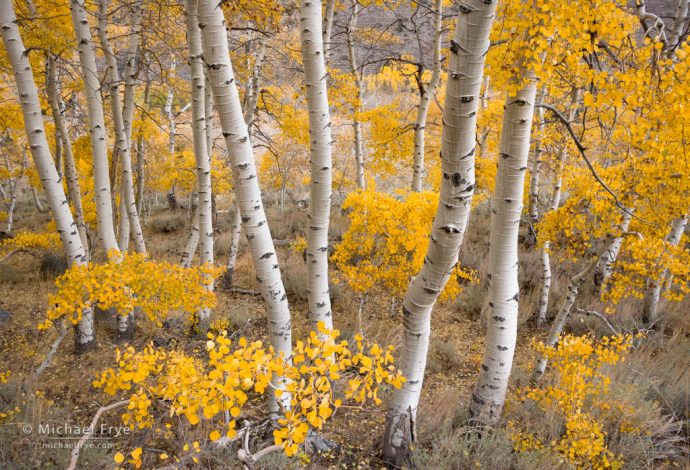
Late-October aspens near Silver Lake, June Lake Loop, Inyo NF, CA, USA. I used f/16 to get everything in focus in this 2008 photograph from the eastern Sierra. (The shutter speed was 1/6th second, the ISO 400.)
I sometimes post my camera settings here on the blog, and I’ve had many people ask me why I often use f/16. Is that the sharpest aperture on my lens? (No.) Don’t you get diffraction at f/16? (A little bit.) Is it for depth of field? (Bingo!)
As many of you know, most lenses are sharpest at middle apertures – generally around f/5.6 to f/11, depending on the lens.
Better lenses will perform decently at wide apertures like f/2.8 or f/4, but usually the corners are softer compared to the middle apertures. On the other end of the spectrum, at smaller apertures diffraction causes all lenses to get softer over the entire image (not just the corners).
(more…)
by Michael Frye | Oct 29, 2017 | Light and Weather, Yosemite Photo Conditions
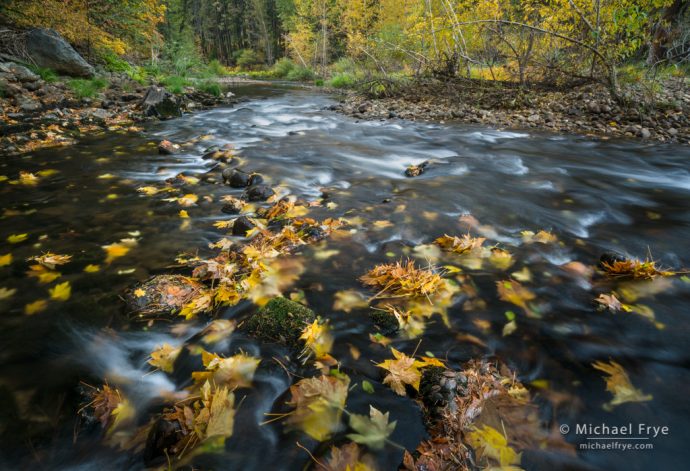
Big-leaf maple leaves along the Merced River, autumn, Yosemite. 19mm, 2 seconds at f/16, ISO 100, polarizer.
Claudia and I spent Friday in Yosemite Valley checking out the fall color. And it was beautiful. The big-leaf maples, in particular, were quite colorful.
It was a clear, sunny day, so there wasn’t any weather to add drama to the valley landscapes. When the weather and light aren’t that interesting I tend to narrow my focus and photograph smaller subjects. And for those subjects, conditions were perfect. The low autumn sunlight kept some parts of the valley in shade virtually all day, and that soft light was perfect for highlighting the autumn color. Plus, from the south side of the Merced River you could look toward sunlit cliffs on the north side of the valley and find beautiful, golden reflections in the shaded water.
(more…)
by Michael Frye | Oct 22, 2017 | Travels and Stories, Yosemite Photo Conditions
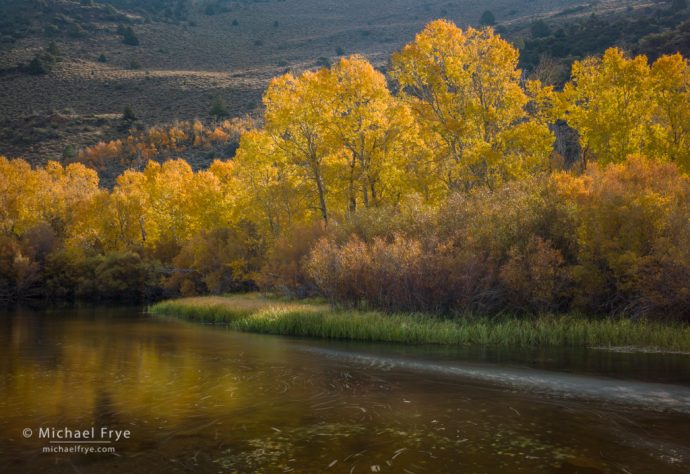
Autumn scene along Rush Creek, Inyo NF, CA, USA
We just finished our workshop on the eastern side of the Sierra. When I arrived a few days before the workshop the aspen color was rather mixed, with bare trees, green trees, and every stage in between. But the weather was cold, and things turned quickly. By the time our workshop started most of the green leaves had turned yellow and orange, and we found lots of beautiful color – particularly along the June Lake Loop.
(more…)