by Michael Frye | Apr 21, 2019 | Composition
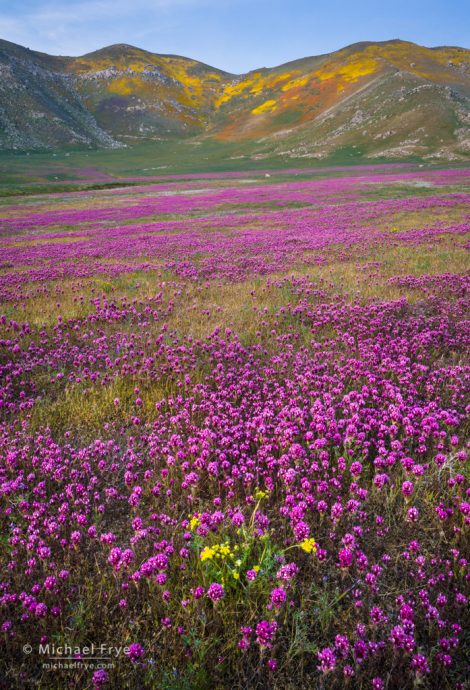
Poppies, goldfileds, owl’s clover, and spring gold, southern Sierra Nevada, California. There were two compositional challenges here: the physical distance between the foreground and background flowers, plus the lack of any distinguishing features in the foreground that could serve as a focal point. I found this slightly-elevated vantage point where I could show the sweep of owl’s clover leading up to the hills, allowing me to fill most of the frame with flowers, so that solved the first problem. And then I spotted this small clump of yellow flowers (spring gold), which added a foreground focal point, and tied in visually with the yellow colors in the background. 27mm, 1/10th of a second at f/16, ISO 800.
It’s been a good year for wildflowers in California – above average in some places, and exceptional in a few spots.
One of those places that seemed to be having an exceptionally-good year was Antelope Valley, so after our Death Valley workshop Claudia and I made a quick trip down there. We had seen poppies in Antelope Valley back in the late ’80s, but hadn’t been back since, so this seemed like a good time for a return visit. And the flowers were amazing. In the sun the combination of bright, red-orange poppies and yellow goldfields was downright blinding. It actually hurt my eyes to look directly at the flowers.
(more…)
by Michael Frye | Apr 14, 2019 | Night Photography
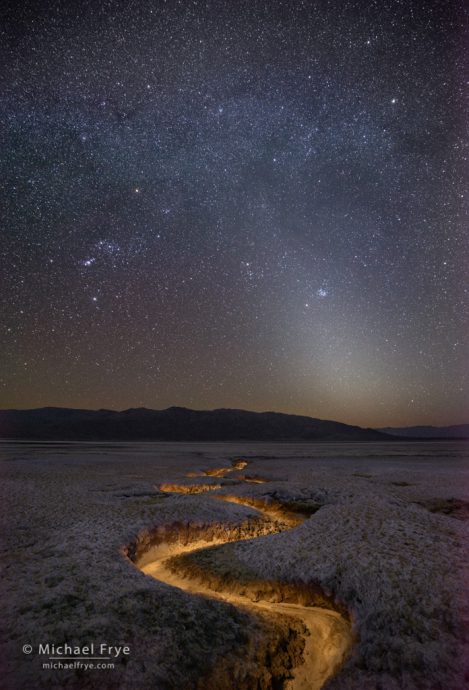
Stars, Orion, and zodiacal light over an eroded gully, Death Valley. Robert Eckhardt, Claudia, and I found this twisting gully while scouting for the workshop, and I thought it might line up well with Orion and the zodiacal light just after dark. It was actually Robert’s idea to light-paint the gully, though he didn’t join me on the night I photographed it. The focal length had to be very wide (16mm) in order to fit everything in the frame. I made eight exposures for the sky, each at 15 seconds, f/4, ISO 12,800, and blended those together with Starry Landscape Stacker. I made another longer exposure to record more detail in the landscape (4 minutes at f/4, ISO 6400). Then I captured four light-painting frames, adding a little light from the right and left, and tracing the gully with a flashlight as I walked beside it. All these images were blended together in Photoshop.
Death Valley has been used as the setting for many Hollywood movies. Not surprisingly, some of these films use the austere, other-worldly landscapes of Death Valley as a stand in for another planet. (This includes two titles from the original Star Wars series – Episode IV: A New Hope, and Episode VI: Return of the Jedi.)
This same other-worldly feeling works beautifully for night photography. I’ve made many nighttime images in Death Valley, and had a chance to capture a few more both before and during our recent workshop there. We had some challenging conditions at times, with wind, and plenty of clouds. But we also had one clear, calm night out in the dunes.
(more…)
by Michael Frye | Apr 10, 2019 | Travels and Stories
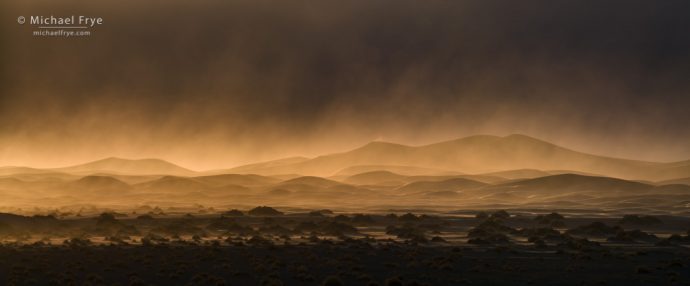
Sandstorm, Mesquite Flat Dunes, Death Valley NP, CA, USA
We tend to think of deserts as barren and desolate, but most deserts are actually full of vegetation. The plants may be widely spaced, but they’re abundant. Some desert areas, like Saguaro National Park, and Organ Pipe Cactus National Monument (both in Arizona), seem almost lush.
In Death Valley, however, there are miles and miles of bare, naked earth, without a scrap of vegetation. It’s austere, yet beautiful in its simplicity. The earth is laid out in plain sight, without any plants to obscure its colors, folds, and textures.
(more…)
by Michael Frye | Mar 17, 2019 | Travels and Stories
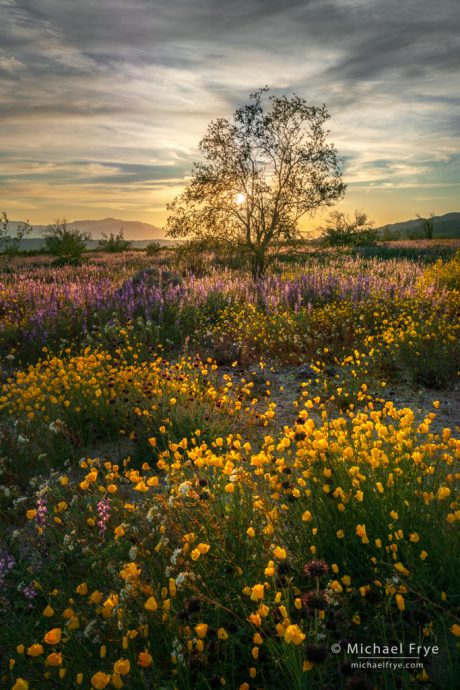
Desert in bloom at sunset, Joshua Tree NP, California. I bracketed three exposures, two stops apart, and blended them with Lightroom’s HDR Merge. 33mm, f/16, ISO 100.
Last week Claudia and I visited family in Southern California, and, while we were in the neighborhood, detoured to some early-season wildflower spots: Walker Canyon, Anza-Borrego Desert State Park, and Joshua Tree National Park.
In past years I’ve photographed beautiful wildflower displays in semi-desert areas like Antelope Valley and the Carrizo Plain, but never in true, low-desert habitats like Anza-Borrego and Joshua Tree. It was amazing to see these normally-dry places blooming. The hills in Anza-Borrego were so green that in the right light, if you squinted (and used your imagination), it looked a bit like Ireland. The birds were in a springtime mood as well; we walked up a wash one afternoon accompanied by a symphony of bird song.
(more…)
by Michael Frye | Mar 10, 2019 | Light and Weather
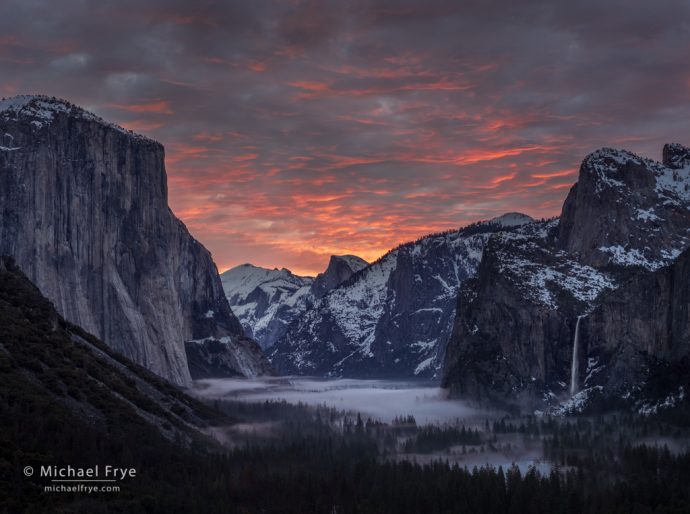
Sunrise from Tunnel View, Yosemite. On this morning the satellite images showed lots of high clouds, but I hoped there might be a gap to the east, allowing the sun to shine through and light the underside of the clouds. And I hoped for mist on the valley floor. That was asking for a lot, but sometimes things work out. The color lasted about three minutes. 50mm, three bracketed exposures, two stops apart, blended with Lightroom’s HDR Merge.
While early February brought lots of snow to Yosemite Valley, over the last three weeks we’ve seen a series of warmer storms, with rain rather than snow. I’d rather have snow, of course, but any weather is more interesting than blue skies. And rain on top of snow is a great mist producer.
Fog or clouds form when the temperature and dew point converge. That means either cooling the air to meet the dew point (like when air rises, and cools, and the water vapor in the air condenses into clouds), or raising the dew point to meet the air temperature (by increasing the amount of moisture in the air).
(more…)