by Michael Frye | May 26, 2019 | Composition
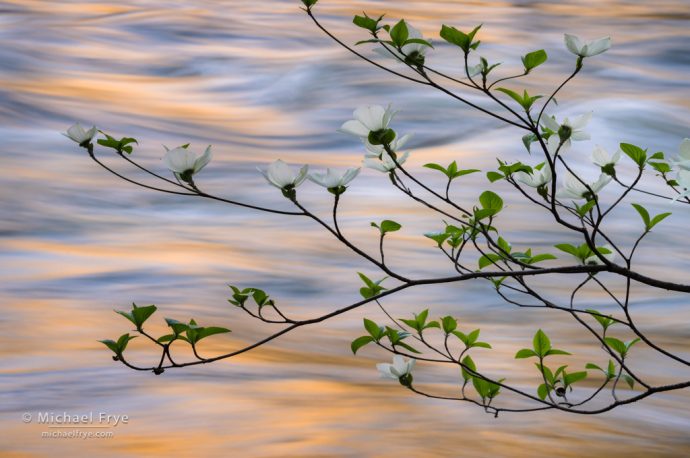
Dogwood and golden reflections, Yosemite. A telephoto lens (116mm) helped simplify the scene by isolating one small section of branches against the water. 1/4 second at f/22, ISO 100.
Claudia and I are up in the redwood country, scouting for our upcoming workshop. I’ll post some photos from this area later, but in the meantime here are a few more dogwood images from Yosemite.
One of the biggest challenges when photographing forest scenes, including dogwoods, is simplifying and organizing all the chaos. Trunks, branches, leaves, and shrubs are scattered about, growing where there’s sunlight and suitable soil. There’s an order to all that, but it’s an organic order that doesn’t translate easily into visual order. To find compositions that make sense, you have to look for ways to simplify these scenes.
(more…)
by Michael Frye | May 19, 2019 | Light and Weather
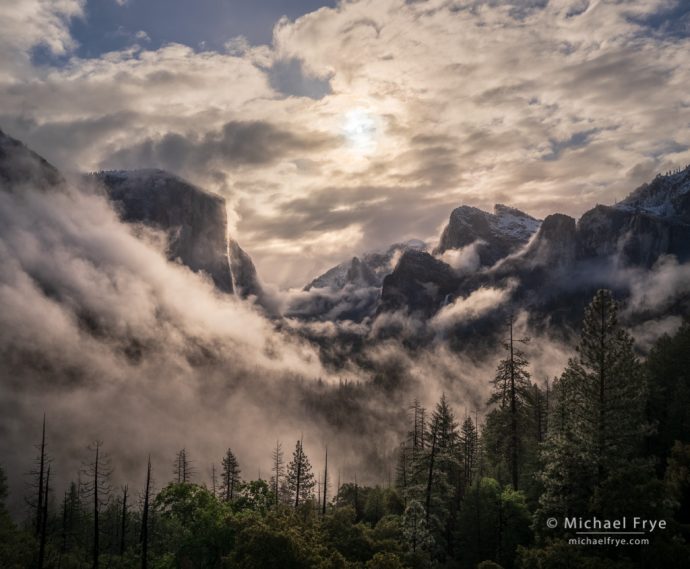
Clearing storm, spring, Yosemite, 7:27 a.m. Friday. Five auto-bracketed frames, two stops apart, blended with Lightroom’s HDR Merge.
We’re having some unusual weather for May. Higher elevations of the Sierra Nevada received over a foot of snow on Thursday. A second storm brought more rain and upper-elevation snow last night. A third storm is forecast to arrive on Tuesday, with another storm possibly coming on Friday.
This kind of weather pattern is fairly common during California’s winter rainy season. In May, as the summer dry season approaches, it’s not unusual to see a small system come through and deliver some light rain. But a series of strong, wet, cold storms like this is practically unheard of.
(more…)
by Michael Frye | May 12, 2019 | Travels and Stories
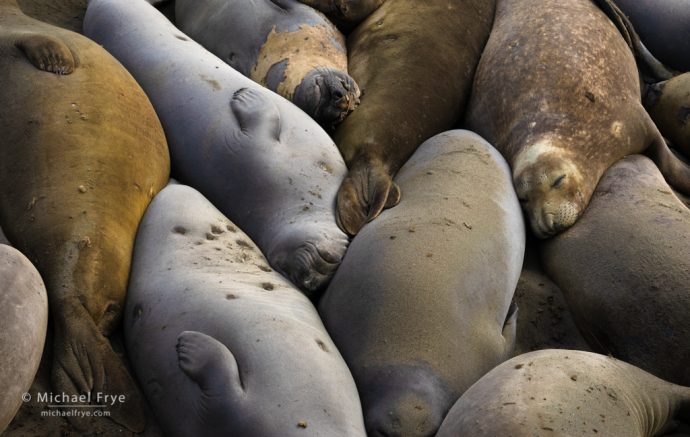
Northern elephant seals near San Simeon, CA, USA
I hope all you moms are having a nice, relaxing day!
Claudia and I found ourselves near San Simeon a few weeks ago, and decided to stop and check out the elephant seals. I became captivated by the patterns made by seals on the beach, so I got out my camera and we ended up staying for over an hour. A thin overcast created soft sidelight and backlight on the seals, which was perfect for highlighting their forms and textures – patterns of seal blubber.
(more…)
by Michael Frye | May 7, 2019 | Composition
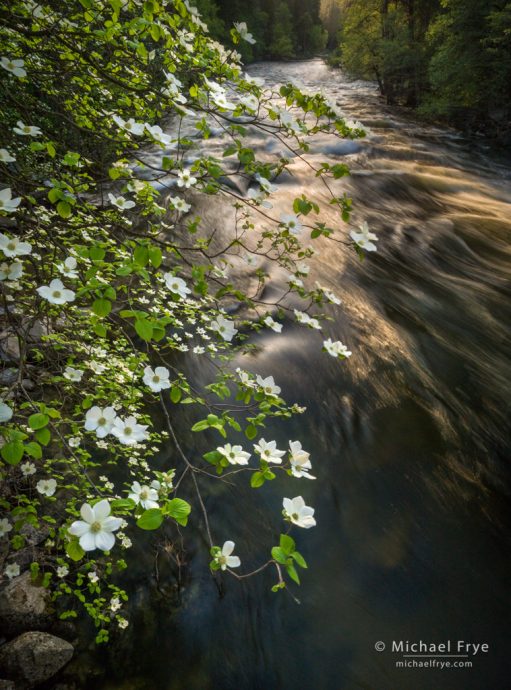
Dogwood and late-afternoon light along the Merced River, Yosemite
While the big wildflower blooms in southern California are now well past peak, spring keeps progressing into cooler regions, like the mountains. It’s been a good year for dogwoods, and Claudia and I have had a few opportunities to photograph them over the last couple of weeks.
Most of my dogwood photographs have been made with telephoto lenses in soft light. The scene above didn’t fit that description at all, with a close foreground that seemed to demand a wide-angle lens, and late-afternoon sunlight streaming down the river, creating lots of contrast. But the backlight looked beautiful – and besides, I’ve photographed dogwoods many times, so I was in the mood to push myself and do something different.
(more…)
by Michael Frye | Apr 28, 2019 | Light and Weather
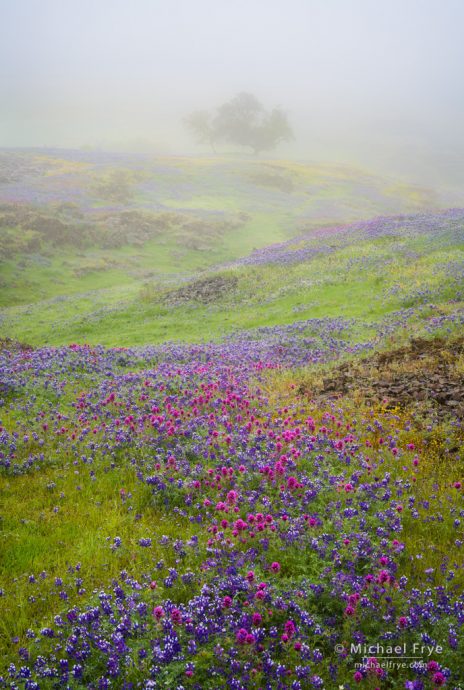
Wildflowers and oaks in the fog, Table Mountain. I loved the s-curve created by the foreground flowers. But a strong leading line won’t work unless it draws your eye to something interesting in the background. In this case the two distant oaks provided that background focal point – a period at the end of the sentence. (And those oaks wouldn’t have stood out so clearly without the fog.) 50mm, 1/3 of a second at f/16, ISO 100, focus-stacked.
After our trip to Antelope Valley Claudia and I hoped to photograph wildflowers again, so I kept my eye on the forecasts, looking for calm winds, and – if we got lucky – some clouds.
There was one day that looked promising, with showers in the forecast for much of California. Clouds and rain could be a great complement to wildflowers. But it looked like those showers would be accompanied by wind in all of the southern California wildflower spots. So I thought about other locations that might have less wind, and decided to go to Table Mountain, in northern California.
(more…)