(If you’re getting this post through email, click here to view the video.)
Here it is, my second video about the new process in Lightroom 4. In Part One I explained how the new tone controls work; here in Part Two I talk about how to use these new tools to process both low- and high-contrast images. Here are some of the main points:
– Where to begin? If you’ve read my eBook Light and Land, or watched one of my previous videos about curves, you know that in the old process I preferred starting with all the Basic tone controls set at zero, and the point curve linear. Does this still apply in the new process? (1:10)
– Curves or sliders? The new Basic Tone sliders are much better than the old ones; are they good enough to replace the Point Curve? (10:30)
– Does the order matter? Adobe suggests using the Basic tools in order from top to bottom, starting with Exposure, then Contrast, and working down to Highlights, Shadows, Whites, and Blacks—essentially working from the midtones out to the black point and white point. But this contradicts a long-standing tradition in digital imaging of setting the black point and white point first. Should you stand with tradition, or embrace the new order? (13:02)
– Processing a high-contrast image. (21:04)
This video is about 27 minutes long, so, as I said with Part 1, grab your favorite beverage, sit back, relax, and enjoy the show. Spending a little time with this video now will save time later when you’re processing photos. More importantly, I hope that this video will help you get the most out of your images so that they convey what you saw and felt when you pressed the shutter.
As I mention in the video, the best way to learn more about processing images in Lightroom is to take a workshop. There’s are still a couple of spots available in my October workshop, The Digital Landscape: Autumn in Yosemite. This is a comprehensive course covering the entire process from capture to print, with field sessions covering exposure, composition, and everything you do before pressing the shutter, and lab sessions where we process and print the images with Lightroom.
Michael Frye is a professional photographer specializing in landscapes and nature. He is the author and photographer of The Photographer’s Guide to Yosemite, Yosemite Meditations, and Digital Landscape Photography: In the Footsteps of Ansel Adams and the Great Masters, plus the eBooks Light & Land: Landscapes in the Digital Darkroom, and Exposure for Outdoor Photography. He has written numerous magazine articles on the art and technique of photography, and his images have been published in over thirty countries around the world. Michael has lived either in or near Yosemite National Park since 1983, currently residing just outside the park in Mariposa, California.
In photography, creativity and technical skill are both essential. It’s great to have a wonderful eye and imagination, but no one will appreciate your genius if your images are washed out and blurry.
The most essential technical skill a photographer must master is exposure. On the surface, exposure seems easy. It’s simply a matter of making the image bright enough—not too dark, and not too light. But the endless variety of light makes exposure challenging. No two situations are the same, so there can be no exact formula for getting the right exposure. On the other hand, exposure doesn’t need to be overly complicated. The fundamental controls—shutter speed, aperture, ISO, light meters—are easy to understand.
Previously on this blog I’ve written about some of these fundamentals, like reading histograms and adjusting exposure. In this ebook I start with a more comprehensive discussion of these essentials, then go deeper by taking you through ten practical, real-life examples where I’ve used these basic principles to control the exposure, the sharpness, and the photograph’s message.
The examples go from easy to complex, and include using a histogram to find the right exposure, controlling depth of field, freezing and blurring motion, when to push the ISO, spot metering and the Zone System, and HDR and exposure blending. I also include several exercises to help improve your technique. It’s a concise, easy to understand, yet comprehensive course in mastering the most important skill in photography.
Like all Craft & Vision ebooks, Exposure for Outdoor Photography is normally only five dollars. But for the next four days you can get it for only four dollars. Just use the code EXPOSURE4 at checkout. Or use the code EXPOSURE20 to get 20 percent off if you buy five or more Craft & Vision ebooks—including my previous volume, Light & Land: Landscapes in the Digital Darkroom.
Exposure for Outdoor Photography is temporarily unavailable. Stay tuned for updates on a revised version.
Michael Frye is a professional photographer specializing in landscapes and nature. He is the author and photographer of The Photographer’s Guide to Yosemite, Yosemite Meditations, and Digital Landscape Photography: In the Footsteps of Ansel Adams and the Great Masters, plus the eBook Light & Land: Landscapes in the Digital Darkroom. He has written numerous magazine articles on the art and technique of photography, and his images have been published in over thirty countries around the world. Michael has lived either in or near Yosemite National Park since 1983, currently residing just outside the park in Mariposa, California.
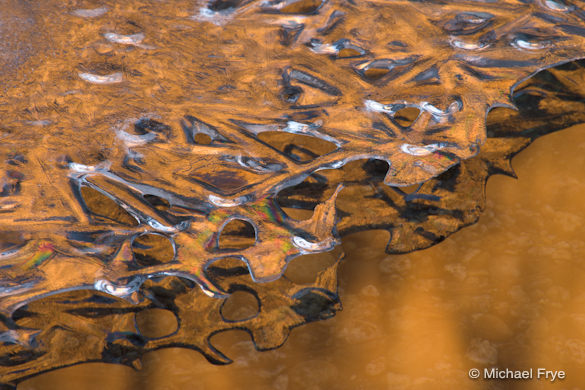
Ice and reflections along the Merced River, Yosemite, January 19, 2011
The year has flown by! Here are my most popular posts from 2011; I hope this list helps you find some tips or articles you may have missed, and get a head start on making your best images in 2012.
Are some of your favorites missing from this list? I’d love to hear which posts you liked best, as well as what topics you’d like me to cover in 2012.
Thanks for making 2011 such a great year! Your comments and participation add immensely to the quality of this blog. I hope you have a wonderful New Year!
P.S. Tune in New Year’s Day to help pick my best images from 2011!
Michael Frye is a professional photographer specializing in landscapes and nature. He is the author and photographer of The Photographer’s Guide to Yosemite,Yosemite Meditations, and Digital Landscape Photography: In the Footsteps of Ansel Adams and the Great Masters, plus the eBook Light & Land: Landscapes in the Digital Darkroom. He has written numerous magazine articles on the art and technique of photography, and his images have been published in over thirty countries around the world. Michael has lived either in or near Yosemite National Park since 1983, currently residing just outside the park in Mariposa, California.
Yes, the critiques are back—finally! This critique features a beautiful forest image called “Mist,” by David Eaton. The photograph was made in an area called The Chase near Birmingham, England.
This is my second video critique, and I’ve broken it into two parts. The first video discusses the processing (briefly), light, composition, exposure, and sharpness. In the second video I demonstrate how I re-processed the image in Lightroom.
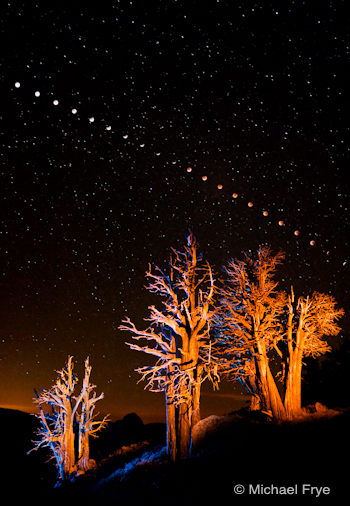
Lunar Eclipse Sequence, 1:23 a.m. to 4:49 a.m., August 28, 2007
Before getting to the topic at hand, I want to let you know that eight people have signed up for the Eastern Sierra Fall Color Workshop since I announced it last Thursday. The limit is twelve students, and I’m sure it will fill up soon, so if you’re thinking about signing up don’t procrastinate!
Okay, on to the eclipse. Before dawn this Saturday, December 10th, viewers in the Western U.S. and Canada will be able to see a total lunar eclipse. If you live in the eastern half of the U.S. unfortunately you’ll only be able to see a partial eclipse. People in most of Europe, Asia, and Australia will also be able to see a total eclipse, though in Europe it will be visible at moonrise on Saturday evening. This NASA page shows where the eclipse will be visible throughout the world, and this page shows more detail for western North America.
Moon Position
If the weather cooperates, and you want to try make your own eclipse photographs, here are some tips. (I’ve copied some of this from my post a year ago, but the information about the moon position is all new.)
I’ve been using Lightroom since Adobe released the beta version in 2006. Over the years I’ve learned many shortcuts, and in this video I share some of my favorite tips – things I use all the time to streamline my workflow:
We will never sell or share your email address with anyone. Read our complete Privacy Policy.
Subscribe to My Blog:
Success! Now check your email to confirm your subscription.