by Michael Frye | Aug 14, 2011 | Workshops
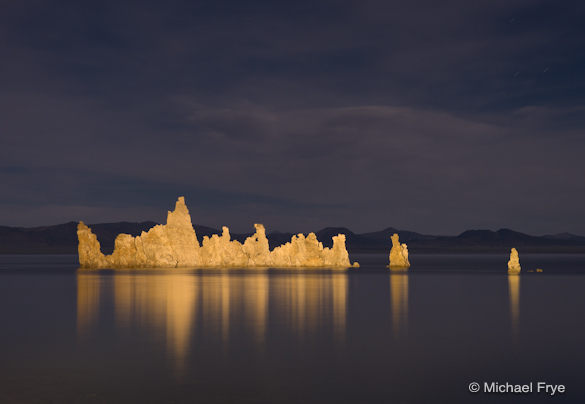
Light-painted tufa towers at Mono Lake
My Full Moon Night Photography workshop ended just after midnight last night. We had a lot of fun. Once people learned the basics I think they realized that photographing after dark isn’t that difficult. Then their creative juices started flowing and they started light-painting tufa towers and juniper trees with abandon!
As a bonus, we saw a spectacular sunset at Mono Lake Friday evening. Here’s one of my photographs of that sunset, and a couple of images from South Tufa I made while working with students on light-painting techniques. I hope to post some of the participant’s images here also as soon as they’ve processed them.
(more…)
by Michael Frye | Feb 8, 2011 | Yosemite Photo Conditions
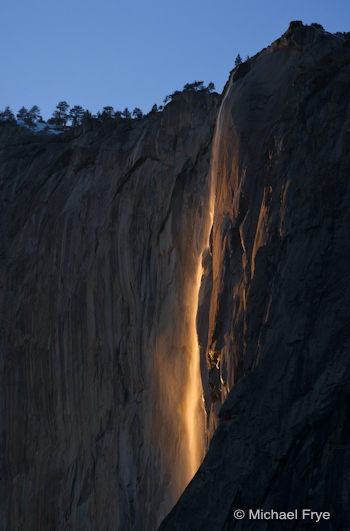
Horsetail Fall, February 22nd, 2010
It’s here—almost. The window of best light on Horsetail Fall will begin around February 12th and continue until approximately February 22nd this year. The big questions is how much water will be in the fall.
Horsetail Fall is fed by snow melting from a small area on top of El Capitan. While there was plenty of snow up there in December, we’ve had only one small storm since January 2nd, and much of that early-winter snowpack has disappeared. Horsetail has a decent flow right now, indicating that there’s still some snow on top of El Cap, and I think there will be enough to last through the window of best light—but it might be a close call. If the snowpack holds up, and the warm, dry weather continues, it could be a banner year for Horsetail Fall photographs, with many clear sunsets.
For more details about photographing Horsetail Fall, see this article on my web site, or previous blog posts here and here. And check out the time-lapse video of Horsetail that Steve Bumgardner just posted.
Meanwhile, Yosemite Falls is still going strong, with exceptionally high flow for February, and excellent early-morning light. That light starts to shift soon—by the end of the month it’s not nearly as good. But for the next week or so the sun will strike the upper fall early, creating golden light on the water, and the chance to see rainbows from the eastern end of Cook’s Meadow.
Just to make things more interesting, there will be a full moon the night of February 17th, right in the middle of the Horsetail window. In Yosemite Valley the best opportunities for moonrise photos occur one to three days before the actual full moon date. I recommend using The Photographer’s Ephemeris to figure out the the specifics, but it looks like the moon might be visible near Half Dome at sunset on the 15th from the eastern end of the valley (Cook’s Meadow and the Ahwahnee Meadow). The evening of the 16th you might be able to see a moonrise from Tunnel View. So if you’re in Yosemite one of those days you’ll have to choose between trying to photograph Horsetail Fall or the moonrise.
If you get any good photographs of Horsetail, a moonrise, or anything else in the park, I’d love to see them, so please feel free to post links in the comments. Good luck!
by Michael Frye | Jan 25, 2011 | Wildlife Photography
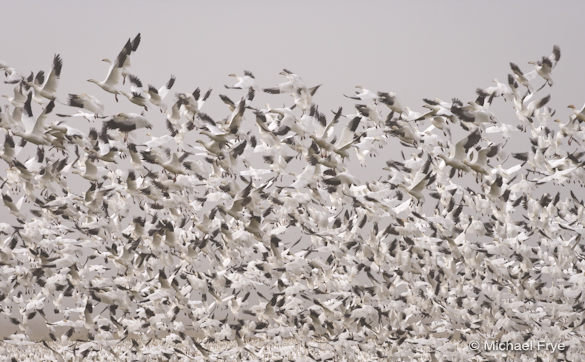
Ross’ geese taking flight yesterday at Merced National Wildlife Refuge
I’ve seen many beautiful natural phenomena in my life: lightning storms, lunar rainbows, Horsetail Fall turning into a ribbon of orange water at sunset. But the most impressive and magical thing I’ve witnessed might be the sound and movement of large flocks of snow geese. The roar and synchronized motion of 10,000 glittering white birds taking flight is unforgettable.
(more…)
by Michael Frye | Jan 7, 2011 | Announcements
The polls are closed, the votes are in, and here are the winners—as chosen by you, the readers.
The response went far beyond my expectations. Over 100 people chimed in with their picks, and Claudia had to create a spreadsheet to keep track of them all! My heartfelt thanks to all of you who voiced your opinions. I really appreciate your taking the time to help me make these difficult choices. (Click here to see all 46 original nominees.)
Although I reserved the right to override theses votes, in the end I decided that the collective wisdom was greater than mine, especially with so many people chiming in. Here’s a list of the ten images which received the most picks, and the number of votes they each received:
- Image #3, Winter sunrise from Tunnel View, 69 votes
- Image #11, Redbud reflection II, 64 votes
- Image #13, Horsetail Fall by moonlight, 64 votes
- Image #9, Painted Hills in the Temblor Range (vertical), 45 votes
- Image #18, Middle Gaylor Lake at sunset, 45 votes
- Image #32, First light on Three Brothers (second version), 45 votes
- Image #5, Gray pines after a snowstorm, 44 votes
- Image #19, Sunrise, North Peak and Greenstone Lake, 42 votes
- Image #40, Swirling mist, El Capitan Meadow, 39 votes
- Image #42, Ice sculptures and Wildcat Fall, 39 votes
(more…)
by Michael Frye | Nov 4, 2010 | Night Photography
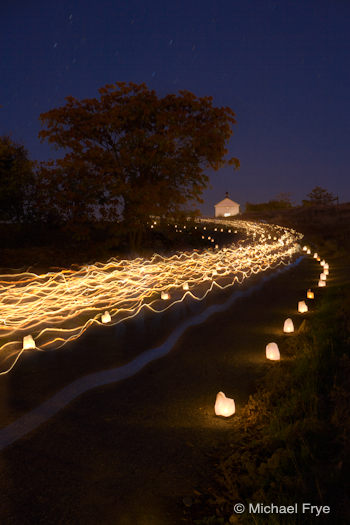
Day of the Dead procession, Hornitos, California
Last year Claudia and I attended theDay of the Dead (All Soul’s Day) celebration in Hornitos for the first time. Hornitos is a tiny town in the Sierra foothills near my home in Mariposa. During the 1850s over 15,000 people lived there; now the residents number less than a hundred. But every November 2nd the town’s population swells, and several hundred people form a silent, candlelit procession from the town up a hill to the old church and graveyard, where they participate in a ceremony honoring the departed.
As I wrote last year, Claudia and I both found the ceremony moving and inspiring, and knew we had to return. Tuesday night we attended the event for the second time. We loved it, again; in our noisy world it’s wonderful to see hundreds of people holding candles and walking silently, solemnly through the night to an old graveyard. Although neither of us are practicing Catholics, we can appreciate rituals that help connect us with some of the more essential and elemental aspects of life and death.
About the Photograph
Last year I made some good images, but it’s difficult to photograph something like this when you’ve never seen it before, don’t know what to expect, and only have one chance at it. This time I had a plan. I positioned myself where I could see the curving line of the procession walking up the hill toward the church. With the camera locked on a tripod I made an exposure at dusk to capture some of the ambient light, then made a further series of long exposures as the procession passed by. The pieces were assembled in Photoshop. The squiggly lines were made by candles that people held as they walked up the hill. The blue streak is actually the viewing screen of a video camera dangling from a man’s shoulder as he walked up the hill—a nice touch of color, and the line helps fill in an otherwise empty space in the composition.
Some photographs are created spontaneously; others require planning. This is obviously an example of planning, as is my photograph of Horsetail Fall by moonlight. But most of my best images were made by simply reacting to what I saw around me—fleeting light or weather, or maybe just aninteresting arrangement of elements that could make a compelling composition. Planning and flexibility are both essential tools in a photographer’s kit.
Next November 2nd I may leave the camera at home and actually join the procession. Then again, I might not be able to resist trying to capture an event with such rich photographic potential. Either way, I’ll be there.