by Michael Frye | May 31, 2015 | Reviews
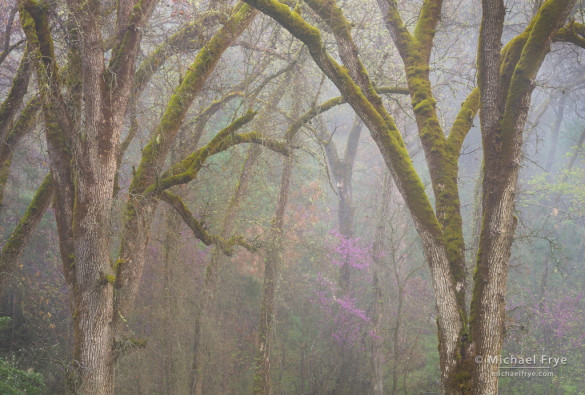
Oaks and redbuds in the fog, Mariposa County. A sharp lens, good technique, and the 36-megapixel sensor on my Sony A7r captured an incredible amount of detail in this photograph; I’ve printed it up to 40×60 inches with great results.
I’ve been getting a lot of questions lately about Canon’s new 50-megapixel cameras, the 5DS and 5DS R. These models haven’t been released yet, but many Canon users are wondering whether they should upgrade.
Since these cameras aren’t available for testing yet, it’s hard to say anything definitive about them. But since I bought my 36-megapixel Sony A7r over a year ago I’ve learned a lot about working with high-resolution cameras, and some of those lessons might be relevant to people who are considering buying one of those new Canon models, or a 36-megapixel camera like the A7r, Nikon D800, or Nikon D810.
(more…)
by Michael Frye | May 30, 2015 | Light and Weather, Travels and Stories
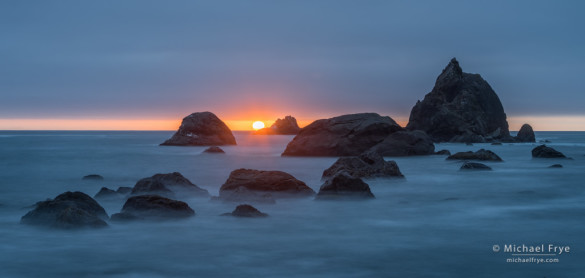
Sea stacks at sunset along the northern California coast, Redwood National Park
Claudia and I are back in the redwoods, scouting and preparing for our workshop next week. I feel such a deep connection to this damp, lush, wild, primeval landscape. It feels like coming home.
While it’s common to find fog or low stratus here, over the past couple of days the stratus deck has been unusually persistent, staying all day instead of burning off in the afternoon. This is great for photographing redwoods, where fog often adds the perfect complement to the forest scenes. It doesn’t work so well for coastal landscapes, where sunlight usually helps. But we did see the sun poke underneath the stratus at the last moment one evening, as you can see from the photograph above. And I’ve included a few forest photographs below. I’m really looking forward to the workshop!
— Michael Frye
(more…)
by Michael Frye | May 24, 2015 | Yosemite Photo Conditions
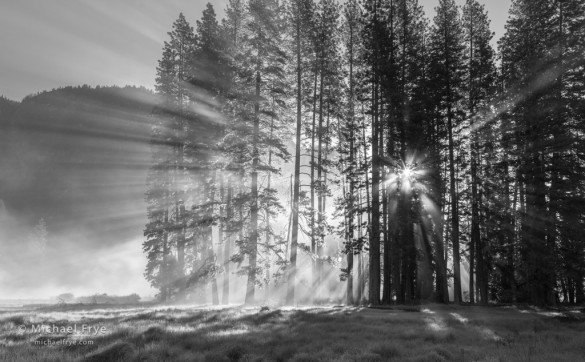
Pines, sunbeams, and mist, Cook’s Meadow, 6:13 a.m.
Yosemite got some rain yesterday. In fact we’ve had a lot of unsettled weather this month, with frequent showers in the afternoon, especially in the high country. Tioga Pass opened May 4th, but has since closed and reopened several times due to snow. The total precipitation hasn’t amounted to much, but every bit helps, and we’ve even had enough rain here in the foothills to keep the grass from turning brown – at least in some places.
I haven’t had much time to get up to the park and photograph the weather, but after the rain yesterday it seemed likely that there would be mist in the meadows this morning, so Claudia and I rose early and drove up to Yosemite Valley. When I say early, I mean really early. Sunrise is at 5:40 a.m. these days, which meant leaving home at 4:30!
(more…)
by Michael Frye | May 14, 2015 | Composition
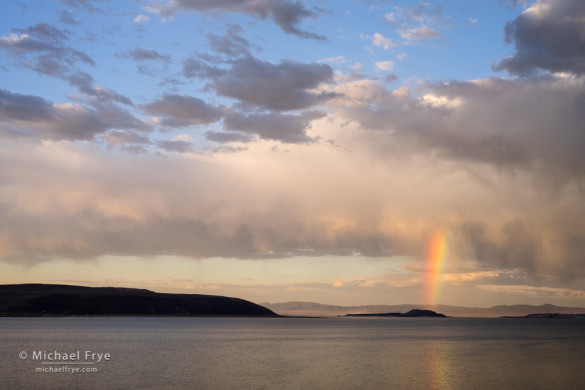
Rainbow over Negit Island, Mono Lake, California. Although I made other compositions of this scene with longer lenses, I liked the slightly wider perspective created by a normal 50mm lens, because it allowed me to include some of the blue sky.
The “normal” lens doesn’t get much love. Longer and shorter focal lengths seem more attractive, because they create unusual perspectives. As I wrote in this recent post, wide-angle lenses stretch space and make things look farther apart, sometimes creating a sense of depth, while telephoto lenses compress space and makes objects look closer together, helping to emphasize patterns and juxtapositions.
I, too, was guilty of disdain for the normal lens for many years. Although I used normal lenses (around 50mm for full-frame cameras, or about 35mm for APS-size sensors) for two decades with my film cameras, for a ten-year stretch the only lenses I used with my Canon DSLRs were 17-40mm and 70-200mm zooms. I never felt the need to fill the gap between 40mm and 70mm because I usually wanted to go either wide or long. On the rare occasions when I needed a focal length between 40mm and 70mm, I used 40mm and cropped.
(more…)
by Michael Frye | May 10, 2015 | Night Photography
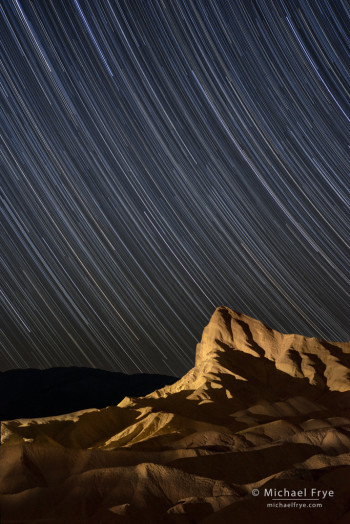
Manly Beacon at night with star trails, Death Valley NP, CA, USA
Manly Beacon is Death Valley’s most iconic feature, seen in millions of photographs from Zabriskie Point, including the image on the cover of the park map and brochure. So naturally I thought it would be fun to light it up at night.
One evening during our recent trip to Death Valley, Claudia and I, accompanied by our friend Robert Eckhardt, started down the Golden Canyon Trail from Zabriskie Point, carrying my powerful (3200 lumens), battery-powered spotlight, and radios for communication. Robert and I wanted a lower vantage point where the Beacon would poke up into the sky, and found a perfect spot. We set up our cameras and made some dusk exposures. Then after dark I hiked about half a mile further down the trail, carrying the spotlight and a radio, to a location I thought would work for the light-painting. Claudia acted as radio operator, and Robert tripped the shutters on both our cameras, while I used the spotlight to illuminate the Beacon.
We took a guess at the exposure, initially leaving the shutters open for 30 seconds at f/4, with the ISO set to 2500. According to Claudia and Robert’s radio reports, this exposure – surprisingly – turned out to be perfect. It did take several tries to get the lighting balance just right, but the problem was that the ridges underneath the Beacon weren’t getting lit from this spot. So I climbed back up the trail to a different location, closer to the cameras, which proved to be perfect for lighting those foreground ridges.
(more…)