In the Moment:
Michael Frye's Landscape Photography Blog
by Michael Frye | May 24, 2015 | Yosemite Photo Conditions
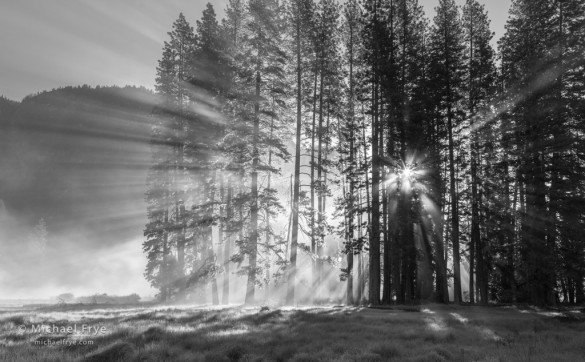
Pines, sunbeams, and mist, Cook’s Meadow, 6:13 a.m.
Yosemite got some rain yesterday. In fact we’ve had a lot of unsettled weather this month, with frequent showers in the afternoon, especially in the high country. Tioga Pass opened May 4th, but has since closed and reopened several times due to snow. The total precipitation hasn’t amounted to much, but every bit helps, and we’ve even had enough rain here in the foothills to keep the grass from turning brown – at least in some places.
I haven’t had much time to get up to the park and photograph the weather, but after the rain yesterday it seemed likely that there would be mist in the meadows this morning, so Claudia and I rose early and drove up to Yosemite Valley. When I say early, I mean really early. Sunrise is at 5:40 a.m. these days, which meant leaving home at 4:30!
(more…)
by Michael Frye | May 14, 2015 | Composition
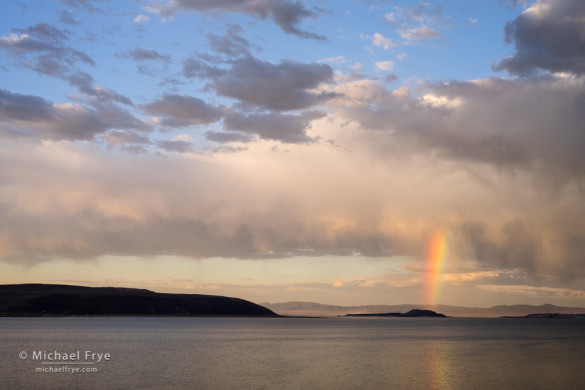
Rainbow over Negit Island, Mono Lake, California. Although I made other compositions of this scene with longer lenses, I liked the slightly wider perspective created by a normal 50mm lens, because it allowed me to include some of the blue sky.
The “normal” lens doesn’t get much love. Longer and shorter focal lengths seem more attractive, because they create unusual perspectives. As I wrote in this recent post, wide-angle lenses stretch space and make things look farther apart, sometimes creating a sense of depth, while telephoto lenses compress space and makes objects look closer together, helping to emphasize patterns and juxtapositions.
I, too, was guilty of disdain for the normal lens for many years. Although I used normal lenses (around 50mm for full-frame cameras, or about 35mm for APS-size sensors) for two decades with my film cameras, for a ten-year stretch the only lenses I used with my Canon DSLRs were 17-40mm and 70-200mm zooms. I never felt the need to fill the gap between 40mm and 70mm because I usually wanted to go either wide or long. On the rare occasions when I needed a focal length between 40mm and 70mm, I used 40mm and cropped.
(more…)
by Michael Frye | May 10, 2015 | Night Photography
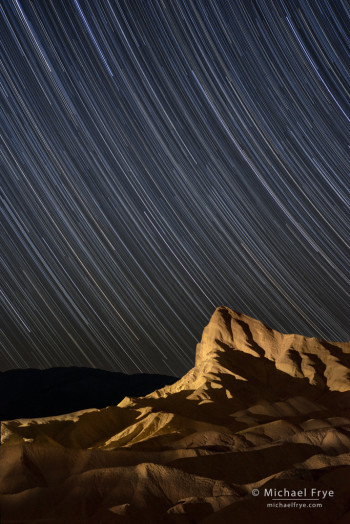
Manly Beacon at night with star trails, Death Valley NP, CA, USA
Manly Beacon is Death Valley’s most iconic feature, seen in millions of photographs from Zabriskie Point, including the image on the cover of the park map and brochure. So naturally I thought it would be fun to light it up at night.
One evening during our recent trip to Death Valley, Claudia and I, accompanied by our friend Robert Eckhardt, started down the Golden Canyon Trail from Zabriskie Point, carrying my powerful (3200 lumens), battery-powered spotlight, and radios for communication. Robert and I wanted a lower vantage point where the Beacon would poke up into the sky, and found a perfect spot. We set up our cameras and made some dusk exposures. Then after dark I hiked about half a mile further down the trail, carrying the spotlight and a radio, to a location I thought would work for the light-painting. Claudia acted as radio operator, and Robert tripped the shutters on both our cameras, while I used the spotlight to illuminate the Beacon.
We took a guess at the exposure, initially leaving the shutters open for 30 seconds at f/4, with the ISO set to 2500. According to Claudia and Robert’s radio reports, this exposure – surprisingly – turned out to be perfect. It did take several tries to get the lighting balance just right, but the problem was that the ridges underneath the Beacon weren’t getting lit from this spot. So I climbed back up the trail to a different location, closer to the cameras, which proved to be perfect for lighting those foreground ridges.
(more…)
by Michael Frye | May 3, 2015 | Night Photography
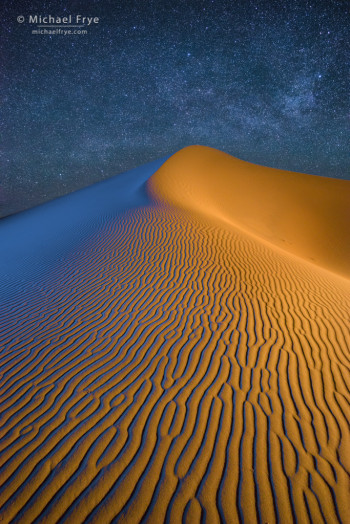
Sand dune and the Milky Way at night, Death Valley National Park
One night during our Death Valley workshop we went out to the sand dunes. After some searching, I found this wonderful dune with it’s rippled foreground textures. Lighting it was a group project; we all set up our cameras, and took turns lighting the dune from the left and the right, trying to find the right angles to highlight those ripples. Then we set our interval timers to record star trails – and took naps on the sand while we waited for the star-trail sequences to finish. After that the Milky Way was in the right position over the dune, so before moving our cameras we made some more exposures of pinpoint stars as well.
Recording all these exposures of the same composition gave us the option of including either star trails or pinpoint stars in the final image, and having the dune lit either from the left, the right, or both. I liked the pinpoint stars better, and chose to include lighting from both sides. The final image you see here is a composite of three exposures (assembled in Photoshop using the Lighten blending mode): one for the sky, one with the dune lit from the left (colored blue), and one with the dune lit from the right.
(more…)
by Michael Frye | Apr 26, 2015 | Yosemite Photo Conditions
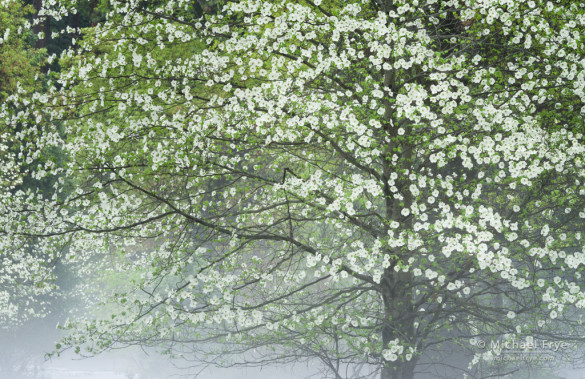
Dogwoods and mist, Yosemite Valley, yesterday afternoon
I assumed that the dogwoods in Yosemite would have peaked and started to whither while we were down in Death Valley. But upon our return we heard reports that the dogwoods were still good. Yesterday afternoon was wet and showery, which seemed like perfect conditions for photographing dogwoods, so Claudia and I drove up to Yosemite Valley, and found that yes, the dogwoods were still good – great, in fact.
Only one dogwood was clearly past peak, and that tree is always an early bloomer. The rest were rather mixed, with some fully leafed out, others with only small leaves, and even a couple with newly-emerging greenish blossoms. The cool and showery weather this past week apparently has helped preserve the flowers, and made this a long-lasting dogwood bloom. But what really struck me yesterday was how full they were. Many trees were just overflowing with blossoms, and we saw many strikingly-beautiful specimens.
(more…)