In the Moment:
Michael Frye's Landscape Photography Blog
by Michael Frye | May 13, 2018 | Night Photography
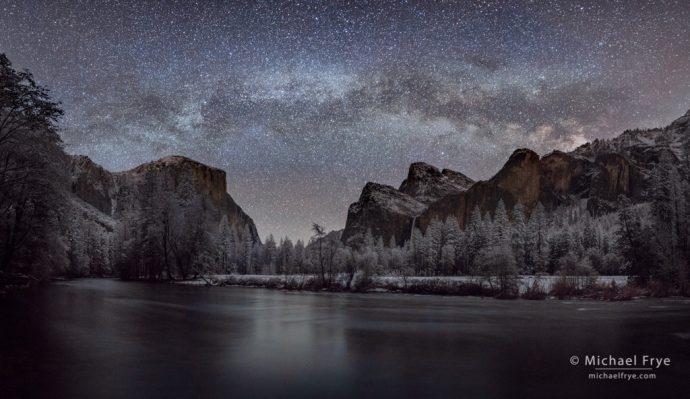
Milky Way over Yosemite Valley. Four frames stitched together with Lightroom’s Panorama Merge. Each frame was 30 seconds at f/2.5, ISO 6400.
Sometime around the middle of April a small weather system passed through our area, dropping about half an inch of precipitation on Yosemite Valley. In typical fashion, the temperature dropped toward the end of the storm, and rain turned to snow in the valley.
I kept my eye on the weather, as usual, and it became obvious that this small storm wouldn’t clear before sunset. It looked like it would clear sometime during the night, but it was hard to tell exactly when. My best guess, based on the radar and satellite images, was that it would clear sometime between midnight and 2:00 a.m. Should I grab a couple hours of sleep first, or stay up? Or just skip the whole thing and get a good night’s sleep?
(more…)
by Michael Frye | May 6, 2018 | Light and Weather, Yosemite Photo Conditions
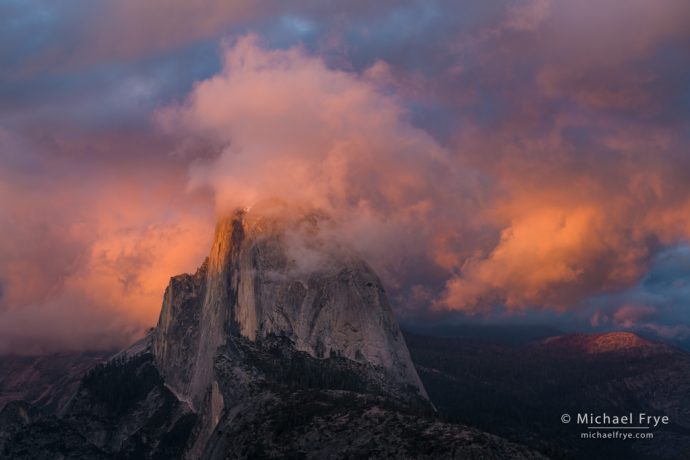
Half Dome and clouds at sunset from Glacier Point, Yosemite (7:44 p.m.)
The Glacier Point Road opened early this year – on Saturday, April 28th. Then it closed again two days later due to a chance of snow. When Claudia and I drove up to Yosemite Valley on Tuesday to check on the dogwoods the Glacier Point Road was still closed.
On Wednesday afternoon I finished writing a post about the dogwoods, and then decided to look at the Yosemite webcams. The forecast called for a chance of showers and thunderstorms over the high country, and sure enough, the webcams showed some cloud buildup. I called the Yosemite road and weather number (209-372-0200), and lo and behold, the Glacier Point Road was open! At this point it was already 4:30 in the afternoon, but the sun wouldn’t set until 7:50, so there might still be enough time to get up to Glacier Point. I told Claudia the Glacier Point Road was open, and she didn’t hesitate: “Let’s go!”
(more…)
by Michael Frye | May 2, 2018 | Yosemite Photo Conditions
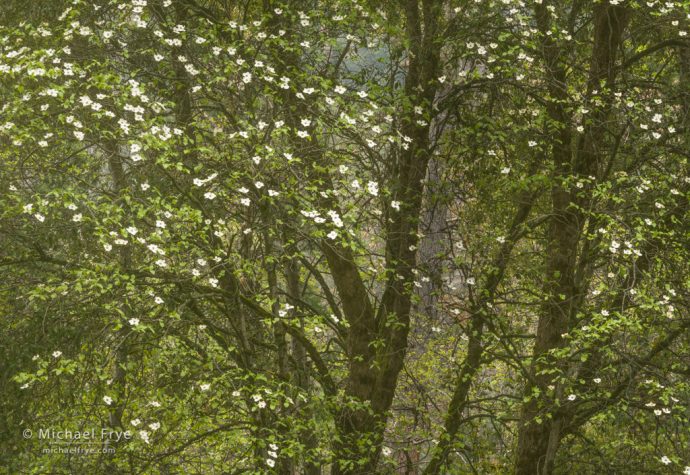
Dogwood, Yosemite (yesterday afternoon)
Claudia and I went up to Yosemite Valley yesterday to check on the dogwoods. We had heard they were a bit late this year, but were starting to come out. And indeed they seem to be coming out quickly, and are close to their photographic peak now. Some are still greenish, a few looked a bit bedraggled already, and many seem to be leafing out quickly, but overall they were quite pretty. Some trees weren’t as full as I’ve seen them in the past, but others had more blossoms than usual.
Dogwoods bloom for two to three weeks, but I think they’re most photogenic when the blossoms are fresh (like now), and before the leaves get too big (which tends to hide the flowers a bit).
(more…)
by Michael Frye | Apr 30, 2018 | Vision and Creativity, Workshops
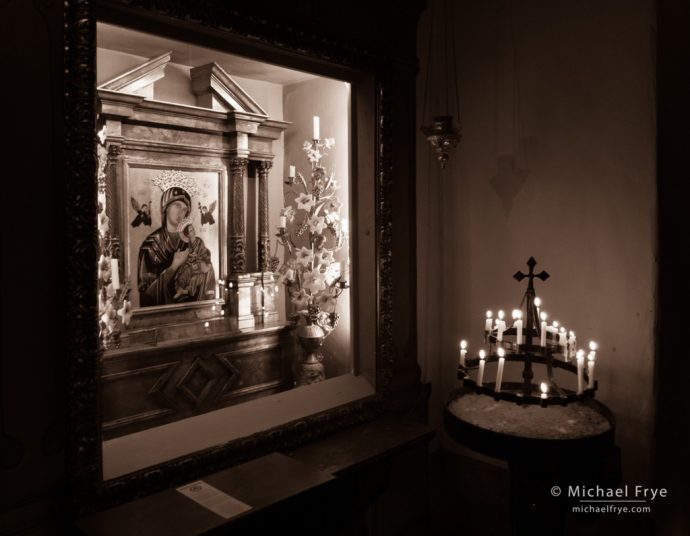
Carmel Mission, Carmel-by-the-Sea, California. Even when a church or museum allows photography (as was the case here), a smartphone camera is less obtrusive than a big SLR.
Last month Claudia and I went to Carmel to assist our good friend Robert Eckhardt’s iPhone photography workshop. Robert is a highly creative photographer, a great instructor, and knows more about iPhone photography than anyone I’ve ever met. This is the second time we’ve done this workshop, and both editions have been really fun. Everyone (including me) learned a lot, and we had a great time photographing around Carmel and processing the images right on our phones.
Participating in this workshop made me reflect on how much smartphone photography has progressed in just a few years. Smartphone cameras have gone from novelty items to highly-capable devices, and a plethora of apps allow you to do just about anything imaginable to the photographs you take on your phone. (And some things that you would never imagine until someone makes an app for it.)
(more…)
by Michael Frye | Apr 22, 2018 | Night Photography
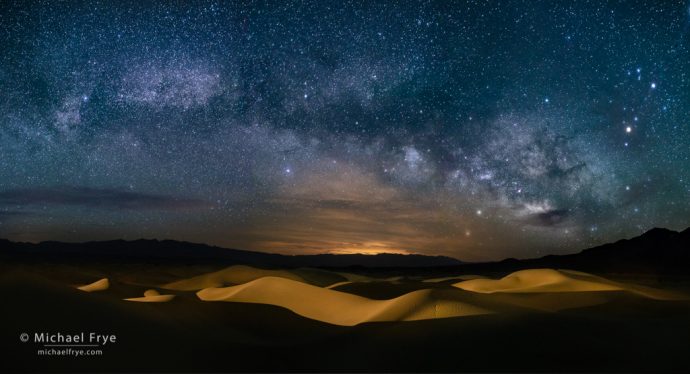
Milky Way over the Mesquite Flat Dunes, Death Valley. We set up continuous, low-level lighting on the dunes, using two LED light panels, so that we’d have consistent lighting for each frame while capturing multiple-image panoramas. I gave everyone a homework assignment before the workshop to practice capturing panoramas, as you don’t want to try that for the first time in the dark in the sand dunes! Everyone did really well and managed to capture a panorama that stitched together properly. I used Lightroom’s Panorama Merge to blend three images together for this final photograph. The exposures for each frame were 20 seconds at f/2.8, ISO 3200.
As I mentioned in my previous post, we had two beautiful nights in the dunes during our recent Death Valley workshop. Photographically, the dunes work really well both day and night, as the sculptural quality of the sand that works so well with low-angle sunlight also lends itself to light painting.
One night we stayed out in the dunes through the wee hours of the morning, photographing star trails, then the Milky Way, followed by the moonrise and moonlight on the dunes. And when the sky started to lighten we decided we may as well wait around for sunrise.
(more…)