In the Moment:
Michael Frye's Landscape Photography Blog
by Michael Frye | Aug 18, 2011 | Critiques, Yosemite Photo Conditions
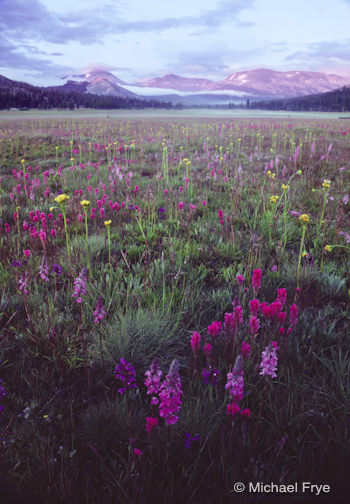
Wildflowers, Tuolumne Meadows, 1986
It’s wildflower season in the Yosemite high country, which made me think about this image that I made 25 years ago, in August of 1986, in Tuolumne Meadows.
In the 1980s large swaths of Lemmon’s paintbrush and shooting stars were common in Tuolumne Meadows in the summer. But 1986 brought the best bloom I’ve ever seen there, with this great mix of paintbrush, little elephant’s heads, lupine, shooting stars, penstemons, and… that yellow flower (arrowhead butterweed?). For some reason though wildflowers have diminished in Tuolumne Meadows in recent years, and those great blooms seem to be a thing of the past.
In the summer of 1986 I was working at The Ansel Adams Gallery in Yosemite Valley. On the day I made this photograph I drove up to the high country after work. A thunderstorm had rolled through, leaving the meadows wet and the skies overcast. But just before sunset the sun crawled underneath the clouds and lit up the peaks in the distance.
I actually think I did a pretty good job with the composition here. I needed to find some kind of structure or design to hold the foreground together and lead the viewer’s eyes into the distance. The little V- shaped group of flowers at the bottom of the frame accomplished both those things, giving the foreground some structure and leading viewer’s eyes toward the background. As a bonus, that V-shape mirrors the upside down Vs of the peaks.
The horizon line is high, but I think that’s appropriate here: the foreground is much more interesting than the sky. I’m glad I wasn’t overly concerned about putting the horizon a third of the way from the top.
(more…)
by Michael Frye | Apr 13, 2011 | Announcements
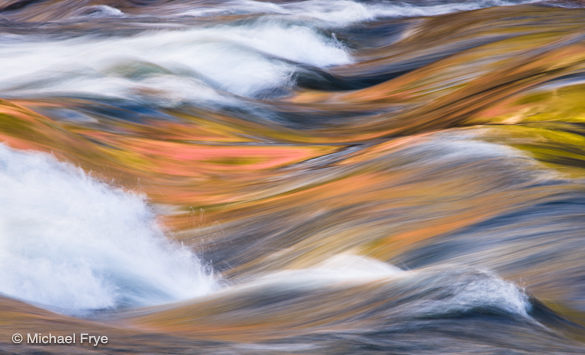
Waves and Reflections in the Merced River
Some great events coming up! Here are a few highlights:
Reflections on Yosemite Exhibit
The Ansel Adams Gallery, April 18 – May 25
I’m busily printing and matting images for this show, which starts on Monday. We’ve picked the photographs and layout, and I think it will look great. The exhibit will include lots of new work, as well as a few of my classic Yosemite images. Regular readers of this blog will recognize many of the photographs, but there’s nothing like seeing actual prints.
I hope some of you will get to stop by the gallery (next to the Visitor Center in Yosemite Valley) during the show, or better yet come to the reception on Saturday, May 7th, from 3 to 5 p.m.
(more…)
by Michael Frye | Mar 17, 2011 | Critiques
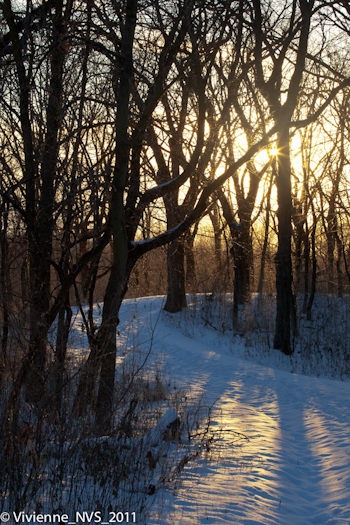
“Late Afternoon, Moraine Hills State Park” by Vivienne Shen
Light and Mood
This week’s photograph was made by Vivienne Shen at Moraine Hills State Park, near Chicago, Illinois.
The light in this image really caught my eye, with the sun peeking through branches, the long tree shadows in the foreground, and the golden, late-afternoon colors. The light, bare trees, and snowy ground combine to create a strong mood—cold and wintry, but with a hint of warmth.
There’s nothing special about the weather here; you could probably capture similar light on any clear winter afternoon. This shows that you don’t need extraordinary conditions to convey a mood—you just need to visually emphasize the conditions you have. Here everything in the frame (snow, bare trees, low-hanging sun) communicates the idea of a cold, clear, winter day.
(more…)
by Michael Frye | Feb 25, 2011 | Critiques

“Another Lousy Sunset” by Ken Hornbrook
The critique is finally here—thanks for your patience!
Light
This week’s photograph was made by Ken Hornbrook at Bandon Beach along the Oregon coast. There’s some wonderful sunset color in the sky, plus blue and orange reflections in the water, creating great color contrasts throughout much of the frame. Any photographer standing at this beach that evening would be excited about the possibilities. But what do you do with that light, that color?
Composition
Ken found a great camera position to take advantage of the colorful sunset and interesting shapes of the rocks. It looks like he moved into a small cove or gap between cliffs or sea stacks. This created a nice window, with dark shapes on the sides framing the view of the stacks beyond. The curving, colorful V-shape of the water in the foreground leads our eyes smoothly from bottom to top. It even has a bit of an S-curve. I’ve pointed out problems with foregrounds in previous critiques, but I think this one really works, and adds a lot to the photograph.
(more…)
by Michael Frye | Jan 28, 2011 | Critiques

“Badwater Lake” by Grant Kaye
This week’s photograph was made by Grant Kaye at Badwater in Death Valley National Park, California. The water in this place may be bad to drink, but it’s good for photography. It’s always interesting to see water in the desert, and this spot often has great reflections, especially with clouds at sunrise or sunset, like the ones Grant captured in this image. It’s easy to see why Badwater attracts lenses.
Composition
With reflection images, horizon placement is a key decision. It’s usually better to avoid putting the horizon across the middle of the frame, as this cuts the photograph in half, and often creates the feeling of two different photographs stuck together. (I pointed out this problem in another recent critique.)
But there are exceptions to any rule. With reflections, putting the horizon in the middle emphasizes the symmetry between the elements above the horizon and their reflections below, and can be an effective way of expressing calm and serenity, or simply creating repetition and a unified composition. Placing the horizon above or below the center can also work: pointing the camera down emphasizes the reflection; pointing the camera up emphasizes the actual objects above the water.
In this photograph Grant chose put the horizon above center and highlight the foreground and the reflection. I often like this approach, as reflections have richer color than the real objects they’re reflecting. Here this arrangement also accentuates the converging lines of the clouds—they all seem to point to a spot behind the peaks in the center of the image. Overall the composition is simple and direct, with a strong radiating design.
(more…)