In the Moment:
Michael Frye's Landscape Photography Blog
by Michael Frye | Dec 1, 2013 | Vision and Creativity
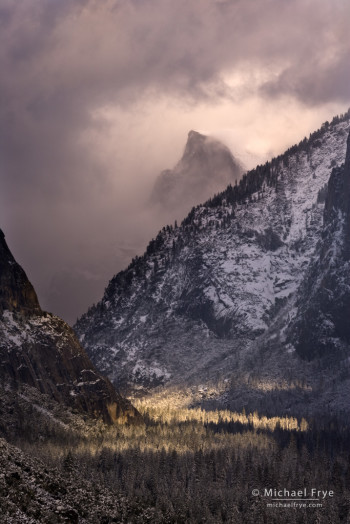
Half Dome and Yosemite Valley from Tunnel View, Yosemite NP, CA, USA
In a recent post I talked about adapting your composition to the light, rather than hoping that the light adapts to your composition. Nowhere is this more true than at Tunnel View. Sometimes the classic view – with El Capitan on the left, and Cathedral Rocks on the right – works perfectly. But not always. When I made this photograph the most interesting part of the scene was a small area in the distance where the light was hitting Half Dome and the valley floor below, so I zoomed in with my 70-200mm lens, turned the camera to a vertical orientation, and filled the frame with just those two spots.
Looking at this photograph made me think about clearing storms, and snow, and Christmas coming. I hope we get lots of snow this winter, not just for the sake of photographers, but for everyone in California. We’ve had two straight years of meager precipitation here, and we really need a wet winter. So let it snow!
— Michael Frye
Related Posts: Courting Luck: How to Take Advantage of Special Light and Weather in Landscape Photography; Courting Luck, Part 2: Adapting Your Composition to the Conditions; A Beautiful Week in Yosemite
Did you like this article? Click here to subscribe to this blog and get every new post delivered right to your inbox!
Michael Frye is a professional photographer specializing in landscapes and nature. He is the author or principal photographer of The Photographer’s Guide to Yosemite, Yosemite Meditations, Yosemite Meditations for Women, and Digital Landscape Photography: In the Footsteps of Ansel Adams and the Great Masters. He has also written three eBooks: Light & Land: Landscapes in the Digital Darkroom, Exposure for Outdoor Photography, and Landscapes in Lightroom 5: The Essential Step-by-Step Guide. Michael written numerous magazine articles on the art and technique of photography, and his images have been published in over thirty countries around the world. Michael has lived either in or near Yosemite National Park since 1983, currently residing just outside the park in Mariposa, California.
by Michael Frye | Dec 1, 2013 | Announcements
Just a reminder that there are less than 36 hours left in our Black Friday Sale, with 35% off my Landscapes in Lightroom 5 ebook and video package, and 40% off The Photographer’s Guide to Yosemite iPhone and iPad app. The sale ends at midnight Pacific time tomorrow, December 2nd. Again, you don’t need to enter any special codes – those are just the prices until the sale is over.
I hope everyone had a great holiday weekend!
— Michael Frye
by Michael Frye | Nov 29, 2013 | Announcements
Yes, we’re having a Black Friday sale too! Here at our world headquarters in downtown Mariposa, California, we’ve cooked up two sweet deals:
35% Off Landscapes in Lightroom 5: The Essential Step-by-Step Guide
Normally $14.95, this ebook and video package is now only $9.95! You don’t have to enter a discount code – that’s just the price until midnight Pacific Time on Monday, December 2nd.
In this ebook I take you step-by-step through processing six images in Lightroom. You can download the Raw files so you can follow along yourself, plus you get exclusive access to eight videos demonstrating different aspects of Lightroom’s Develop Module.
This is a great gift for the photographer on your Christmas list! Just click “Add to Cart” underneath the words “Gift Coupon.”
40% Off The Photographer’s Guide to Yosemite iPhone/iPad App
This app is a must-have for any photographer visiting Yosemite. Normally it sells for $6.99, but until midnight Pacific Time on December 2nd it’s only $3.99! Click here to go to the iTunes store, and once again there are no discount codes you need to enter.
(more…)
by Michael Frye | Nov 26, 2013 | Composition, Photography Tips, Vision and Creativity
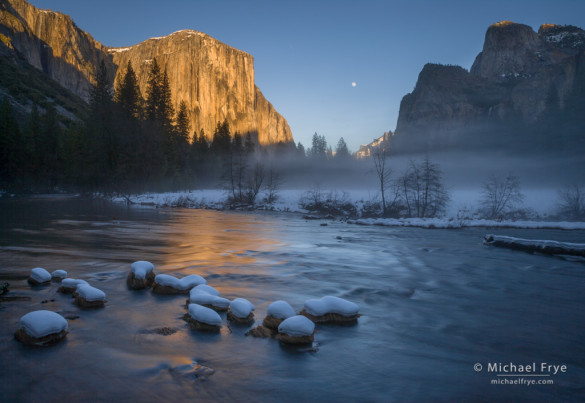
Moon rising between El Capitan and Cathedral Rocks from Valley View. What’s the least interesting part of this image?
The best compositions are simple; they present only the essentials, and leave out extraneous clutter. The most common mistake in photography – by far – is including too much in the frame. Anything that’s not adding to the photograph’s message is detracting from it.
To help simplify your compositions, ask yourself, before you press the shutter, “What’s the least interesting part of this photograph?” Try to identify the weakest area of your composition, and find a way to get rid of it. Then, once you’ve done that, ask the same question again: “Now, what’s the least interesting part of this image?” And get rid of that. And keep doing that until there’s nothing left that you could possibly cut out without losing something vital.
To give you some practice, look at the photograph above. What’s the least interesting part of that image? And if you got rid of that, what would be next – what’s the next least interesting part of the photograph?
I’ll give you a minute to think about it. When you’re ready, take a look at this next photograph, and answer the same question: what’s the least interesting part of this image?
(more…)
by Michael Frye | Nov 19, 2013 | Composition, Photography Tips, Vision and Creativity
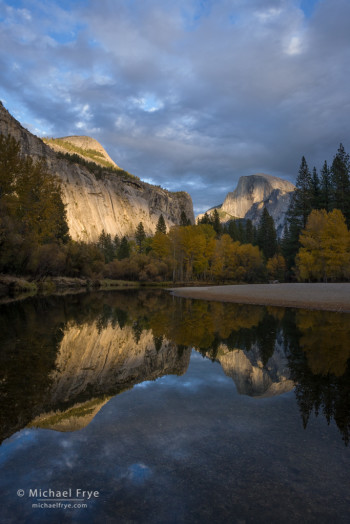
Half Dome and the Merced River, 4:28 p.m.
Is it better to be active or static? To change your location and composition to suit the light, or hope that the light changes to suit your composition?
There’s this persistent myth that Ansel Adams would camp for days at one spot, waiting for the right light. Ironically, this myth is often repeated in relation to Clearing Winter Storm, which was made at Tunnel View, only a few miles from his warm home and comfortable bed in Yosemite Valley. In fact Ansel wrote, “I have always been mindful of Edward Weston’s remark, ‘If I wait for something here I may lose something better over there.’ I have found that keeping on the move is generally more rewarding.”
I have also found that keeping on the move is more rewarding. I’ve sometimes regretted moving, but more often regretted staying when I ignored the inner voice that told me the light would be better elsewhere. And when I do find myself in the right place at the right time, I’ve found that it pays to stay active with my camera and my compositions, and not get lazy about changing lenses or camera positions. If I decide in advance what my composition should be, and stick with that no matter what, I’ll probably miss some great opportunities.
(more…)