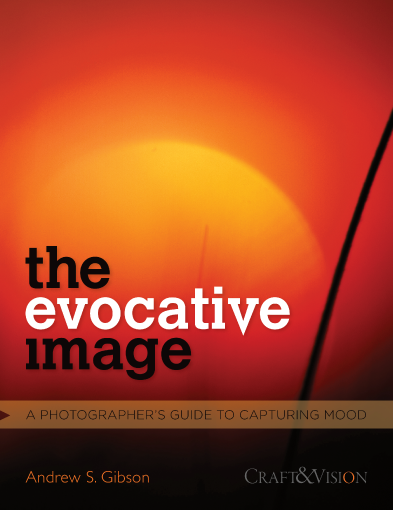
Craft & Vision has just released their latest eBook: The Evocative Image by Andrew S. Gibson. It just came out today, so I haven’t had a chance to read all of it, but I really like what I’ve seen so far.
The subtitle for this new volume is “A Photographer’s Guide to Capturing Mood.” If you’ve attended one of my workshops, read my Digital Landscape Photography book, or looked at some of my critiques, you know that I place a lot of importance on mood in photographs. And I’ve thoroughly enjoyed Andrew’s previous eBooks on black-and-white photography, so I was anxious to read what he had to say about mood. So far, I’ve seen lots of interesting ideas, like this:
“One idea I’ve been exploring is that good photography (and moody images) is created on the ‘edges.’ Sunset and sunrise are edges—the border between night and day. Low light (many moody photos are taken in low light) is the edge between light and dark. The beach—one of my favourite places—is the edge between land and sea. A clearing storm is at the edge of rain and sun.
“There are edges in technique too. Try shooting at a shutter speed that is just a little too slow to get a sharp image. You’re at the edge between sharpness and blur, and exciting things can happen here.
“Wherever I look, more edges reveal themselves, and it’s at these edges that moody photographs happen.”
Nicely said. I hadn’t thought about “edges” in that way, but I certainly will now.
I look forward to reading the rest of the book, but I wanted to let you know about it as soon as possible, since for the first five days, until midnight February 28th, you can get this volume for only 4 dollars. Just use the code “EVOCATIVE4” on checkout. Or buy five Craft & Vision titles, including my December release, Light & Land: Landscapes in the Digital Darkroom, and get 20 percent off by using the code EVOCATIVE20. Here’s a link to the Craft & Vision site, where you can see excerpts from The Evocative Image, as well as all their eBooks.
I’ll be posting a critique tomorrow. Here’s a sneak peak at the photograph I’ll be reviewing, by Ken Hornbrook. I thought it might be fun to let you look at it now, think about the light, composition, and technique, and form your own opinions before reading what I have to say tomorrow. Until then…
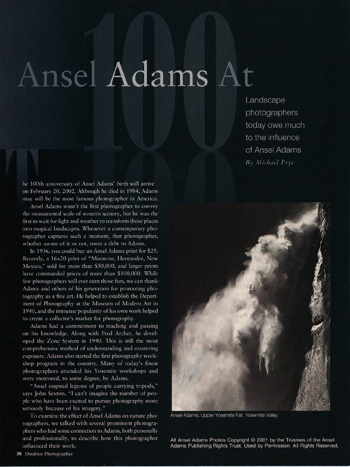
Ansel Adams was born on February 20th, 1902—109 years ago today. For his 100th birthday, in 2002, Outdoor Photographer magazine asked me to interview four photographers who had been influenced by him—William Neill, John Sexton, Galen Rowell, and Chris Rainier—as well as write about his influence on my own work. It was an interesting assignment, and I certainly felt honored to be included in the company of these outstanding photographers.
Bill Neill is an old friend, and I’d met John, Galen, and Chris before, but the assignment was a great excuse to ask them questions. All the interviews were conducted over the phone except Galen’s, which I did in person at his office in Bishop. Without exception they were gracious, open, and generous with their time. In short, it was a lot of fun—although editing the interviews down to 500 word segments later was a lot of work!
Sadly, Galen died in a plane crash soon afterward, in August 2002, so that interview was the last time I saw him. And I never got to meet Ansel: I began working at The Ansel Adams Gallery in 1985, shortly after Ansel passed away in the spring of 1984. But I almost feel as if I knew him because I’ve heard so many stories and read so much of his writing.
I think the article highlights the tremendous impact Ansel had on the way all of us photograph today. Here’s a link to a PDF version of the article, titled Ansel Adams at 100. Hope you enjoy it—and Happy Birthday Ansel!
Did you ever meet Ansel Adams? Has your photography been influenced by him? I’d love to hear about your thoughts and experiences in the comments.
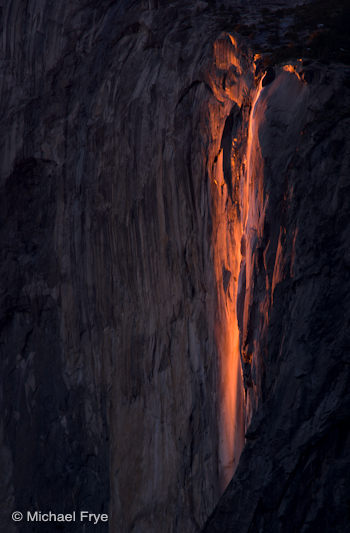
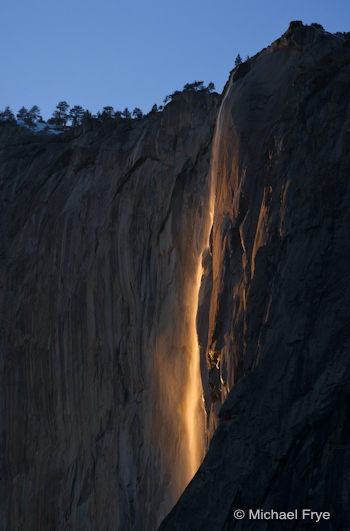
Last Friday I was in Yosemite Valley being interviewed by Steve Bumgardner for a segment of his Yosemite Nature Notes video series. After the interview I decided to head over to the Southside Drive viewpoint for Horsetail Fall. Skies were clear to the west, so the waterfall got that last orange light, but as you can see from this photo there wasn’t a lot of water. It’s a decent flow for this ephemeral fall, better than in some years, but a little below average. Compare the accompanying photo to this one from 2010, or another from 2009. Of course none of these approach the tremendous volume of water in my image from February 1995.
Despite the less-than-spectacular flow, clear skies last weekend allowed many people to capture some nice Horsetail Fall images. You can find links to a few of those photos in the comments of my last post about Horsetail from February 8th.
Meanwhile, a snowstorm deposited about six inches of snow on the valley floor yesterday. Another larger storm is predicted to bring snow tonight through Saturday. We may get a break Sunday or Monday, so Horsetail photos might still be possible again this year. The cold weather has diminished the flow in Horsetail even further, but one warm, sunny day could revive it.
But hey, Horsetail, schmorsetail—we’ve got snow! And clouds, and the chance for clearing storm photos when the next system departs. After six weeks of rather bland skies, it’s nice to see some interesting weather. We could have some great photo opportunities in Yosemite over the next week.
I’ve had a busy workshop schedule, plus a last-minute writing assignment, so I haven’t been able to devote time to the next photo critique, but I should be able to post that next week. I think it will be an interesting one, so stay tuned!
On Wednesday Claudia and I returned to the San Joaquin Valley with our friend Kirk. We had another great day, capped by watching more than 10,000 Ross’ geese land in a pond right in front of us, silhouetted against the dusk sky. Claudia and I came back the next morning and watched them all fly out, the white birds reflected in the still water.
Video is a great medium for showing the incredible sights and sounds of these birds, and Claudia did an amazing job of capturing these events with our little Flip Mino video camera. At the end of each video you’ll also see some stills that I made.
It’s here—almost. The window of best light on Horsetail Fall will begin around February 12th and continue until approximately February 22nd this year. The big questions is how much water will be in the fall.
Horsetail Fall is fed by snow melting from a small area on top of El Capitan. While there was plenty of snow up there in December, we’ve had only one small storm since January 2nd, and much of that early-winter snowpack has disappeared. Horsetail has a decent flow right now, indicating that there’s still some snow on top of El Cap, and I think there will be enough to last through the window of best light—but it might be a close call. If the snowpack holds up, and the warm, dry weather continues, it could be a banner year for Horsetail Fall photographs, with many clear sunsets.
For more details about photographing Horsetail Fall, see this article on my web site, or previous blog posts here and here. And check out the time-lapse video of Horsetail that Steve Bumgardner just posted.
Meanwhile, Yosemite Falls is still going strong, with exceptionally high flow for February, and excellent early-morning light. That light starts to shift soon—by the end of the month it’s not nearly as good. But for the next week or so the sun will strike the upper fall early, creating golden light on the water, and the chance to see rainbows from the eastern end of Cook’s Meadow.
Just to make things more interesting, there will be a full moon the night of February 17th, right in the middle of the Horsetail window. In Yosemite Valley the best opportunities for moonrise photos occur one to three days before the actual full moon date. I recommend using The Photographer’s Ephemeris to figure out the the specifics, but it looks like the moon might be visible near Half Dome at sunset on the 15th from the eastern end of the valley (Cook’s Meadow and the Ahwahnee Meadow). The evening of the 16th you might be able to see a moonrise from Tunnel View. So if you’re in Yosemite one of those days you’ll have to choose between trying to photograph Horsetail Fall or the moonrise.
If you get any good photographs of Horsetail, a moonrise, or anything else in the park, I’d love to see them, so please feel free to post links in the comments. Good luck!
Ross’ geese landing, Merced National Wildlife Refuge
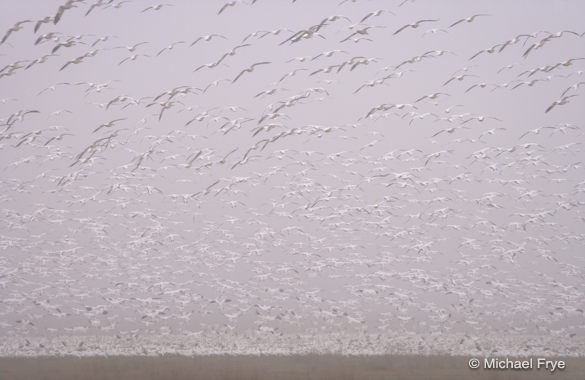
As most of you probably know, last week I posted this image of Ross’ geese from Merced National Wildlife Refuge, and held a little contest to see who could guess the number of geese—in the air—in the photograph. The response was great; 83 people submitted estimates. The guesses covered a wide range, from 300 to 4000. Thanks to all of you who joined in—this has been a lot of fun!
So here’s the actual number of geese, in the air, that I counted: (drumroll please) 1585. The closest guess was 1600, made by Jack Kirchert. Congratulations Jack! Honorable mentions go to Jim Davies, 1560; James Williams, 1545; and Pam, 1543. All these people came within 42 of the actual number. The next closest estimate was 1505, 80 geese away from my count.
Since four people came so close, I’m going to award four prizes: all the people I just mentioned will get their choice of either my Digital Landscape Photography book or one of my three Yosemite posters. In addition, the Grand Prize winner, Jack Kirchert, will receive an 8×10 matted print of this photograph with a congratulatory message and my signature.
Most of the guesses turned out to be too low. The actual count surprised me as well. When I first looked at the image, I thought there might be 600 to 800 birds in the air. But when I started actually counting them (I know, too much time on my hands…) it quickly became apparent that there were a lot more geese than I thought. As I mentioned earlier, this was part of a large flock that arrived to join the birds already on the ground. This photograph shows only a portion of this group of new arrivals, certainly less than half, so this new group might have had 4000 to 5000 birds, joining perhaps another 5000 or more on the ground. An amazing number, and a wonderful sight. (Here’s a larger view of this photograph.)
So thanks again to all who participated, and congratulations to the winners!
Understanding how to read a histogram is the best way to judge exposure in high-contrast scenes like this.
With film, exposure always involves some guesswork—you can never be sure you made the correct exposure until you develop the film. But with digital cameras you can tell immediately whether the right amount of light reached the sensor by looking at a histogram. This ability to instantly evaluate exposure is a game changer—the single biggest advantage of digital photography over film.
But many photographers are still guessing about exposure because they’re unable to decipher the histogram’s cryptic messages. Instead they judge exposure by how bright the image looks on their camera’s LCD screen. But while those little screens are extremely useful for many things, evaluating exposure isn’t one of them. There are too many variables: screen quality (usually bad), the LCD brightness setting in the camera, and the amount of ambient light.
Ross’ geese landing, Merced National Wildlife Refuge
Claudia and I had such a great time visiting Merced National Wildlife Refuge last Monday we went back two more times last week. On Wednesday we found a large flock of geese—mostly Ross’ geese—feeding in a field near the tour road. Small groups flew in, joining the group, then a huge flock arrived from the north. This photograph shows only part of this new group landing.
When watching flocks of snow or Ross’ geese like this, it’s always hard to estimate the numbers. You know you’re looking at a lot of birds, but how many? So out of curiosity I counted the number of geese in the air in this photograph. Yes, really, I counted them. I took the image into Photoshop, zoomed in, and marked little dots on each bird to make sure I didn’t miss any or count them twice.
So I thought it might be fun to see if you, my readers, could guess how many birds are in the air in this photograph. And just to add a little incentive, the person who’s estimate comes closest to my count will win a free copy of my book Digital Landscape Photography: In the Footsteps of Ansel Adams and the Great Masters. Or, if you already have a copy, you can choose one of my three posters (you can view them here).
To make your guess and enter the contest, go to my blog home, where you can read the rules, see a larger image, and post your guess in the comments.
This week’s photograph was made by Grant Kaye at Badwater in Death Valley National Park, California. The water in this place may be bad to drink, but it’s good for photography. It’s always interesting to see water in the desert, and this spot often has great reflections, especially with clouds at sunrise or sunset, like the ones Grant captured in this image. It’s easy to see why Badwater attracts lenses.
Composition
With reflection images, horizon placement is a key decision. It’s usually better to avoid putting the horizon across the middle of the frame, as this cuts the photograph in half, and often creates the feeling of two different photographs stuck together. (I pointed out this problem in another recent critique.)
But there are exceptions to any rule. With reflections, putting the horizon in the middle emphasizes the symmetry between the elements above the horizon and their reflections below, and can be an effective way of expressing calm and serenity, or simply creating repetition and a unified composition. Placing the horizon above or below the center can also work: pointing the camera down emphasizes the reflection; pointing the camera up emphasizes the actual objects above the water.
In this photograph Grant chose put the horizon above center and highlight the foreground and the reflection. I often like this approach, as reflections have richer color than the real objects they’re reflecting. Here this arrangement also accentuates the converging lines of the clouds—they all seem to point to a spot behind the peaks in the center of the image. Overall the composition is simple and direct, with a strong radiating design.
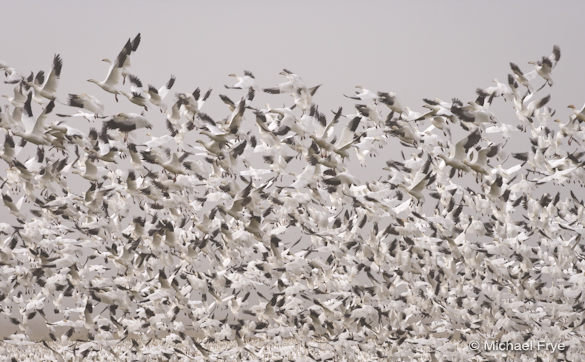
Ross’ geese taking flight yesterday at Merced National Wildlife Refuge
I’ve seen many beautiful natural phenomena in my life: lightning storms, lunar rainbows, Horsetail Fall turning into a ribbon of orange water at sunset. But the most impressive and magical thing I’ve witnessed might be the sound and movement of large flocks of snow geese. The roar and synchronized motion of 10,000 glittering white birds taking flight is unforgettable.
I’ve been using Lightroom since Adobe released the beta version in 2006. Over the years I’ve learned many shortcuts, and in this video I share some of my favorite tips – things I use all the time to streamline my workflow:
We will never sell or share your email address with anyone. Read our complete Privacy Policy.
Subscribe to My Blog:
Success! Now check your email to confirm your subscription.

 Craft & Vision has just released their latest eBook: The Evocative Image by Andrew S. Gibson. It just came out today, so I haven’t had a chance to read all of it, but I really like what I’ve seen so far.