In the Moment:
Michael Frye's Landscape Photography Blog
by Michael Frye | Mar 28, 2010 | Yosemite Photo Conditions
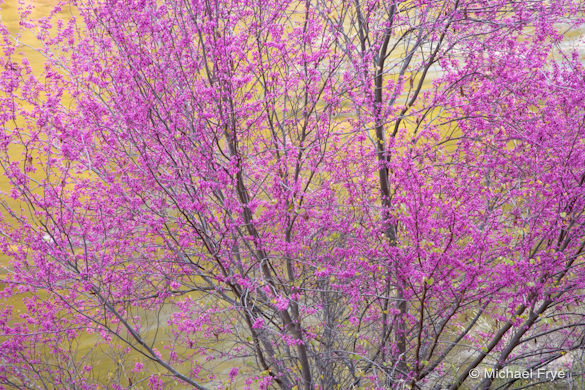
Redbud and reflection along the Merced River
Yesterday I drove to and from Yosemite Valley in the dark, but even car headlights were enough to reveal that the redbud are blooming. I’d guess that about half are in full bloom, and the rest should be soon. They’re most photogenic when they just start flowering and before they begin to leaf out—right now for many of them.
March has been dry and warm, but that’s about to change, as a strong and cold storm is expected to reach us Tuesday or Wednesday, with snow levels predicted to reach down to 2500 feet for lower. That cold weather probably won’t affect the redbud much, but might dampen the wildflower bloom in other parts of the state.
by Michael Frye | Mar 24, 2010 | Critiques
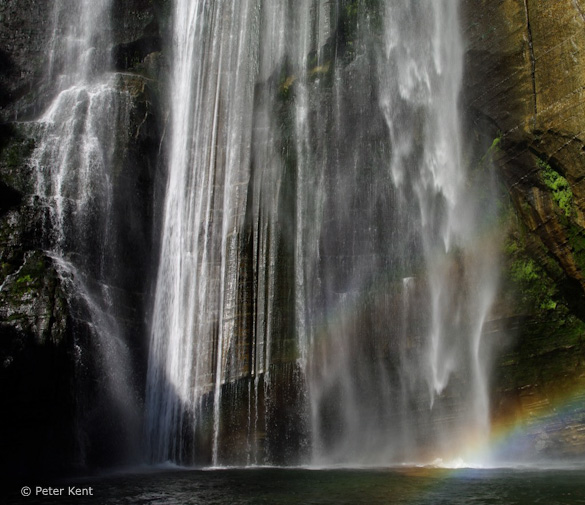
Shine Falls Base—Hawkes Bay, by Peter Kent
This week’s image, by Peter Kent of Canberra, Australia, was made in the Boundary Creek Reserve in the Hawkes Bay region of New Zealand. It’s nice to add a photograph from down under to this series!
There’s something about falling water that holds an irresistible attraction; photographers have a hard time passing by a waterfall without breaking out their cameras. Having lived in or near Yosemite for over 25 years I get to photograph some of the world’s most spectacular waterfalls on a regular basis, yet it never gets old—I still find them fascinating. But Yosemite doesn’t have a monopoly—there are thousands of waterfalls in the world, each with its own unique character and photographic potential.
I’d never heard of Shine Falls before I saw this image, but it certainly looks like a beautiful cascade, and a rich subject for photographs. On Peter’s Flickr photostream you can see a couple of other variations, including an overall view.
That wider view is a pretty good composition as well, but when I look at it my eyes are drawn to the bottom of the waterfall, with its interesting patterns and textures, and of course the rainbow. So I think Peter did a good job of identifying the most appealing part of the scene, the area that captured his attention the most, and filling the frame with just that.
This is the essence of composition: identifying what catches your eye, and eliminating all but the most essential elements. The best images are simple. The photographer’s point stands out clearly without distractions or clutter.
Good compositions almost always have something else in common: a strong, abstract design. Too often photographers become trapped into thinking in terms of subjects rather than designs. When photographing a tree, for example, many people approach the scene with a pre-formed mental image of what a tree is supposed to look like, instead of seeing the unique qualities of the particular tree they’re photographing. To avoid this trap, try studying the tree’s lines and shapes. Think of the abstract designs created by the trunk and branches, then find the composition that presents these patterns in the strongest way. And don’t be afraid to cut off the top or bottom of the tree. The desire to include the whole subject is grounded in that mental image of what a tree is supposed to look like, not in the desire to present the most interesting, essential elements of a particular tree in the strongest manner.
Here Peter wasn’t afraid to cut off the top of the waterfall and focus attention on what he thought was the most interesting part. In doing so he also emphasized the lines and shapes of the subject—the repeating vertical lines in the cascading water, and the small diagonal lines and triangles in the corners.
I think there’s potential for other compositions of this scene as well, especially more abstract images that include just small sections of the fall. In fact Peter said he did just that while he waited for the sun to be in the right position for wider views, but he didn’t post them to his Flickr page.
The light was coming from behind, above, and to the left of the camera. Frontlight like this often leads to flat, dull photographs, but there’s enough contrast here between the white water and the dark surrounding rocks to avoid that, plus of course the rainbow adds a splash of color.
If there’s a problem with this image, it’s the position of that rainbow. Since it’s the only really colorful thing in the photograph, it pulls your eye into the corner. It would be great if the rainbow arced through the middle of the frame. Of course we don’t have control over those things, except to try to be in the right place at the right time.
Here’s where some planning can be beneficial, because rainbows on waterfalls are actually predictable. Rainbows form a circle around a point opposite the sun. Because the sun is always above us, the point opposite it is always located below us, so we usually only see the top half of the circle, which looks like an arch (the bottom half is interrupted by the earth). To find a rainbow in any waterfall, position yourself so that the sun is at your back as you look toward an area with abundant spray. Rainbows are most vivid when they arc through the base of the fall, where copious amounts of mist are generated.
This image was made at around 10:00 a.m. Remember, a rainbow forms a circle around a point opposite the sun, so as the sun rises in the morning, the rainbow moves down, from the top of a waterfall to the bottom. In the northern hemisphere it moves from top-left to lower-right, but in the southern hemisphere it travels from top-right to lower-left. So it probably just slid through the lower-right corner of this image, and was never in an ideal position from this camera position on the morning Peter made this photograph. If he had been able to move further to his left the rainbow would have “followed” him and arced through the lower-middle of the waterfall. I don’t know if that was possible; Peter actually included a photo of his camera and tripod on Flickr, which show their position, but it’s hard to tell if there was any more room to the left. Most likely stepping to the left would have put him in the river!
Time of year also matters. My brain has a hard time wrapping itself around the movement of the sun in the southern hemisphere, but I think that the rainbow would be visible further left, toward the middle of the fall, on shorter days, when the sun would rise further north. The EXIF data says this was made on March 14th, a little over a week ago. Maybe in another month or two it would be in the right place, or again in the southern spring, around August.
Of course we don’t always have the opportunity to plan things that precisely. Peter made this photograph while on a business trip, and tried to take advantage of whatever conditions he found. That kind of flexibility is vital in landscape photography, but so is the ability to plan and try to figure out when the light will be best for a certain image. Often on your first visit to a location you find subjects that would work better at a different time, conjuring thoughts of a return trip.
One more thing about rainbows: they’re actually enhanced slightly by polarizing filters. Rotated to maximum strength, where it darkens a blue sky and cuts reflections, a polarizer will make the rainbow disappear, but turned 90 degrees from that it will make the rainbow a bit more vibrant.
The exposure looks great overall: the water is as light as it can be without being washed out. I might try darkening the brightest strand of water, about a third of the way from the left edge, to keep it in balance with the rest. I like the choice of a fast shutter speed for this image. While slow shutter speeds usually work well with small cascades, as in the photograph by Charlene Burge that I critiqued on February 24th, fast shutter speeds are often a better choice for big waterfalls, as frozen motion preserves the form and texture of the spray.
Thanks Peter for sharing your photograph! You can see more of his work on Flickr.
If you’d like your images considered for future critiques, just upload them to the Flickr group I created for this purpose. If you’re not a Flickr member yet, joining is free and easy. You’ll have to read and accept the rules for the group before adding images, and please, no more than five photos per person per week. I’ll be posting the next critique on March 30th or 31st. Thanks for participating!
by Michael Frye | Mar 20, 2010 | Yosemite Photo Conditions
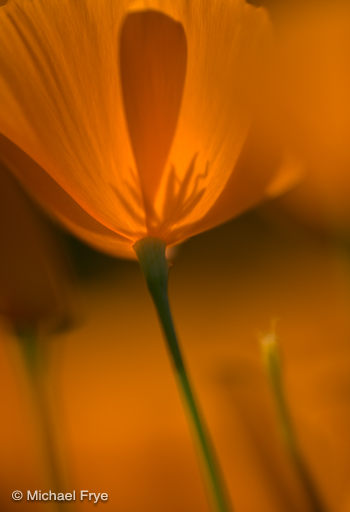
On the way up to Yosemite Valley yesterday my wife and I scouted the flowers in the Merced River Canyon. After a week of warm weather I expected to see more poppies, but they were blooming in the same places, in about the same quantities, as last Sunday. In fact it looked like the hills were starting to dry out, and the poppy season is nearing its end.
We hiked the first half-mile of the Hite’s Cove trail, and found nice mixes of poppies and tri-colored gilia. We ran into several photographers we know—surprise, surprise—and I made some photographs, mostly close-ups of backlit poppies.
While I’m spoiled after last year’s spectacular bloom, this year is below average even by normal standards. I didn’t really believe the map that I linked to in my post from March 9th, which showed below-average precipitation in the Merced River Canyon, since all the surrounding areas are above average. But maybe it’s true.
Elsewhere things are heating up, with reports of flowers coming in from the hills around the southern end of the San Joaquin Valley and near the Carizzo Plain, although Anza-Borrego is apparently disappointing. See that post from March 9th for some links to these reports. Keep in mind that what looks like a great bloom to one person may appear ho-hum to another, and a great variety of flowers does not necessarily mean thick enough carpets for landscape photographs. Personally I’m most interested in dense blooms that have a mix of different colors—rare events, to be sure.
by Michael Frye | Mar 17, 2010 | Critiques
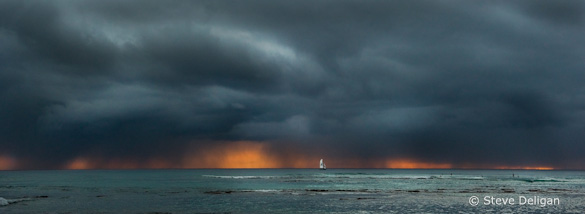
“Oahu Sunset” by Steve Deligan
This week’s image, by Steve Deligan, was photographed from near the base of Diamond Head on Oahu, Hawaii. (Click here to see a bigger version.)
It’s no secret that weather plays a big role in landscape photography, and this image provides a great example. Turbulent clouds dominate the frame, and the sunset color peeking underneath those clouds creates a striking color palette of orange and gray-blue. These elements help convey a dramatic, stormy mood.
The panoramic crop fits the subject well, concentrating attention on the most interesting parts of the scene. The sailboat adds a great touch—it’s perfectly placed within the frame, and provides a focal point, something for the eye to latch onto before roaming around the water and sky. The sailboat is almost centered from left to right, but that doesn’t bother me, as this seems like a natural, balanced placement. (I discuss centered subjects and the rule of thirds in more depth in my critique from February 10th.) In this instance the framing of the sky is the first consideration, and if the sailboat happens to move into a good spot within that composition, great. A large view shows other interesting details, especially the surfers near the right edge of the frame.
Technically this image was well-executed; everything looks sharp, and the exposure is perfect. The large view shows some minor JPEG artifacts, but those are probably the result of compressing the file for uploading, and hopefully not part of the original file. The clouds have an HDR look, but when I asked Steve about this he said that no HDR was involved—that’s just the way they looked. Sometimes nature is just spectacular.
Usually I pick images for these critiques that have more flaws, as those flaws give me more to talk about. There’s not much to criticize in this photograph. There’s a small light area in the lower-left corner—a wave, I think—that’s a bit distracting, but it could easily be cropped out. The panoramic format works esthetically, but making such a big crop throws away a lot of pixels and resolution, so technically it would have been better to stitch together two or more images. Those are about the only things I can think of that might have improved this photograph.
The main reason I chose this image is because it has a such a great mood. Ultimately, the best photographs are not just interesting, or even beautiful—they capture a mood or feeling, or evoke some reaction in the viewer. Ansel Adams felt that the photographer had to respond to a subject before the viewer could: “I have made thousands of photographs of the natural scene, but only those visualizations that were most intensely felt at the moment of exposure have survived the inevitable winnowing of time.”
To infuse your own photographs with mood, you must pay attention to light and weather, and use every possible visual tool—line, shape, pattern, tone, color, movement, exposure, depth of field—to emphasize the feeling you’re trying to convey.
Weather, in the form of roiling clouds and visible sheets of rain, contributes greatly to this photograph’s mood. The color palette also helps; the blue-gray color of the clouds—just the color—adds a stormy feeling, further enhanced by the orange glow. Although color grabs our attention here, tonality is also important—there’s actually a lot of contrast, and that helps convey drama. Long, horizontal lines, like the ones that dominate this photograph, usually evoke calm and serenity, but here they form an interesting counterpoint, something to contrast with, and balance, the turbulence in the sky. The sailboat conveys a sense of scale and space; it seems so small and fragile underneath those clouds. The boat and surfers also add a human element; looking at this image we can put ourselves in the scene and imagine what those people were thinking, like, “Hmm… I wonder if we should get out of here?”
Now I’m sure Steve wasn’t considering all this when he composed this image. He probably did what most of us would when faced with a scene like this: concentrate on framing and getting the exposure right. But the more you become aware of how all the elements of a photograph—lines, shapes, colors, tones, weather, sharpness (or the lack of it)—interact with the subject to create a feeling, the more often you’ll be able to create wonderful, moody photographs.
Landscapes can have an infinite variety of moods—dramatic, delicate, cheerful, peaceful, quiet, somber, or mysterious. One of the keys to conveying mood is to not fight what’s in front of you. If it’s a sunny, cloudless day, then go with it—try to capture that bright, cheerful feeling in your photograph. If it’s raining, use that to your advantage—make the viewer feel how damp it is.
Thanks Steve for sharing your photograph! You can see more of his work on Flickr.
If you’d like your images considered for future critiques, just upload them to the Flickr group I created for this purpose. If you’re not a Flickr member yet, joining is free and easy. You’ll have to read and accept the rules for the group before adding images, and please, no more than five photos per person per week. I’ll be posting the next critique on March 23rd or 24th. Thanks for participating!
by Michael Frye | Mar 15, 2010 | Yosemite Photo Conditions
My wife and I made a quick trip into the Merced River Canyon yesterday afternoon. We saw some dense but small patches of goldfields, and poppies beginning to emerge. The best poppy location right now is probably the beginning of the Hite’s Cove trail. The areas that burned in the summer of 2008 have some poppies as well, but so far not nearly as many as last year. This week is predicted to be warm and dry, so I would expect that more poppies and other flowers will emerge. It’s unlikely that the display will be as amazing as 2009, but it could still be good. On the other hand, the poppies may be confused by the intermittent wet weather we’ve seen over the past few weeks and never amount to much. I’ll keep you posted.
by Michael Frye | Mar 9, 2010 | Yosemite Photo Conditions
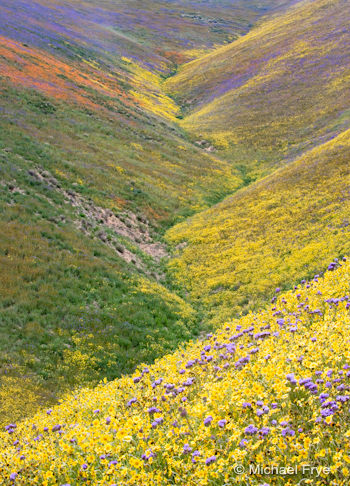
Wildflowers in Carrizo Plain National Monument, April 2006
This could be a great wildflower year in some parts of California, so although I’m on vacation this week I thought I’d pass along some resources, places you can go to find out where the flowers are blooming.
First there’s this map from NOAA depicting rainfall in the western U.S. since September. Note that Death Valley and other areas of the Mojave Desert have received over 150 percent of normal rainfall, so we can expect good flower displays in those areas. Other traditional wildflower hotspots like Anza-Borrego, Antelope Valley, and the Carrizo Plain have also received above-average precipitation.
Carol Leigh has created two great resources for flower photographers: Carol Leigh’s California Wildflower Hotsheet, and the CalPhoto group on Yahoo. Both feature reader reports of wildflowers from around the state. I’ve been a Calphoto member for a long time and it’s a great place to find information about photographing many California subjects, not just wildflowers.
DesertUSA is another valuable site, with wildflower reports for Arizona, Nevada, New Mexico, and Texas as well as California. Also check out the Theodore Payne Foundation’s Wildflower Hotline.
These links just scratch the surface of what’s available, so if you know of other good sources please feel free to post them in the comments.
Of course I’ll keep you up to date on what’s happening around the Yosemite area in this blog. Right now it’s hard to say what kind of wildflower year it will be in the Merced River Canyon west of Yosemite. We’ve had above-average precipitation, but we need a stretch of warm, clear weather to get the bloom rolling.
As a reminder, I won’t be posting a critique this week, so I’ll post the next critique on March 16th or 17th. See you then!
by Michael Frye | Mar 3, 2010 | Critiques
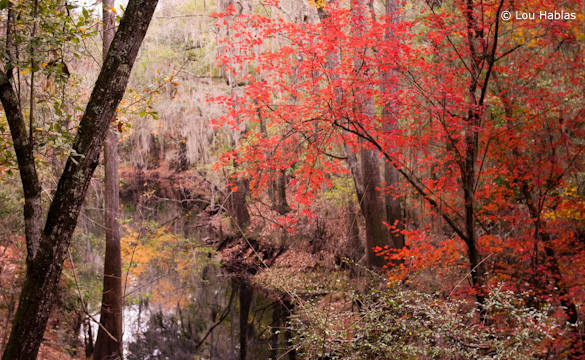
“Ogden Lake II” by Joe Hablas
This week’s photograph, by Lou Hablas, is from O’Leno State Park in Florida. Did you know they had fall color like that in Florida? I sure didn’t.
Lou said that he made this photograph on an overcast and sometimes rainy day while on a hike with his family. That weather provided perfect conditions for this subject. I mentioned last week how soft light enhances colors and color contrasts, but it has another benefit: simplification. Forests have random, chaotic configurations of branches, trunks, and leaves. Sunlight filtering through the trees creates splotchy patterns of light and dark, further adding to the visual confusion. Soft, even light helps simplify such scenes.
But forests are still difficult to photograph, even on an overcast day, because it’s hard to create visual order out of so much chaos. I think Joe did a pretty good job of finding a coherent design; we grasp the main ideas easily, and it doesn’t seem too confusing. The main focal point is the red maple on the right side, and its Y shape echoes the lines of the trunks on the left edge of the frame, giving this image structure and repetition.
(more…)
by Michael Frye | Mar 1, 2010 | Photography Tips, Yosemite Photo Conditions
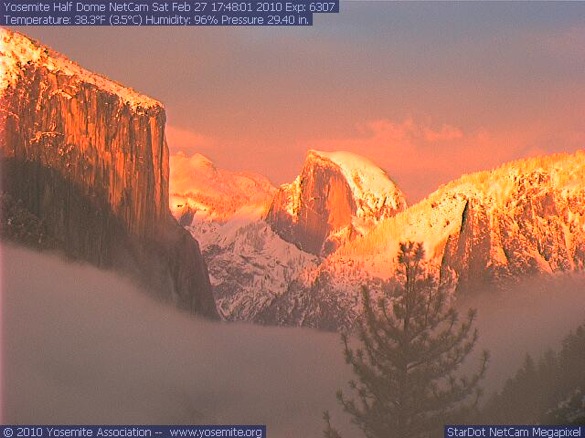
Yosemite Association’s web cam, Saturday, 5:48 p.m.
As I was worked in my office in Mariposa Saturday afternoon I kept an eye on the weather outside, as well as the satellite and radar images on the web, just in case the storm might clear before sunset. It looked like there was a chance, but only a small chance. I had a lot of work to do. I decided to stay home rather than make the two-hour round trip to Yosemite Valley.
Just before sunset I noticed a sliver of clear sky to the west, then sun hitting some trees on a nearby ridge. I looked at the Yosemite Association’s web cam and saw the image you see above. Ouch! Oh well, I guess you can’t always be in the right place at the right time. The moral of the story is that I should always take the chance, even if the odds are low, because it’s precisely those situations when truly spectacular light can occur. I hope some of you were there and captured some great images!
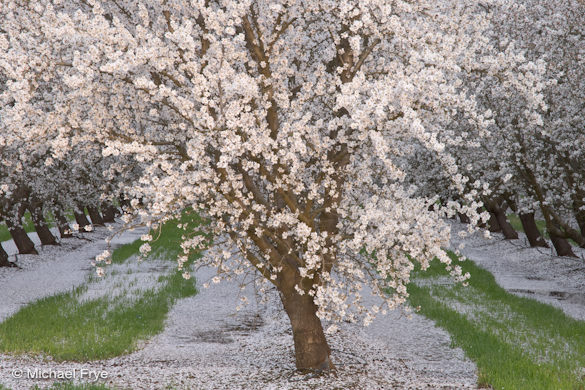
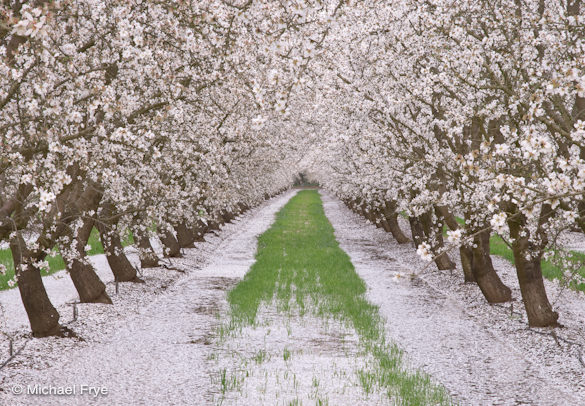
To console myself, my wife Claudia and I drove down to Merced yesterday afternoon to check out the orchards. We found numerous trees in bloom, mostly almonds I think, including this grove where the recent rain had knocked off many petals, making it look like snow had fallen. What appears to be dry ground between the rows of trees is actually long pools of water two to six inches deep covered in blossoms.
by Michael Frye | Feb 24, 2010 | Critiques
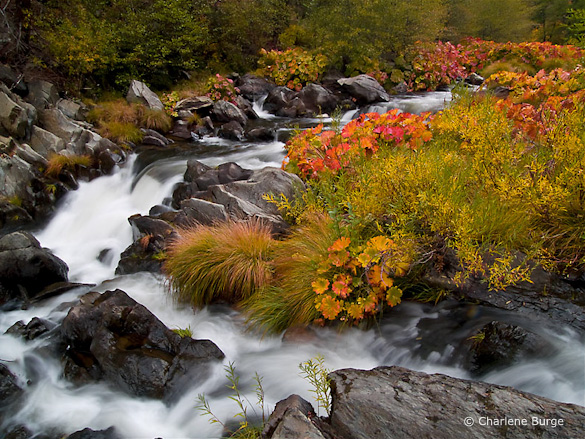
“A Walk Along the Cascades” by Charlene Burge
This week’s photograph, by Charlene Burge, is from the Plumas National Forest near the northern end of my home mountain range, the Sierra Nevada. The colorful plants along the creek are called wild rhubarb or Indian rhubarb. They’re found in a few places in and around Yosemite, but I was pleasantly surprised to discover this photo and see that they grow further north as well. It’s hard to tell from this image, but their leaves are quite large, sometimes more than a foot in diameter. Since they’re colorful in the fall, and grow along creeks, these plants make great photo subjects.
Color is one of the most appealing things about this image. The reds and oranges of the rhubarb draw the eye and contrast with the greens of the grasses and trees. The soft light of an overcast day worked perfectly for this subject. Sunlight would have been too harsh, creating bright highlights and dark shadows that would have overwhelmed the colors.
This seems counterintuitive to many beginning photographers—they assume that sunlight is a requirement for good photos, and that overcast is inherently dull. And that’s true for many subjects—the gray granite of El Capitan, for instance, seems lifeless on a cloudy day. But colorful subjects often look best with soft light. The even illumination gives prominence to color contrast rather than light-and-dark contrast.
While we’re on the subject of color, the white balance looks good here—the rocks and white water appear neutral, and everything else is the appropriate hue, except perhaps the greens, which look a bit too red to me. Usually I see the opposite problem—greens that look blue-green. Here the greens are too warm, so they blend with the surrounding golds and oranges, and some of the natural warm-cool color contrast has been lost. I used Lightroom to remove some of that reddish tint in this next version. The difference is subtle, and takes a good monitor to see, but to me it’s significant.
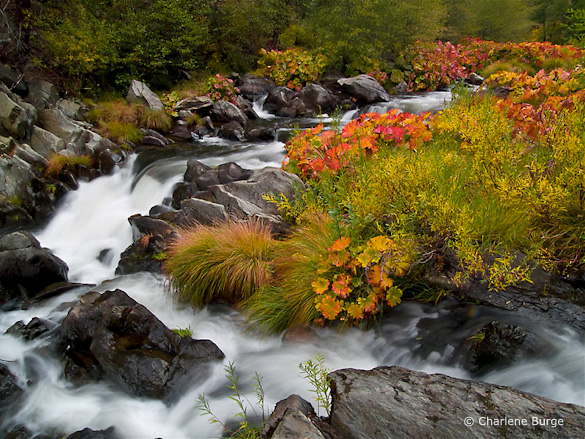
With the greens adjusted to remove the reddish tint
This image was captured at f/22 with a 1/2 second shutter speed. These were appropriate choices for showing the movement of the water and getting enough depth of field to keep everything in focus. The blurred, silky look of the water creates a nice textural contrast with the rocks and vegetation. The largest cascade, however, near the middle of the frame along the left side, lacks definition—it’s mostly the same shade of white. I might have tried a slightly faster shutter speed, like 1/4 sec. or 1/8 sec., to try to keep more texture in that area without losing the flowing appearance of the water. Of course that would have required opening the aperture to f/16 or f/11, creating possible depth of field problems, or using a higher ISO, which would have added noise. In photography, everything is a compromise.
The two branches of the creek form a nice semi-circular shape and give the image structure. The top and right edges of the frame seem well placed. The lower-left corner, however, is troublesome. Bright areas along the edge of a photograph are often distracting, and here the white water in the lower-left corner pulls my eye out of the frame and away from the main centers of interest.
But having identified this problem, there may not have been a solution. Charlene told me that she couldn’t include anything to the left because she couldn’t hang out further over the water. I’m guessing that intervening vegetation blocked the view. Even if she could have pointed the camera down and to the left more, the creek obviously continues in that direction, and white water would have touched the edge of the frame somewhere. In those situations I try to put dark rocks along as much of the edge as possible, but sometimes there’s no perfect solution.
These dilemmas are common in landscape photography. A subject catches your eye, yet somehow it defies your attempts to make a clean composition. Some annoying, distracting element can’t be eliminated without losing an essential component of the scene.
Most of my best photographs have practically composed themselves; the right framing was immediately obvious. When I struggle with the composition I rarely like the end result. But there are exceptions, situations where I’ve worked with a subject for half an hour and finally found a good solution. And even if it doesn’t work I often learn something in the process. So it’s worth the effort, even if resulting image isn’t successful.
In researching my most recent book I found this quote from Ansel Adams: “I have found that when I have to labor over a composition I seldom achieve anything worthwhile.” So even the great Adams faced the same problem!
With the composition we see here, the only thing that might help prevent the eye from leaking out of that lower-left corner is to darken the water a bit, and I’ve done that in this next version. For good measure I also darkened and added contrast to that cascade near the middle-left edge to try to bring out more texture. I can’t say these changes made a big difference, but every little bit helps.
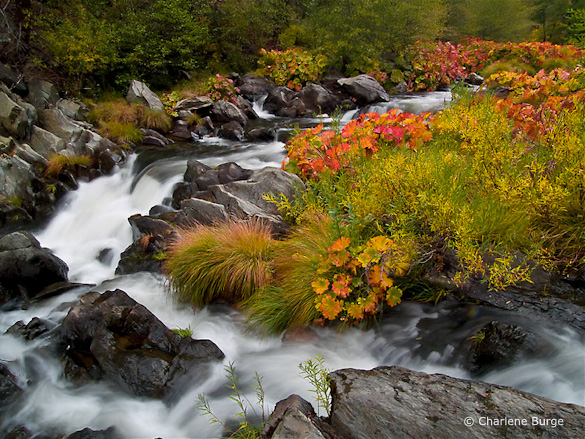
Water along the left side darkened, plus more contrast added to the large cascade
Despite my nitpicks this is a pleasing photograph of an intimate landscape. It makes me wish I had been there.
Thank you Charlene for sharing your image! You can see more of her work on Flickr.
If you’d like your images considered for future critiques, just upload them to the Flickr group I created for this purpose. If you’re not a Flickr member yet, joining is free and easy. You’ll have to read and accept the rules for the group before adding images, and please, no more than five photos per person per week. I’ll post the next critique on March 2nd or 3rd. Thanks for participating!
by Michael Frye | Feb 21, 2010 | Yosemite Photo Conditions
Poppies, tri-colored gilia, and a gray pine, March 2009
After a long dry stretch we’ve encountered some wet weather. Rain fell yesterday, and a more significant storm arrived today. This one is cold enough to produce snow in Yosemite Valley. The storm is predicted to end tomorrow morning, and whenever a system like this breaks there’s a chance of seeing classic Yosemite clearing storm conditions. The forecast calls for “unsettled” weather the rest of the week.
A reliable source—namely my frequent workshop assistant Mike Osborne—told me that some poppies, along with a few other flowers, have started to bloom in the Merced River Canyon west of Yosemite. Last year, of course, was a fabulous year for poppies, the best I’ve seen in over 25 years. While it’s unlikely that this year will be as spectacular, we could still have an above-average season since last year’s poppies must have left a lot of seeds, and the ash deposited by the Telegraph Fire of 2008 may still provide left-over benefits. On the other hand, the grass is already quite high and may crowd out the flowers.
I just returned from the NANPA (North American Nature Photography Association) Summit in Reno, Nevada. We heard some great speakers—for example, check out Wild Wonders of Europe, the amazing project co-founded by Friday morning’s keynote speaker, Staffan Widstrand of Sweden.
But the best part of the conference was simply connecting with other photographers. Gary Crabbe told me the astounding story of his freakish accident last year. He literally fell off a forty-foot cliff in the dark. Jed Manwaring entertained us with tales of assisting high-powered advertising photographer Jim Sugar. I traded books with Brenda Tharp and Stephen Ingram, exchanging my new book, Digital Landscape Photography, for an advance copy of the revised edition of Brenda’s (deservedly) popular Creative Nature & Outdoor Photography, and Stephen’s beautiful Cacti, Agaves, and Yuccas of California and Nevada.
But aside from the camaraderie and book trades, I learned a lot. I think we sometimes underestimate the vast knowledge of our fellow photographers. They’re the ones who can get beyond the theories and tell us their practical experiences with equipment and locations. Fellow professionals can help us avoid book contract pitfalls or hassles with permits at a national park. I learned a lot from discussions with other pros about voice-recognition software, something I’ve been trying lately. (If you’re interested in this topic, here’s a great video blog about it.)
Gordon Illg and I had an interesting discussion about why we go to the NANPA Summit. He told me that at his first Summit he had all these plans for meeting editors and photo buyers and showing them his portfolio. Then after a couple of years he stopped trying so hard to make connections and sales, and as a result enjoyed himself more and made more connections and sales. I told him I had the same experience. Once I relaxed I met lots of interesting people. Some were photo buyers, but most were other photographers. And it’s really those connections with my peers that have been the most valuable, that have really helped my photography and enriched my life. There’s nothing like talking to real people face to face, especially those you have something in common with. Social networking started long before the internet.