In the Moment:
Michael Frye's Landscape Photography Blog
by Michael Frye | Feb 19, 2016 | Light and Weather, Yosemite Photo Conditions
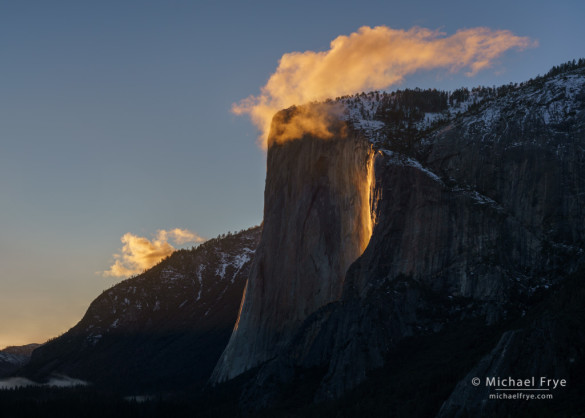
El Capitan and Horsetail Fall at sunset, Yosemite
I rose early yesterday morning to go up to Yosemite Valley, thinking the storm might clear just after sunrise. But showers persisted, and the sun didn’t break through until almost ten o’clock. By the time I finished photographing it was almost noon, so I decided to stay in the valley until sunset.
In the afternoon typical after-storm condensation clouds formed around the rim of the valley. Thinking those clouds might add something to a photograph of Horsetail Fall, and allow me to capture something a little different from my other images of this waterfall, I headed for a spot with a good overall view of El Cap and Horsetail.
(more…)
by Michael Frye | Feb 17, 2016 | Yosemite Photo Conditions
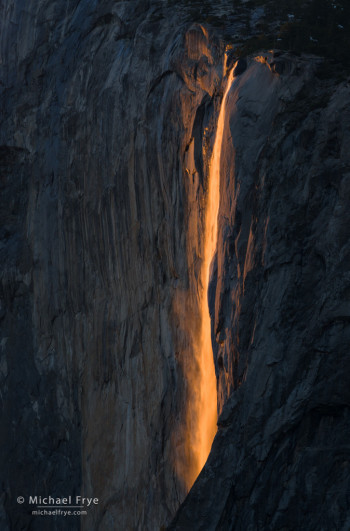
Horsetail Fall last night, 5:27 p.m.
February has been completely dry around here so far, with very warm temperatures. That warm weather has been melting the snow on top of El Capitan and creating a strong flow in Horsetail Fall – easily the most water in the fall since 2010. Yesterday was another clear, warm day (the high in Yosemite Valley was 67 degrees), with nearly ideal conditions for Horsetail. I wondered when I might see such conditions again, so I decided to head up to Yosemite Valley.
A first-hand look at Horsetail actually revealed less water than I expected. With the exceptionally warm weather we’ve been having I thought Horsetail would really be gushing, perhaps even approaching the high flow shown in this photograph from 1995. But nevertheless it was flowing well. I’d say the water level was a little above average for February (and, of course, way more than anything we’ve seen during the last four years of drought).
(more…)
by Michael Frye | Jan 20, 2016 | Yosemite Photo Conditions
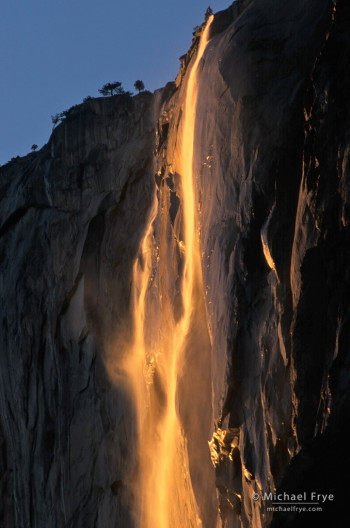
Horsetail Fall at sunset, Yosemite
We’re getting close to Horsetail Fall season, and I’m getting lots of questions about the water flow and the right time of year to photograph it.
As I said in my last post, there’s a healthy snowpack at higher elevations of Yosemite. Badger Pass ski area still reports 60 inches of snow on the ground at the base of the mountain (7,200 feet), and 72 inches at the top (8,000 feet). Horsetail’s small drainage on top of El Capitan lies at similar elevations, but faces south, and the slopes of Badger Pass face north. That means Horsetail’s drainage gets more sun, and the snow melts faster. But there should still be at least three or four feet of snow on top of El Cap right now, and it’s hard to imagine how all of that could melt between now and the third week of February. After four years of drought, it looks like we’ll finally have a good flow in Horsetail Fall at the right time of year.
But water flow is just one element. You also need the sun to set at the right angle to backlight Horsetail and make it turn orange, yet have the cliff behind it in the shade, so that the glowing, backlit, orange water is set against a dark background. My best estimate is that this happens between February 16th and 23rd, and perhaps even a few days beyond. (I delve into more detail about all that here.)
(more…)
by Michael Frye | Feb 24, 2015 | Yosemite Photo Conditions
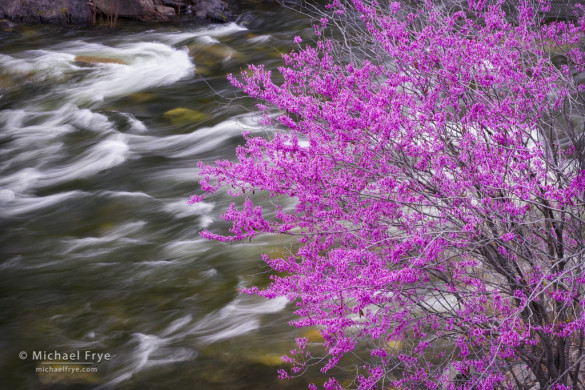
Redbud along the Merced River, Merced River Canyon, March 2013
February has been exceptionally warm, so I probably shouldn’t be surprised to see signs of spring already. But redbuds? In February? Apparently so. Claudia drove up to Yosemite Valley on Saturday, and reported seeing redbuds and a few poppies blooming in the Merced River Canyon west of the park. It’s not unusual to see poppies in late February, but the redbuds are a month early. Claudia said that only a couple of them were in full bloom, but many more were starting.
Temperatures dropped significantly over the weekend, and I’m not sure how that will affect the redbuds, or the poppies. Under normal circumstances the redbuds would continue to progress, and reach peak in perhaps a week or so. But these aren’t normal circumstances, so all bets are off.
(more…)
by Michael Frye | Feb 10, 2015 | Yosemite Photo Conditions
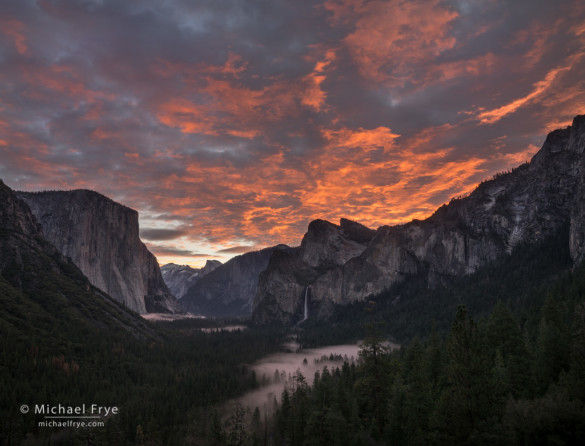
Sunrise from Tunnel View, Sunday morning
Yosemite Valley got about three inches of rain from the storms over the weekend. That’s not a drought-busting amount, but it helps, and I’m grateful for every drop.
The first wave of rain arrived Friday night, and lingered through Saturday. Early Sunday morning I looked at the satellite and radar images online, and saw thin, high clouds moving in ahead of the next system. Thinking that those clouds might light up at sunrise, I made the trip up to Tunnel View. Soon after I got there a bit of color appeared behind Half Dome, and then within minutes the whole sky caught on fire. It turned into the most colorful sunrise I’ve ever seen from that spot; you can see a photograph above.
The second wave of rain arrived Sunday evening. It started slowly, but around 9:30 p.m. a band of heavy rain passed through Mariposa County and headed toward Yosemite. I was actually out driving during this squall, and had to stop and pull off the road four separate times because it was raining so hard I could only see about 20 feet ahead.
(more…)