Posts Tagged ‘ebook’

Noteworthy Books

Tuesday, April 9th, 2013

Visual Flow by Ian Plant and George StockingSome interesting books have been released recently that I think my readers might be interested in:

Visual Flow: Mastering the Art of Composition
by Ian Plant, with George Stocking
287 pages
24.95

Visual Flow: Mastering the Art of Composition is an ambitious eBook that delves deeply into what could be the most important aspect of photography: composition. But composition is a difficult subject to talk about, and teach, because of its complexity. Every situation a photographer encounters is different, and no rules or formulas can encompass all the variables.

Ian puts this well: “The ‘rules’ do not dictate whether a composition is good or not; rather, a composition either works or it doesn’t, and the ‘rules’ are merely an attempt (with the benefit of 20/20 hindsight) to assess common features of successful compositions. This is vitally important to remember: the ‘rules’ flow from successful compositions, not the other way around.”

I couldn’t agree more, and Ian and I are in complete agreement about this too: “Learning to think abstractly about visual elements is the single most important thing you can do to improve your compositional skills.” The less you think about the subject, and the more you think about the underlying abstract design – the lines, shapes, and patterns – the better you compositions will be.

(more…)

Craft & Vision’s “Big Book”: Lightroom 4 Unmasked

Wednesday, November 21st, 2012

Lightroom 4 UnmaskedEven if you know a program well it helps to have a comprehensive guide, a book that covers everything from A-Z, so you can look up a keyboard shortcut, remember how to do that thing that you only do once a year, or learn some new tricks.

My favorite Lightroom bible has been Martin Evening’s The Adobe Photoshop Lightroom 4 Book. I still think that’s a great resource, but I might have a new favorite: Piet Van den Eynde’s new ebook called Lightroom 4 Unmasked.

This is a truly comprehensive guide to Lightroom 4, from setting up and importing, to organizing in the Library Module, processing images, mapping them, exporting them or publishing them to Flickr or Facebook, and printing.

If you’re new to Lightroom there’s a lot of great information here to help you get started. For example, the Lightroom Do’s and Don’ts (page 20) offers some invaluable advice to help you make the most of the program and avoid some common pitfalls.

Even if you know Lightroom well you’ll undoubtedly discover some new tips. One that I’m anxious to try is on page 238 — using Lightroom’s Publish Services to automatically put images on my iPhone and iPad. Cool — I didn’t know you could do that.

This is another ebook by Craft & Vision, the publisher of my two previous ebooks. But this one is different. Craft & Vision is calling this a “big book,” and it is that: a full 312 spreads. Because this is roughly four times the size of their typical ebooks, the price for Lightroom 4 Unmasked is higher than normal — $20. But until midnight on Tuesday, November 27th you can get it for only $15. Just use the code LR4FIVE on checkout.

(more…)

Quick Horsetail Update

Sunday, February 19th, 2012
Horsetail Fall, 5:27 p.m., Wednesday, February 15th

Horsetail Fall, 5:27 p.m., Wednesday, February 15th

First, a reminder that this is the last day to get a discount on my new eBook, Exposure for Outdoor Photography. Until midnight tonight you can use the code EXPOSURE4 at checkout to get the book for only 4 dollars. Or use the code EXPOSURE20 to get 20 percent off if you buy five or more Craft & Vision eBooks—including my previous volume, Light & Land: Landscapes in the Digital Darkroom.

Now, on to Horsetail Fall. Yosemite Valley received about four inches of snow on Tuesday night, and higher elevations got a little bit more. Unfortunately that precipitation did little to improve the water volume in Horsetail Fall. It’s flowing, but barely. Yet it’s amazing how little water it actually takes. You can strain your eyes to detect any flow at all for most of the day, and then as the sun lowers it highlights the fall perfectly and makes whatever water there is stand out.

The accompanying photographs were made on Wednesday and Thursday evenings while I was teaching private workshops, and show the current conditions pretty well. On Wednesday some mist drifted past the fall, adding interest, but distant clouds dimmed the light before it reached its most intense color. On Thursday, the light was about as good as it gets for Horsetail, lasting right until the theoretical sunset time, with the cliff behind the fall shaded. If only there was more water!

(more…)

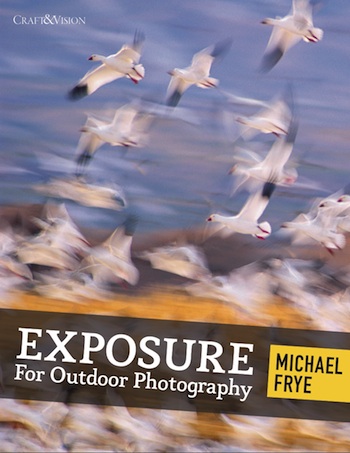
New eBook: Exposure for Outdoor Photography

Thursday, February 16th, 2012
Exposure for Outdoor Photography

Exposure for Outdoor Photogoraphy

I’m pleased to announce the release of my second eBook: Exposure for Outdoor Photography.

In photography, creativity and technical skill are both essential. It’s great to have a wonderful eye and imagination, but no one will appreciate your genius if your images are washed out and blurry.

The most essential technical skill a photographer must master is exposure. On the surface, exposure seems easy. It’s simply a matter of making the image bright enough—not too dark, and not too light. But the endless variety of light makes exposure challenging. No two situations are the same, so there can be no exact formula for getting the right exposure. On the other hand, exposure doesn’t need to be overly complicated. The fundamental controls—shutter speed, aperture, ISO, light meters—are easy to understand.

Previously on this blog I’ve written about some of these fundamentals, like reading histograms and adjusting exposure. In this eBook I start with a more comprehensive discussion of these essentials, then go deeper by taking you through ten practical, real-life examples where I’ve used these basic principles to control the exposure, the sharpness, and the photograph’s message.

The examples go from easy to complex, and include using a histogram to find the right exposure, controlling depth of field, freezing and blurring motion, when to push the ISO, spot metering and the Zone System, and HDR and exposure blending. I also include several exercises to help improve your technique. It’s a concise, easy to understand, yet comprehensive course in mastering the most important skill in photography.

Like all Craft & Vision eBooks, Exposure for Outdoor Photography is normally only five dollars. But for the next four days you can get it for only four dollars. Just use the code EXPOSURE4 at checkout. Or use the code EXPOSURE20 to get 20 percent off if you buy five or more Craft & Vision eBooks—including my previous volume, Light & Land: Landscapes in the Digital Darkroom.

Click here to order your copy!

—Michael Frye

Related Posts: Light & Land eBook Available Today!Digital Photography Basics: Reading HistogramsDigital Photography Basics: Adjusting Exposure

Michael Frye is a professional photographer specializing in landscapes and nature. He is the author and photographer of The Photographer’s Guide to Yosemite, Yosemite Meditations, and Digital Landscape Photography: In the Footsteps of Ansel Adams and the Great Masters, plus the eBook Light & Land: Landscapes in the Digital Darkroom. He has written numerous magazine articles on the art and technique of photography, and his images have been published in over thirty countries around the world. Michael has lived either in or near Yosemite National Park since 1983, currently residing just outside the park in Mariposa, California.

New eBook by Jim Goldstein

Wednesday, December 7th, 2011

Photographing the 4th Dimension - Time

Jim Goldstein has just released a new eBook called Photographing the 4th Dimension – Time. In the book Jim describes seven different slow shutter speed and video techniques for making more creative photographs—including long exposures, light-painting, star trails, time-lapse, and cinemagraphs.

This book is a great way to delve into some new, fun, and creative aspects of photography. If you’ve never tried photographing star trails, making time-lapse videos, or creating cinemagraphs, Jim makes it easy to get started by giving you step-by-step instructions, sometimes including video tutorials.

Just browsing through the book can inspire you to try some new techniques and give your photography a creative kick in the pants. Personally I was intrigued by the cinemagraphs, where part of a still photograph is animated. Some cinemagraphs I’d seen before looked rather cheesy, but after viewing some of the examples here I realize that they can be done subtly, and beautifully, so I’m eager to try them—and it’s nice to have Jim’s detailed instructions for doing so.

(more…)

Free eBook From Craft & Vision

Friday, December 2nd, 2011

Craft & Vision Free eBook

Craft & Vision has just released a new eBook called, appropriately, Craft & Vision: 11 Ways to Improve Your Photography. The book includes eleven different articles, including Tame Your Digital Exposures, by David duChemin, The Power of the Moment, by Eli Reinholdtsen, Slow Down and Learn to See, by Stuart Sipahigil, and Learn to Direct the Eye, by Yours Truly.

And best of all, it’s free—zero dollars, now and forever. You can download your copy here. And tell your friends!

Black Friday Photography Deals

Friday, November 25th, 2011

I’ve seen some great deals today! B&H has Lightroom 3 for half price (it’s normally $299), as well as discounts on Canon cameras and lenses. Friend of this blog G Dan Mitchell has all the details. Also, Craft & Vision is offering 50% off their whole photography eBook collection, including my eBook Light & Land: Landscapes in the Digital Darkroom. Or you can get a $40 gift certificate for $20. All these discounts are today only.

I’m sure there are some other good deals out there too, so if you see anything, please let us know by posting a comment.

New eBook by David duChemin: The Inspired Eye III

Thursday, September 22nd, 2011

David duChemin has just released another eBook, The Inspired Eye III. If you read my review of his previous eBook, A Deeper Frame, you know that I’m a fan of David’s writing. He looks at photography in a deeper way than most, and is able to articulate sometimes-complex ideas clearly.

This latest eBook, the third part of his Inspired Eye series, is no exception. It contains lots of interesting thoughts and insights into the creative process of photography. I was particularly struck by this passage:

“You can learn about photography by reading books, watching videos, and listening to other photographers. You can study hundreds of photographs. But you will not learn your own process of making photographs until you have a camera in your hands and you make photograph after photograph.”

As I mentioned in my last post, I went to the Millpond Music Festival last weekend, and in his workshop on Sunday Joe Craven said something similar—that we learn by imitating, and by doing, not by studying theory. I think he’s right on the mark about that, and so is David in saying that you have to make lots of photographs to “learn your own process.”

(more…)

New eBook: Making Light by Piet Van Den Eynde

Friday, August 19th, 2011

Making LightLight is a vital aspect of photography—maybe the single most important element. We often assume that we have to adapt our photography to whatever light is available, but that’s not always true. We can create our own light.

Flash is one of the most effective ways of doing that, but flash technique and equipment can be complicated and intimidating. I’d been a serious photographer for a long time before I ever used flash. In fact I was assisting Moose Peterson with a workshop in Montana in the early ’90s, and as he tried to attach a flash to my camera he said, “This is a virgin hotshoe!” It was true: no flash had ever been mounted on that camera. Moose shook his head in amazement, and then loaned me an old flash of his that he didn’t use any more, encouraging me to experiment with it.

I guess I took that advice and ran with it, eventually using flash in highly complex ways to make some of my best-known nighttime images. But even if you have no desire to take things this far, learning to use flash can add  an extra dimension to your photography. It’s especially effective with people, but can also be used in many interesting ways for landscapes.

Maybe I’ll write a post about using flash for landscapes sometime, but in the mean time Craft & Vision has just released a new eBook called Making Light, by Piet Van Den Eynde, and I think it’s a great introduction to general flash technique, and especially for using flash with people. Piet (pronounced Pete) does an excellent job of making the sometimes complex world of flash photography easy to understand. He encourages you to take the flash off the camera (absolutely essential in my opinion), and shows you exactly how to do that. I especially liked his examples—nine in all—showing how he used minimal equipment to add light to his photographs of people. Piet likes to travel by bicycle, so that forces him to keep his equipment simple!

As always, this Craft & Vision eBook is only five dollars. What’s more, until midnight, August 21st, you can get Making Light for $4 (discount code LIGHT4). Or you can buy five eBooks for the price of four (discount code LIGHT20). That includes my eBook Light & Land: Landscapes in the Digital Darkroom, so if you don’t already own a copy this is a great opportunity to get both Light & Land, Making Light, and three other Craft & Vision eBooks for only $20. (I’ve reviewed two more of these eBooks in the past: A Deeper Frame by David duChemin, and The Evocative Image by Andrew S. Gibson.)

—Michael Frye

Michael Frye is a professional photographer specializing in landscapes and nature. He is the author and photographer of The Photographer’s Guide to Yosemite, Yosemite Meditations, and Digital Landscape Photography: In the Footsteps of Ansel Adams and the Great Masters, plus the eBook Light & Land: Landscapes in the Digital Darkroom. He has written numerous magazine articles on the art and technique of photography, and his images have been published in over thirty countries around the world. Michael has lived either in or near Yosemite National Park since 1983, currently residing just outside the park in Mariposa, California.

eBook Review: Creative Landscape Photography by Guy Tal

Monday, March 21st, 2011

Creative Landscape PhotographyWhen I think about contemporary landscape photographers who’s work I admire and respect, Guy Tal is definitely on that list. He consistently produces beautiful work in a natural style that reflects his appreciation for the natural world.

I recently had the opportunity to review Guy’s eBook, Creative Landscape Photography. I’ve read a lot of books and articles about photography, and written a few myself, so it’s refreshing when I find something that presents a new idea, or a new way of looking at the process of photography. This book does that. Guy has the ability to get you to think in different ways about photography, and about your own approach to a subject. Rather than presenting recipes for successful photographs, or abstract philosophical ideas, he gives you concrete steps to help provoke your own thought process, and stimulate your creativity.

This includes a list of questions to ask yourself before photographing a subject, like, “What element(s) do I find most visually appealing about the scene?, or “What emotion(s) can I convey to my viewers using the elements in this scene?” All vital questions.. While highly-experienced photographers may consider such things instinctively and automatically, even they can use a reminder, and less experienced photographers will find that a conscious effort to answer these questions will pay big dividends.

Guy has always struck me as a thoughtful person, and that comes through in this volume. It’s clear that he’s has given a lot of thought to every aspect of landscape photography:

“A common enemy of good composition is the impulse when an attractive scene presents itself to immediately reach for the camera, snap a few quick exposures, and move on to continue the hunt. In reality, chances are your perspective will not be ideal at the precise moment you discover your subject.”

“Consider all the rules, take what works. Apply where appropriate, but do not be afraid to break every last one of them. Go with your instinct. Photograph for yourself and satisfy your own sensibilities and aesthetics. True artists do not pander to a pre-selected audience. Instead, they carve an audience of their own from those who will encounter and be moved by their work.”

The heart of the book is the first four sections, called The Creative Process, Concept, Visualization, and Composition. The remaining three parts—Capture, Processing, and Presentation—support the ideas presented in the beginning, explaining how to carry your original vision through to a finished photograph. The book also includes many of Guy’s beautiful photographs to inspire you, most from one of my favorite regions in the country, the canyons of southern Utah.

Anyone who’s serious about making better, more creative landscape photographs will learn a lot from this eBook. It’s available directly from Guy Tal’s web site for 9.95. He’s also announced a sequel,Creative Processing Techniques in Nature Photography, due out later this year.