by Michael Frye | Aug 27, 2017 | Travels and Stories
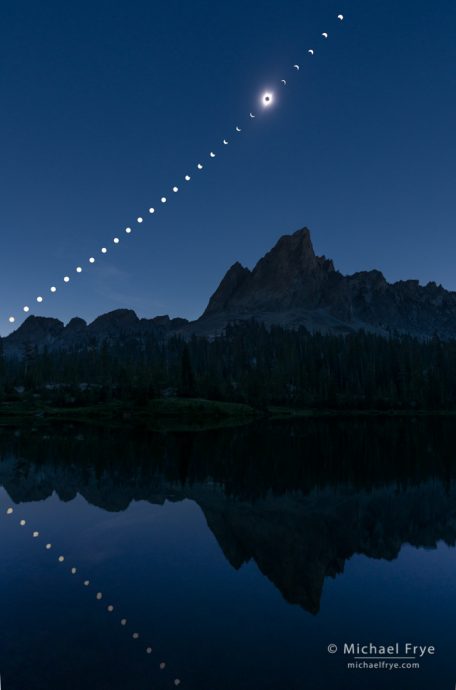
Solar eclipse sequence, Sawtooth Mountains, ID, USA, August 21, 2017
Watching the eclipse was an amazing experience. But for Claudia and me, getting to that moment was quite a journey.
I first heard about this eclipse several years ago, and started making plans to photograph it. But I didn’t make any reservations because I wanted to stay flexible, and be able to go where the weather looked best.
Months ago I virtually scouted locations along the eclipse path using online photographs, Google Earth, and The Photographer’s Ephemeris 3D. I knew that thousands of people would capture beautiful, closeup photographs of the eclipsed sun. But I’m a landscape photographer, and wanted to incorporate the eclipsed sun into a wider scene. As I wrote in my last post, that was difficult to do with this eclipse, because the sun would be so high in the sky. You needed something tall in the foreground, or else you had to get the camera down low and look up at a foreground object.
(more…)
by Michael Frye | Aug 13, 2017 | Advanced Techniques, Photography Tips
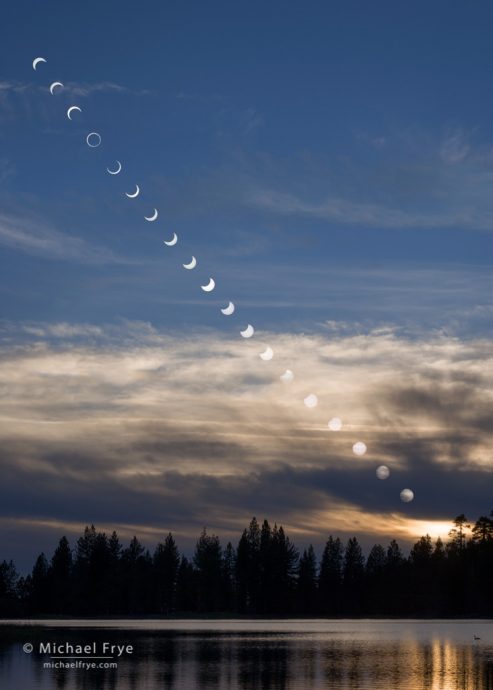
Sequence showing the annular solar eclipse, May 20th, 2012, from Manzanita Lake, Lassen Volcanic NP
The total solar eclipse in the United States is just over a week away (August 21st), and eclipse mania is sweeping the nation. There are many, many articles on the internet describing how to photograph the eclipse (this one by Todd Vorenkamp on the B&H website is the best I’ve found), but I’ll try to cover some topics that haven’t been discussed much elsewhere.
(more…)
by Michael Frye | Aug 6, 2017 | Night Photography, Reviews
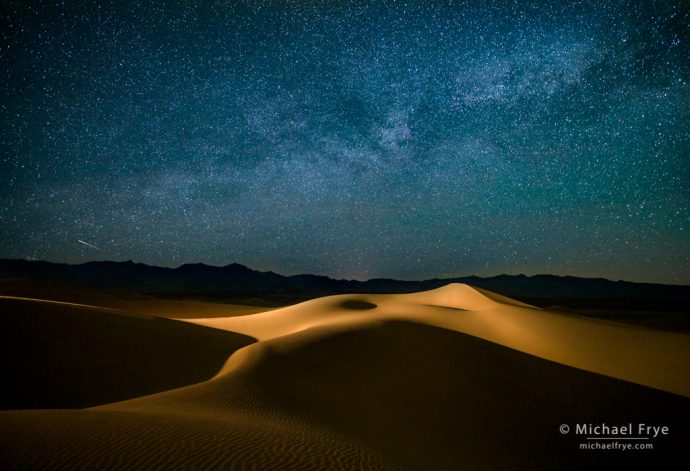
Milky Way over sand dunes, Death Valley. I was puzzled by talk about the “star-eater” issue with Sony cameras, since all my nighttime photos made with my a7R II showed plenty of small stars – including this image made in April from Death Valley.
There’s been a lot internet chatter lately about the so-called “star-eater” issue with Sony cameras. If you haven’t heard of this, last August Sony issued a firmware update for the Mark II versions of all its full-frame E-mount cameras (a7 II, a7s II, and a7r II), and many people have reported that since then these Sony models have been making smaller stars disappear in nighttime photographs. It seems that the new firmware included some kind of noise-reduction algorithm (even with Raw files) that blurred or eliminated those smaller stars. And, unfortunately, there’s no way to revert these cameras to the previous firmware version. In June of this year Sony released new firmware updates for these models, but some initial reports indicated that this new firmware didn’t fix the “star-eater” issue.
(more…)
by Michael Frye | Aug 3, 2017 | Night Photography
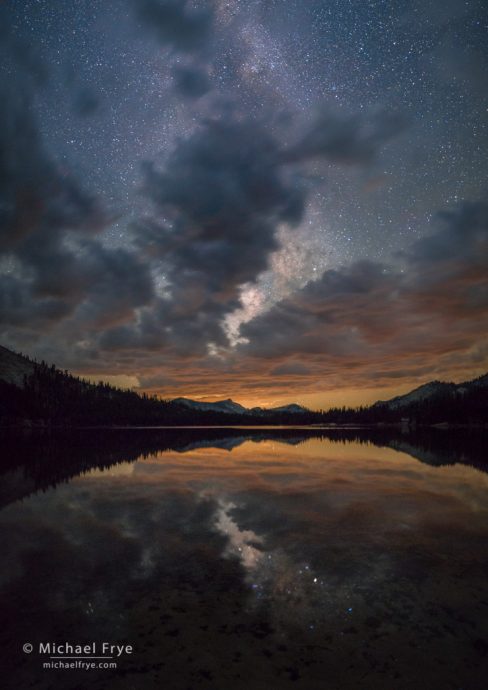
Clouds and Milky Way reflected in Tenaya Lake, Yosemite. A four-frame vertical panorama stitched together with Lightroom’s Panorama Merge; each frame was 20 seconds at f/2.5, ISO 6400.
On the first night of our recent Starry Skies Adventure workshop we started at Olmsted Point in the Yosemite high country. We had beautifully clear skies at first, despite our proximity to the Detwiler Fire. And the early-evening winds died down, making our group feel warmer, and also creating a chance to photograph reflections in nearby Tenaya Lake.
Before we headed to the lake some clouds started moving in from the east, but I didn’t mind. I love photographing nighttime skies with a mixture of stars and clouds. And that’s what we found when we got to the lake, with the underside of the clouds catching an orange glow from the lights of the Central Valley. Better yet, the wind was calm and the water still, creating beautiful reflections.
(more…)
by Michael Frye | Jul 30, 2017 | Light and Weather, Night Photography
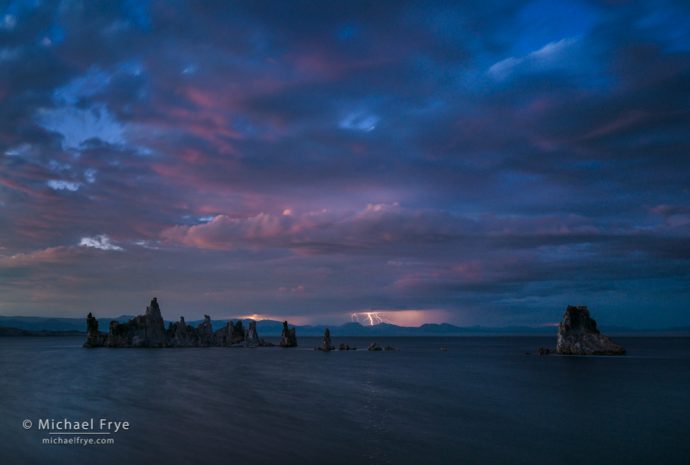
Lightning at dusk, Mono Lake (35mm, 30 seconds at f/5.6, ISO 250)
The Detwiler Fire is now 85% contained, and emitting little smoke. As I mentioned in my last post, Claudia and I never felt that our house was in serious danger, but sadly, 63 homes were destroyed in the fire. None of our friends lost their homes, which we’re grateful for, but we feel for those who did lose their homes, even though we don’t know them. I’m sure that’s a very tough thing to go through. It is heartening, however, to see the community come together to help those who lost their homes.
The fire started a week before our Starry Skies Adventure workshop on the eastern side of the Sierra. Initially the fire was spewing out tons of smoke, and sending it over the mountains to the east, so Yosemite and the Mono Lake area were pretty socked in. But as the week wore on the smoke diminished, and by the time our workshop started the skies were remarkably clear.
(more…)