by Michael Frye | May 19, 2021 | Light and Weather
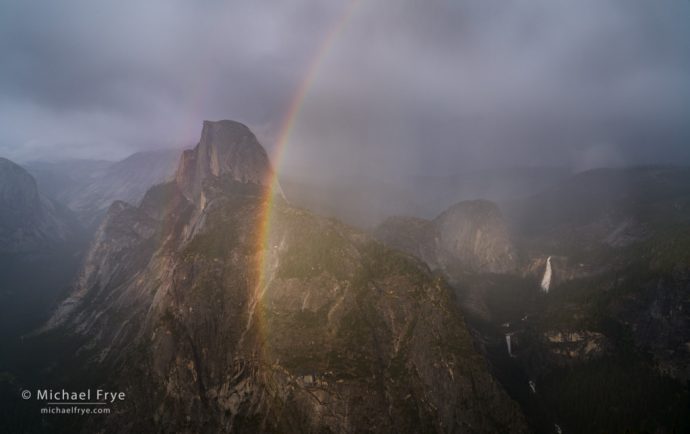
Half Dome, Nevada Fall, and rainbow, Yosemite. I made this photograph shortly after the rainbow first appeared. 28mm, 1/4 sec. at f/11, ISO 100, polarizer.
It’s fun getting wet. Seriously – ask any kid. And for photographers, sometimes you need to stand in the rain, or the spray of a waterfall, to see some dramatic light – including rainbows.
Last weekend a small low-pressure system moved through our area, and forecasts called for some afternoon thunderstorm activity. It looked like the best chance of rain was Sunday, so Claudia and I made our way up to Yosemite Valley that afternoon.
(more…)
by Michael Frye | May 9, 2021 | Yosemite Photo Conditions
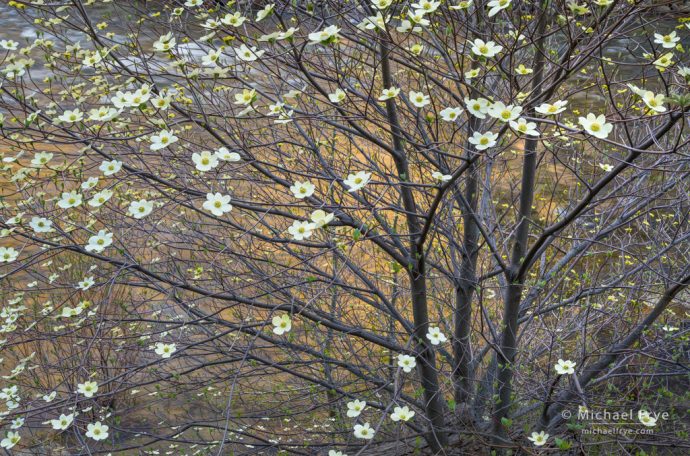
Dogwood above the Merced River, Yosemite. To find this composition I used my iPhone to “sketch” different possibilities. The composition I liked best required holding the phone high over my head, but luckily my tripod went high enough to put my Sony camera up there. 50mm, 1/3 sec. at f/16, ISO 100, focus stacked.
Despite the dry winter – or maybe because of it – it’s been a good year for dogwoods. These things always vary, of course, because that’s the way nature works. The relationships between plants and their environment is incredibly complex. Weather is a big factor, including moisture, temperature, and sunlight. But every plant is affected by soil, by microorganisms in the soil, by animals (especially insects) that want to feed on it, by animals that feed on the animals that want to feed on it, by animals that might pollinate its flowers, and by neighboring plants it competes with, or, sometimes, cooperates with. And the way each plant responds to all those factors is influenced by its own genetics.
Which is to say that not every dogwood lives under the same conditions, and even if they did, they wouldn’t all respond to those conditions in the same way. So when I say that it’s been a good year for dogwoods, it would be more accurate to say that it’s been a good year for many dogwoods, though not all. Some have produced average or below-average blooms. But this year many dogwoods have produced above-average blooms. Some are incredibly full, to the point where it’s hard to imagine where another blossom would fit.
(more…)
by Michael Frye | May 2, 2021 | Light and Weather
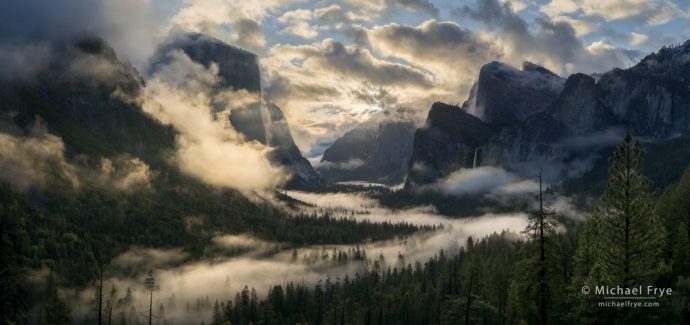
Clearing spring storm, Tunnel View, Yosemite, Monday morning
Last Sunday, for the first time in over a month, we got some significant rain. Well somewhat significant anyway – half an inch.
It looked like the storm would clear around sunrise on Monday morning, which could be good timing. I drove up to Yosemite Valley early, and, as I often do, went to Tunnel View to get an overview of the valley and assess the conditions.
And the conditions looked promising, with lots of mist, and some higher clouds that could light up at sunrise.
(more…)
by Michael Frye | Apr 30, 2021 | Light and Weather
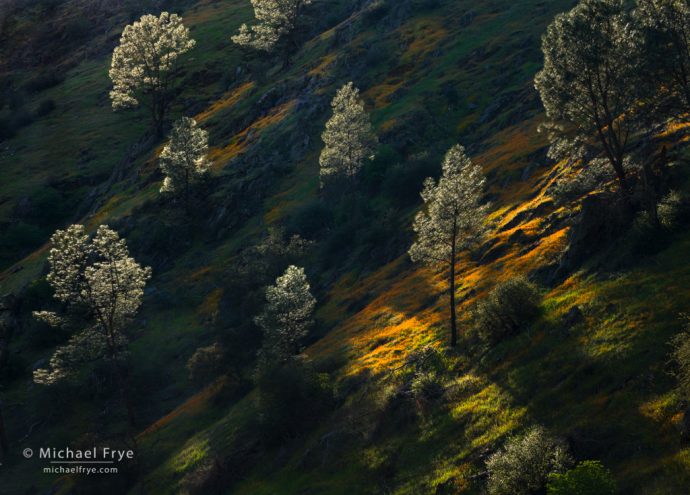
Poppies and foothill pines, Sierra Nevada, California. 91mm, 1/60 sec. at f/11, ISO 100.
We didn’t get any storms here in the Sierra between mid March and late April, and therefore no chance to photograph interesting weather. So what else could I photograph? What was happening that might provide opportunities to make a compelling photograph? Well it’s spring, so… flowers? That would seem logical.
But by California standards, it hasn’t been the greatest year for wildflowers. We had a dry winter, so the desert and semi-desert areas that sometimes display vast carpets of flowers have stayed brown. No “superbloom” (a word that seems to get applied to any above-average wildflower season these days).
Yet Claudia and I managed to find some beautiful patches flowers in the Sierra foothills. Around here, sometimes drier years produce good blooms, while in wet years the grasses can quickly grow tall enough to crowd out the flowers.
(more…)
by Michael Frye | Apr 20, 2021 | Digital Darkroom, Vision and Creativity
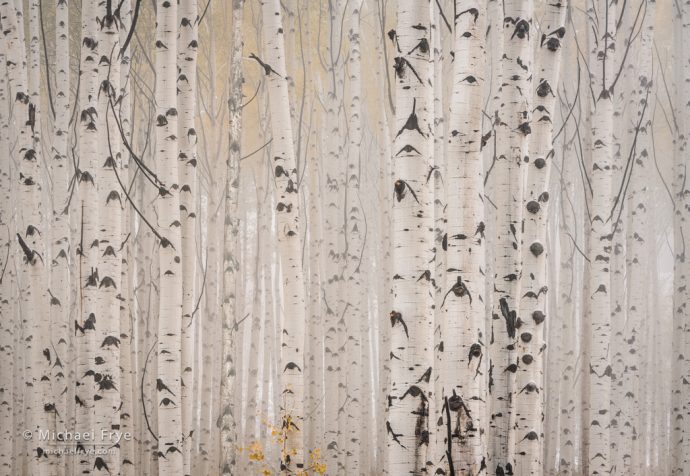
Aspens in fog, White River NF, Colorado. I used a bit of negative Dehaze to slightly soften this image.
In preparing my recent presentation for the Out of Chicago Live conference, I was digging through my archives for examples to use, and found some interesting images I had overlooked. In some cases I had put them aside, too busy to process them at the time, and then just forgot about them. In other cases I think my perceptions had changed. And sometimes I could see the potential to process an image differently, using new tools and new skills.
One of those tools is the Dehaze slider in Lightroom. It’s not that new (2015), but didn’t exist when I initially processed some images, and can sometimes make a big difference – especially with fog. I’m a big fan of fog for forest scenes, and these days I’m often using Dehaze selectively with the Adjustment Brush to cut through fog in one part of an image, or thicken fog in another area to hide or deemphasize something. (Just to be clear, you can’t create fog where none existed; there has to be some fog to begin with. But you can make some tenuous fog look a little more substantial. I show how to do all this in my latest Lightroom course, Landscapes in Lightroom: Advanced Techniques.)
(more…)