In the Moment:
Michael Frye's Landscape Photography Blog
by Michael Frye | Oct 4, 2021 | Travels and Stories
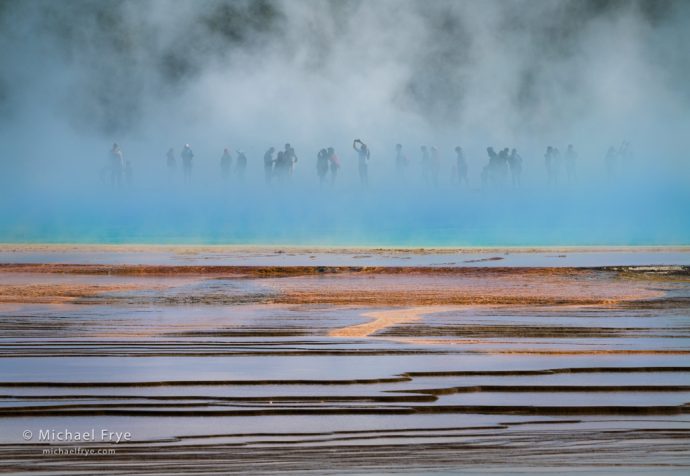
People in the blue mist, Grand Prismatic Spring, Yellowstone
Thermal areas in Yellowstone are often quite colorful. Bacteria form extensive mats in shades of orange, red, yellow, and green, while deep pools become vivid blue, or blue-green.
Viewed from the distance on a sunny day, the steam rising from these pools can look blue, or blue-green, as sunlight hits the water and bounces up into the mist. Sometimes the mist along the edge of a pool turns orange, reflecting the color from one of those bacterial mats.
The grandaddy of these pools is Grand Prismatic Spring. Driving past Grand Prismatic Spring on a sunny day you can see vivid blue and orange mist rising from the pool – an amazing, surreal sight.
(more…)
by Michael Frye | Oct 1, 2021 | Travels and Stories
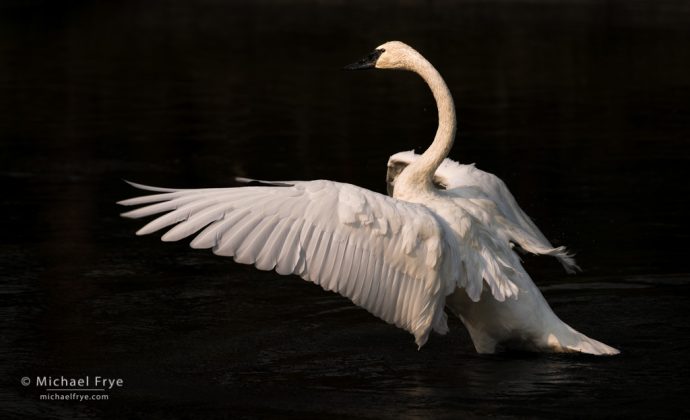
Trumpeter Swan, on our first morning in Yellowstone
On our first morning in Yellowstone, as we were driving back to our campsite, Claudia and I spotted a trumpeter swan along the Firehole River. Claudia pulled into a turnout, while I jumped out of the car, grabbed my camera and 100-400mm zoom, and walked back along the river toward the swan. Our friends Charlotte and Gary Gibb soon pulled into the turnout behind Claudia.
I wasn’t sure, at first, how skittish the swan might be, so I approached cautiously. But I needn’t have worried, as it soon became apparent that the swan was completely unafraid of people. It was feeding along the opposite bank of the river, with messy logs and branches behind it. Then it swam right toward me, stopped in the middle of the river (with a perfect dark background behind it), flapped its wings, and settled down to start preening. Claudia, Charlotte, and Gary witnessed this from the turnout and insisted that the swan was performing for me, but I think it was just random coincidence.
(more…)
by Michael Frye | Sep 26, 2021 | Light and Weather, Travels and Stories
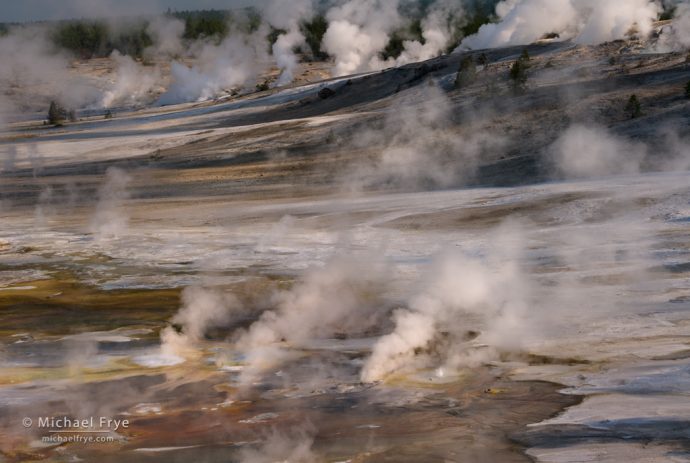
Steaming earth, Yellowstone National Park
Last spring I did a presentation for Out of Chicago Live called The Dynamic Landscape. It’s a topic I’ve been thinking about for awhile, because I realized that I view the landscape not as something fixed and immutable, but as as a living, breathing, constantly changing organism.
And that view heavily influences my photography. I respond to the changes around me with my feet, my eyes, and my camera as I adapt to light, weather, and other conditions.
(more…)
by Michael Frye | Sep 11, 2021 | Travels and Stories
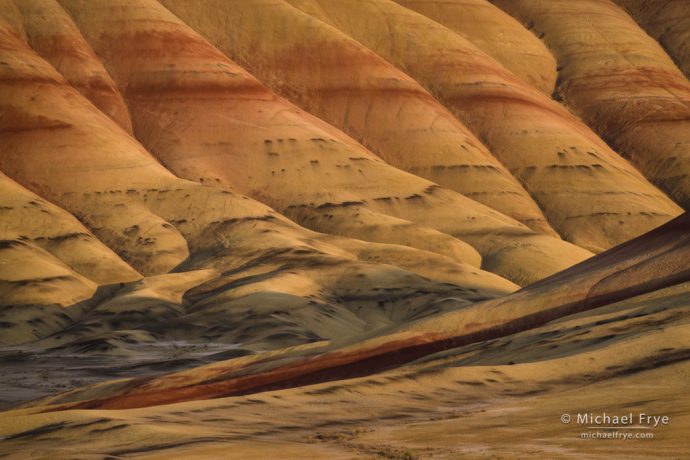
Late-afternoon light, Oregon badlands
Claudia and I are in the middle of a long camping trip. We started in Oregon, then moved to Idaho, and for the last ten nights we’ve been in Yellowstone.
One of our stops was in the badlands of eastern Oregon. These badlands encompass a small area, but they’re colorful, and full of beautiful patterns. I love patterns, as you probably know, so I was like a kid in a candy store, finding new compositions everywhere I looked. I used telephoto lenses almost exclusively, picking designs out of the sculpted earth.
(more…)
by Michael Frye | Aug 15, 2021 | Night Photography
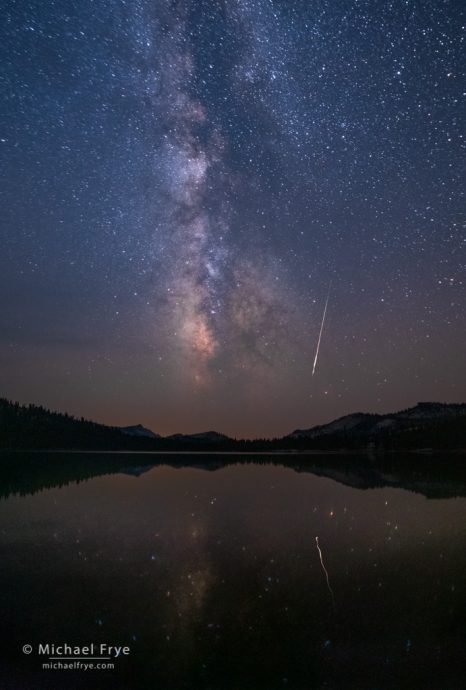
Milky Way and meteor reflected in an alpine lake, Yosemite NP, California. The meteor’s reflection is squiggly because the water was slightly rippled. I blended 20 exposures (each 16mm, 30 seconds at f/4, ISO 6400) with Starry Landscape Stacker to reduce noise. That kind of blending wipes out short-lived light sources, like car headlights or jet trails, which is usually a great thing. But in this case it also wiped out the meteor and its reflection, so I took that one meteor frame into Photoshop, and blended it with the TIFF output from Starry Landscape Stacker to create the final image.
On Thursday evening Claudia and I decided to head up to Yosemite to watch the Perseid meteor shower. Although you can see more Perseid meteors during the early-morning hours, we knew from previous experience that those early-morning meteors rain down from directly overhead, so although numerous, their paths are short. But during the evening you’re much more likely to see an “earth-grazer” – a meteor that glances across the atmosphere at an angle, making a long, bright streak through the sky. So although evening meteors are less abundant, the ones you do see are often more spectacular.
We made our way to a high-country lake. I set up my camera, then we laid out our stadium chairs to watch the show. Only it wasn’t much of a show at first. For a long time we saw no meteors whatsoever, earth-grazers or otherwise. Finally we saw some small ones. And then, eventually, I saw a big, bright, beautiful earth-grazer streak across half the sky. But Claudia missed it. Eventually we saw a few more earth-grazers, though none as bright as that first one.
(more…)