by Michael Frye | Jun 13, 2013 | Digital Darkroom
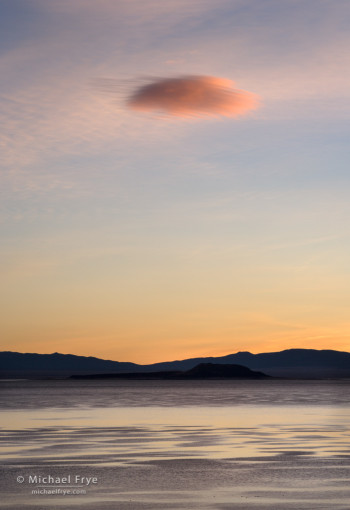
Lone cloud at sunrise, Mono Lake, CA, USA
There’s been a lot of internet discussion lately about the new Adobe Creative Cloud. If you haven’t heard about this, Adobe decided that it will offer its Creative Suite applications only by subscription. You can get the whole suite (including Photoshop, InDesign, Illustrator, Dreamweaver, etc.) for $50 a month, or an individual application for $20 a month. They’re offering first-year discounts for people who own a license to any CS3 or later application.
On the positive side, subscribers will get regular updates to the software when new features are ready, rather than having to wait for a new version to come out. On the other hand, $20 per month for an application represents a substantial price increase. The last Photoshop upgrade was $199. Since the original Photoshop CS came out in 2003, Adobe has upgraded Photoshop, on average, every 20.6 months. If that pace of innovation continued, a $199 upgrade price would average out to around $10 per month – or half as much as they’re asking for a Creative Cloud subscription to a single application.
I might be able to live with the price, but here’s the worst part: if you stop your subscription at any time, you can’t use the software anymore.
(more…)
by Michael Frye | Apr 9, 2013 | Reviews
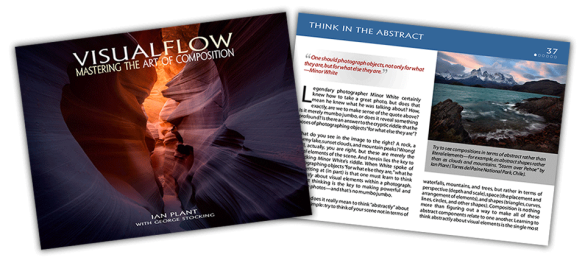
Some interesting books have been released recently that I think my readers might be interested in:
Visual Flow: Mastering the Art of Composition
by Ian Plant, with George Stocking
287 pages
24.95
Visual Flow: Mastering the Art of Composition is an ambitious eBook that delves deeply into what could be the most important aspect of photography: composition. But composition is a difficult subject to talk about, and teach, because of its complexity. Every situation a photographer encounters is different, and no rules or formulas can encompass all the variables.
Ian puts this well: “The ‘rules’ do not dictate whether a composition is good or not; rather, a composition either works or it doesn’t, and the ‘rules’ are merely an attempt (with the benefit of 20/20 hindsight) to assess common features of successful compositions. This is vitally important to remember: the ‘rules’ flow from successful compositions, not the other way around.”
I couldn’t agree more, and Ian and I are in complete agreement about this too: “Learning to think abstractly about visual elements is the single most important thing you can do to improve your compositional skills.” The less you think about the subject, and the more you think about the underlying abstract design – the lines, shapes, and patterns – the better you compositions will be.
(more…)
by Michael Frye | Mar 29, 2013

The Zone System Scale
Here’s how to test your camera’s actual dynamic range. Start by photographing a textured wall, like I did to create the swatches for the eleven zones shown here and in the Zone System article. Use a telephoto lens so you can fill the frame with a relatively small part of the wall. The color and tone of the wall don’t matter, as long as it’s not a highly-saturated color, like a bright blue or red; just make sure the area you photograph is all in the same light – all the shade or all in the sun. Use a tripod to make sure that the framing is consistent.
Make sure your camera is set to capture Raw images. Use manual exposure mode, the camera’s native ISO (usually 100), and set the camera to it’s Standard Picture Style or Mode. Pick a middle aperture, like f/11. Start by testing shadow detail: spot meter the brightest part of the wall (if there’s any variation) and place this on Zone 3 by using a shutter speed two stops faster than the meter indicates, or simply turning the shutter speed dial until your camera’s exposure scale indicates -2.0.
Make your first exposure, then use your shutter speed dial to make an exposure ⅓ of a stop darker (or ½ a stop if you have your camera set to use ½ stop increments), then ⅓ stop darker again, and so on, all the way until you get to Zone 0 – five stops under the meter reading.
Then test highlights: make a Zone 7 exposure at +2.0, or two stops lighter than the meter indicates, then go ⅓ (or ½) stop lighter, ⅓ lighter again, and so on until you get to Zone 10 – five stops lighter than your meter indicates.
Then take those images into your favorite Raw-processing software, but don’t erase the memory card (you’ll want to compare the images on the back of the camera to the images in your Raw-processing software). Then see what you can get out of the highlights and shadows. This part gets a bit tricky, because there are so many programs available, and they all behave differently. There’s also a lot going on under the hood: in every Raw processor, contrast is added to the files by default. Also, in Lightroom 4 and Adobe Camera Raw 7, overexposed highlights are recovered automatically (if possible), and the black point is adjusted automatically to improve shadow detail (if necessary).
To evaluate your camera’s true dynamic range, start by eliminating the extra contrast that the program adds by default. I can’t speak intelligently here about the settings in Aperture, Capture NX, or Capture One, but in Lightroom 3 (or earlier) and Adobe Camera Raw 6 (or earlier), set the Contrast to 0, and the Point Curve to Linear. In Lightroom 4 or Adobe Camera Raw 7, set Contrast to -33. (There’s also extra contrast baked into the “Linear” Point Curve in Lightroom 4 and ACR 7, but that’s too complex to get into here.)
Then, for any images that look washed out (this could be at Zone 7 or higher), use your software’s highlight-recovery tool and try to bring back highlight detail, and note at what point this becomes impossible – Zone 8? 8 ½? 9? (Again, in Lightroom 4 and up or ACR 7 and up, highlight recovery is automatic, but you can use the Highlights or Exposure sliders to darken the frames and get a better look at how much detail there really is.) On the other end of the scale, try lightening the frames that are Zone 2 and darker, and see whether you can bring out shadow detail. (In Lightroom and Camera Raw the Exposure slider works best for this, though using the Blacks slider can also help sometimes.) Be sure to zoom in and check for noise.
Here are three test frames I made of a textured wall. The middle photograph was exposed at Zone 5 (that is, at the camera’s meter reading of 1/180th sec. at f/11), and is shown unprocessed, straight out of the camera at Adobe’s default settings. It looks like it should: a Zone 5 middle tone. The image on the left was was exposed at Zone 1 – that is, four stops below the camera’s meter reading; then in Lightroom I pushed the Exposure slider to +4.00 to bring it up to a Zone 5 value. The right-hand photograph was exposed at Zone 9 (four stops above the camera’s meter reading), then darkened to a Zone 5 value in Lightroom with the Exposure slider.

The middle frame was exposed at Zone 5 and is shown straight out of the camera. The left frame was exposed at Zone 1 and lightened four stops using the Exposure slider in Lightroom. The right frame was exposed at Zone 9 and darkened four stops, also using the Exposure slider in Lightroom.
The right and left frames have good detail and texture, despite being underexposed (left) or overexposed (right) by four stops. They do show some color shifting, but remember that you would rarely darken highlights or lighten shadows this much; at most you would might lighten a shadow to Zone 3, or darken a highlight to Zone 7. In either case the color shift would be less noticeable. A zoomed-in look at the left frame does show considerable noise. A close look at the right-hand image reveals that the very brightest areas within the frame are “hot,” but the overall impression is one of texture and detail.
After seeing how much detail you can bring out of your Raw files in seemingly black shadows and washed-out highlights, compare what you see in your Raw-processing software to the same images on the back of your camera. For example, at what point do you see clipping (blinkies, or a spike at the right edge of the histogram) on the camera? Zone 7 ½? Zone 8? How much further beyond that can you recover highlight detail in software? At what point does your histogram show shadow clipping, and how far below that can you bring out useful shadow detail in software?
If you’re really anal about this stuff (I mean, really committed to gathering precise information!), do the same test at higher ISOs. A camera’s dynamic range decreases as the ISO goes up, plus, of course, shadow noise gets worse.
Now, armed with this knowledge of your camera’s true, usable dynamic range, you have a framework for understanding image contrast, and can make informed decisions about exposure in the field. For example, if you know that you can recover highlight detail at Zone 9, when photographing a high-contrast scene you can spot-meter the brightest highlight and place it at Zone 9 (+4.0). By pushing the exposure as light as possible, you’ll get as much noise-free shadow detail as possible, and in most cases be able to work with one frame, rather than using HDR or other exposure-blending methods.
There is, however, a caveat: recovered highlights don’t have as much information as regular highlights that fall within the camera’s normal dynamic range. In order to recover highlight detail, the software may take information from only one or two color channels, rather than all three, and use that incomplete information to reconstruct what should be in the highlights. That sometimes creates problems, especially with colored highlights. I would never push an orange or pink sunset-colored cloud to Zone 9. I keep colored highlights at Zone 8 or even Zone 7. In general, be conservative about pushing highlights too far until you’ve tested your camera in a variety of actual field situations.
Okay, that’s it – have fun testing your camera!
by Michael Frye | Jan 28, 2013
Speed Up Your Lightroom Workflow
I’ve been using Lightroom since Adobe released the beta version in 2006. Over the years I’ve learned many shortcuts, and in this video I share some of my favorite tips – things I use all the time to streamline my workflow:

We will never sell or share your email address with anyone. Read our complete Privacy Policy.
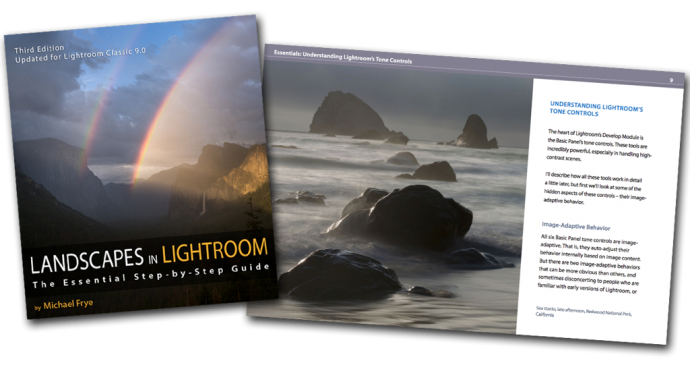
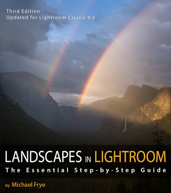
The latest update to my course Landscapes in Lightroom: The Essential Step-by-Step Guide is now available! This new edition is revised and updated for Lightroom Classic CC, and includes a brand new example where I take you step-by-step through processing a Milky Way photograph, plus six new videos about the Range Mask, the Profile Browser, fixing coma, removing color fringing around stars, and more.
Of course this new version still has all the features that made the first edition so popular. First, you can download the original Raw files used as examples in the ebook, and then follow along with each step yourself – just as if you were attending one of my workshops.
Second, when you purchase the ebook you get exclusive access to 17 videos demonstrating different aspects of Lightroom’s Develop Module, like using the Adjustment Brush, Spot Removal Tool, and Point Curve, advanced retouching in Lightroom, the HDR Merge, the Range Mask, and much more. It’s great to read about a tool or technique; it’s even better to watch a demonstration, and then try it yourself on the same image.
Learn more…
I’m absolutely loving everything about your book! It’s fantastic on all fronts.
And your videos are a gigantic bonus; extremely helpful. I love the clarity of your instructional style.
I just wanted to drop you a quick note to tell you that I purchased your ebook and it is excellent. I’m an experienced LR user however I have learned a number of new things in your ebook. Your teaching style is excellent and your photography is outstanding. I would highly recommend this ebook to anyone looking to improve their image processing in LR.
I want to thank you for your “Landscapes in Lightroom″ ebook. I will mirror Scott Oberle’s comments about having watched lots of videos & instructions, including Adobe’s, on Lightroom. Previously, before your e-book, I felt like I was still stumbling around the Develop Module without understanding “what” I was trying to accomplish, but more importantly, the “why and how” I was doing something to the image. Your e-book made it very clear. I’ve gone from dreading post-processing to actually enjoying it, because now I evaluate an image, and THEN decide HOW I want to change it.
Feed Your Creative Vision
I love to share my knowledge of photography and help others express their photographic vision. Here’s what you’ll get when you subscribe to my blog:
– Landscape photography tips
– Video tutorials
– Popular photo critique series
– Yosemite photo updates
by Michael Frye | Sep 27, 2012 | Advanced Techniques, Night Photography, Photography Tips
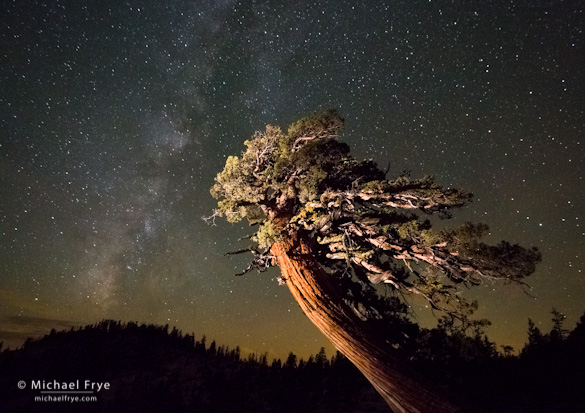
Sierra juniper and the Milky Way, Olmsted Point, Yosemite
Gear Doesn’t Matter—Except When it Does
Regular readers know that I’m not much of an equipment geek. It’s not that I don’t think equipment is important—a photographer needs good tools. It’s just that I think light, composition, technique, vision, and imagination are more important. In other words, how you use the tools is more important than what tools you use.
But sometimes the right gear can make a difference. Two weeks ago I was recording video segments for some online courses I’m working on (more about that later!), and needed a digital SLR that could record video—something my trusty old Canon 1Ds Mark II can’t do—for some “through-the-lens” views. So I called up my friend Jim Goldstein. Many of you know Jim through his popular blog and social media streams. Jim also works for Borrowlenses.com, and he set me up with a Canon 5D Mark III for my video shoot, and then asked, “Is there anything else you need?” Hmm… well I’ve been wanting to test the Canon 24mm f/1.4L lens for night photos, so yes, there was something else!
(more…)