In the Moment:
Michael Frye's Landscape Photography Blog
by Michael Frye | Oct 7, 2014 | Travels and Stories
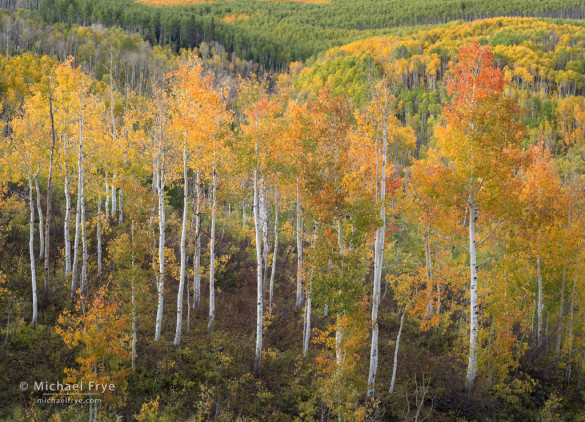
Autumn colors, Gunnison NF, CO, USA
I love photographing aspens. Their autumn color is wonderful, but it’s also those tall, straight, white trunks that make them so compelling.
It’s been a long-time dream of mine to photograph aspens in Colorado in the fall, but various obligations and commitments kept me from going. This year, however, Claudia and I found a brief time slot and decided to go. And we’re so glad we did, as it’s just beautiful here. Some high-elevation areas, like Crested Butte, are past peak, and others seem to be turning late, but we’ve found some wonderful color in several places, and an endless supply of great photo subjects. Here are some photographs from the past few days, and I’ll post more when I get a chance.
(more…)
by Michael Frye | Oct 5, 2014 | Night Photography
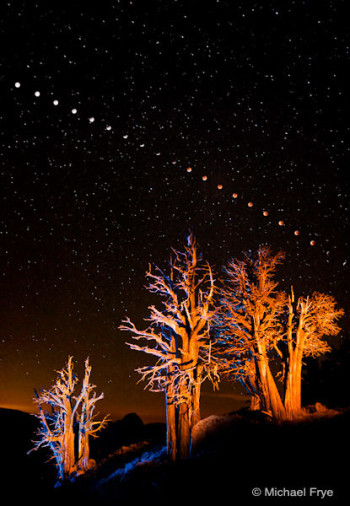
Lunar Eclipse Sequence, 1:23 a.m. to 4:49 a.m., August 28, 2007, Yosemite National Park, California
Lunar eclipses are spectacular events to see and photograph. I’ve been lucky enough to capture several lunar eclipse sequences over the years, including this one from Yosemite in August 2007.
We’re all going to get another chance at photographing an eclipse soon: a total lunar eclipse will be visible throughout North America early Wednesday morning, October 8th.
In the western half of the U.S. the entire eclipse sequence will be visible, from full moon, to partial eclipse, to total eclipse, and back to full again. In California the moon will be high in the sky to the west-southwest at the beginning of the sequence, then sink near the horizon to the west by the end of the sequence. The moon’s path will actually be somewhat of similar to path in this photograph, except that the eclipse will be higher in the sky and a bit further to the right, and the angle of the moon’s path will be steeper.
On the east coast the moon will set when its fully eclipsed, so it won’t be visible as its coming out of the eclipse. But that means the moon will be near the horizon when its fully eclipsed, where you might be able to photograph it next to an interesting foreground object as the dawn lightens the sky. It should be just north of due west as it sets.
For precise guidance about the moon’s position in relation to the landscape, I recommend consulting PhotoPills or The Photographer’s Ephemeris. Here’s the timing for the eclipse:
(more…)
by Michael Frye | Sep 23, 2014 | Yosemite Photo Conditions
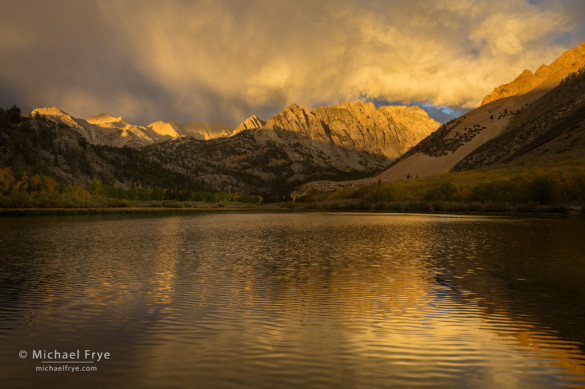
Stormy sunrise at North Lake, Bishop Creek Canyon, Sunday morning
After photographing lightning near Bishop on Saturday night (see my previous post), I thought there might be some interesting clouds still hanging around on Sunday morning, so I woke early and drove up to North Lake, near the upper end of Bishop Creek Canyon.
And there were clouds – almost too many. Another small rain squall was moving up from the south along the Sierra crest, approaching Bishop Creek Canyon just as the sun was due to rise. There were enough clouds to the east that I thought they might block the light. And I think some clouds lingering over the White Mountains did block the very first sunlight, but just after sunrise some clouds started to turn color overhead, and soon the peaks began to light up as well.
It evolved quickly into a dramatic scene. It was a little breezy, rippling the water surface, but there were still nice reflections at first. Then the wind increased, so I climbed up the ridge along the eastern shore of the lake to get a different perspective, one that didn’t depend as much on reflections.
(more…)
by Michael Frye | Sep 22, 2014 | Night Photography
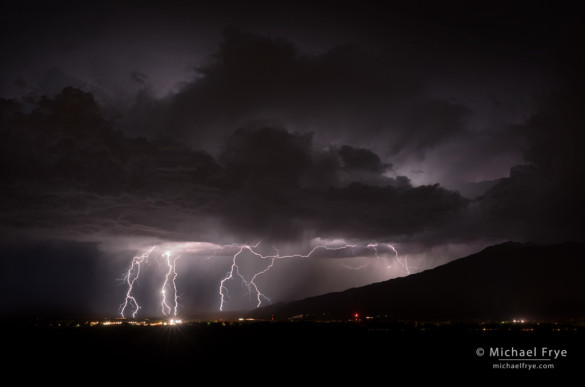
Lightning over Bishop and the Owens Valley, CA, USA
Over the weekend Claudia and I made our annual pilgrimage to the Millpond Music Festival in Bishop, over on the eastern side of the Sierra. This is the 15th consecutive year we’ve attended this festival. Hanging out with friends, listening to music underneath the high peaks of the Sierra, made for a wonderful, relaxing, fun weekend. And as a bonus, I got to photograph some interesting weather.
The land around Bishop is semi-desert, so it doesn’t get much rain. We’ve been sprinkled on a couple of times at Millpond, but had never experienced any serious rain – until Saturday.
A weak low-pressure system pulled some remnants of Hurricane Odile up from the south. Clouds and thunderstorms developed over the mountains, but missed Bishop and the Owens Valley until Saturday evening. As the second-to-last act of the day was performing, a few raindrops fell. I looked at radar images on my phone, and saw some serious-looking storm cells moving right up the valley from the south. I estimated that we had an hour or two before we got dumped on. Figuring that the last performance would be cancelled anyway, I decided to try and get some lightning photographs.
(more…)
by Michael Frye | Sep 9, 2014 | Night Photography
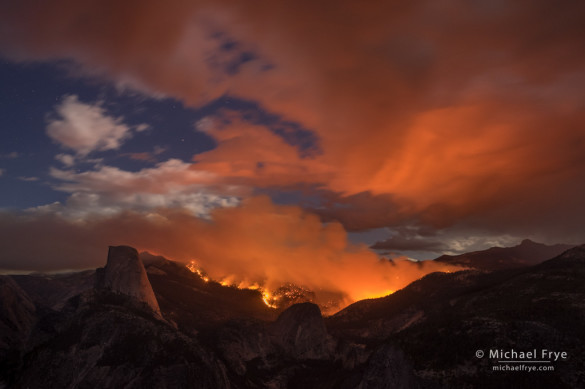
Meadow Fire burning in Little Yosemite Valley at night, with Half Dome on the left, Yosemite; 9-7-14, 8:44 p.m.
Sunday afternoon Claudia and I saw dramatic images on the Yosemite webcams of a fire in Little Yosemite Valley. We’ve had many fires around here the last two summers, and I’ve made plenty of fire photographs. But how often can you photograph a fire next to Half Dome? We decided to head up to Washburn Point (near Glacier Point) to take a look.
The origin of this fire is officially under investigation. The park service has been letting the lightning-caused Meadow Fire burn for awhile, and it’s likely that embers from the Meadow Fire were picked up and blown into an area with heavy fuels, then were fanned by the wind. But it’s also possible that this is a new fire with an unknown cause.
In either case, the winds caused this fire to blow up suddenly Sunday at about 12:30 p.m., closing all the trails in and around Little Yosemite Valley, and forcing the park service to evacuate 50 hikers from the top of Half Dome by helicopter! A big news story, as you can imagine. As of yesterday, the fire was estimated at 2,600 acres. They’re using helicopters, air tankers, and ground crews to contain it. All the park roads and facilities are open, and fortunately no one has been injured by the fire.
There were quite a few photographers at Washburn Point Sunday night, and no wonder – the fire was a spectacular sight. Moonlit clouds kept streaming in from the south, and several times we saw lightning in the distance. Two separate rain showers just missed us, but passed directly over the fire. The first shower seemed to noticeably dim the flames. After the second, heavier shower, a large bank of fog rose up, obscuring the fire and Half Dome. The fog may actually have been steam, created by water hitting the fire. These brief showers didn’t put the fire out, but they probably slowed it down.
(more…)