Night Photography
by Michael Frye | Sep 7, 2014 | Night Photography
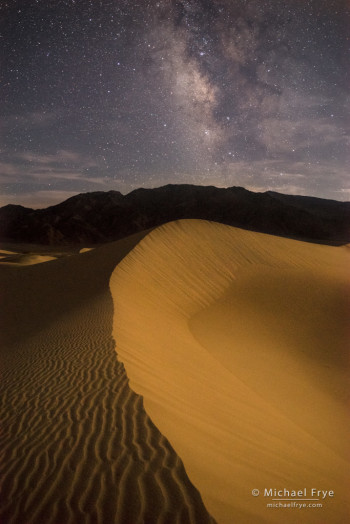
Moonlit sand dunes and the Milky Way, Death Valley. This is the photograph I originally envisioned from Death Valley, with dunes lit by the setting moon and the Milky Way above. (20 sec. at f/2.8, 6400 ISO)
Where do you go to escape the crowds on Labor Day weekend? How about Death Valley, where the temperature was forecast to be 112 degrees! That should keep the tourists away.
Okay, escaping the crowds wasn’t really the motivation for going to Death Valley in August. I had an idea for making a photograph with low-angle moonlight illuminating the sand dunes, and the Milky Way above. The moon had to be in the right phase: too much moonlight and the sky would become washed out, obscuring the Milky Way and most of the stars; too little and you wouldn’t see the effect of the moonlight on the dunes.
The moon also had to be far enough from the Milky Way to keep the moon itself out of the photograph, as it would be impossible to properly expose both the moon and the landscape in the same frame. The moon also needed to be close to the horizon, and off to the side (with the camera pointed at the Milky Way), as that low-angle sidelight would emphasize the form and texture of the dunes.
Not long ago I wrote about two apps for forecasting the position of the Milky Way and moon, PhotoPills and Star Walk. Consulting both of these apps I had figured out that the moon and Milky Way would be in the right position for the photograph I had in mind on the Friday and Saturday before Labor Day. And the next time the moon and Milky Way would be in a good position for this would be… next April, or even May. I decided to brave the heat rather than wait.
I had initially planned to go to Death Valley on Friday, but a thick bank of high clouds moved in – the remnants of Tropical Storm Marie. Since the skies looked clearer further south, Claudia and I kept driving and headed for the Trona Pinnacles.
(more…)
by Michael Frye | Sep 2, 2014 | Night Photography
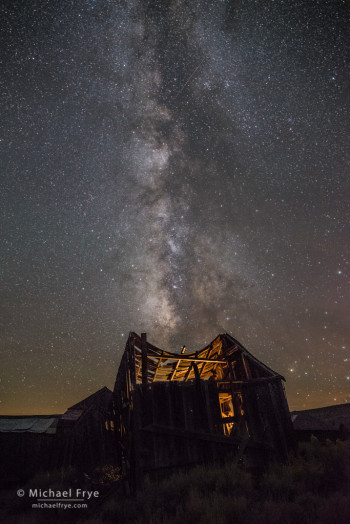
“Swayback” building at night with the Milky Way, Bodie. While helping some members of our group photograph this building I set up my own camera as well. I put tissue paper over a flashlight to act as a diffuser, then stuck my hand through a gap in one of the walls to light the interior of the building during the 20-second exposure for the stars.
As promised, here are some of my recent photographs from Bodie. Bodie, if you’re not familiar with it, is just north of Mono Lake, and is billed as the best-preserved ghost town in the United States. Bodie is now a state park, and a very interesting place to photograph, but it’s usually only open from 9:00 a.m. to 6:00 p.m., which means you can’t photograph it during the best light of the day, much less at night.
A few years ago I was able to photograph Bodie on a moonlit night with Lance Keimig and Scott Martin during one of their workshops. Then, earlier this summer, Claudia and I went to Bodie on one of occasional evenings when the park stays open until 10:00 p.m. This was a moonless night, but since it didn’t get completely dark until about 9:00 p.m. that left only an hour for true night photography. It was still fun, but much too short.
Luckily I would have another chance soon. We had managed to secure a hard-to-get permit to take a workshop group there at night, and added that evening to my Starry Skies Adventure workshop. We had so much fun there with the group. This time we were able to stay until 1:00 a.m., but it wasn’t long enough!
Here’s a selection of both daytime and nighttime images from those recent trips to Bodie. I tried many different ideas, but had to leave other ideas still percolating in the back of my mind, as I just didn’t have time to execute them all. I think there’s so much potential there for creative lighting of both interiors and exteriors, and working with reflections in the old windows. I certainly look forward to going back. If you haven’t been to Bodie, I highly recommend it, even during the middle of the day. And if you get a chance to go in the late afternoon or at night, take it!
— Michael Frye
(more…)
by Michael Frye | Aug 28, 2014 | Night Photography
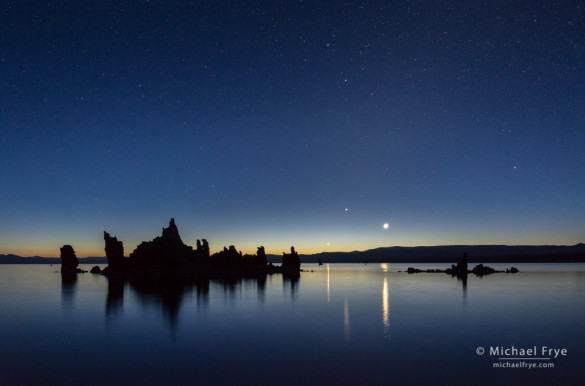
Venus, Jupiter, and the Moon rising at dawn, Mono Lake, Saturday morning
We had a wonderful time during our Starry Skies Adventure workshop last week. We managed to dodge the fires and had four clear, smoke-free nights. It was a really nice group, and photographing under a sky full of stars is always such a great experience.
One of the highlights of the workshop was viewing and photographing a dawn alignment of Venus, Jupiter, and the Moon over Mono Lake last Saturday. It’s hard to convey how gorgeous this was in a photograph, but you’ll find my best attempt above.
We also photographed star trails and the Milky Way, and went to Bodie on our last night. I’ll save the Bodie images for a later post, but you’ll find a selection of other images from the workshop below.
(more…)
by Michael Frye | Aug 14, 2014 | Night Photography
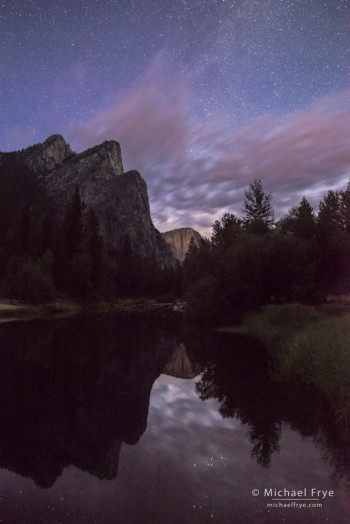
Stars and clouds over Three Brothers, Tuesday evening; 20 seconds, f/2.8, 6400 ISO
Tuesday evening Claudia and I drove to Yosemite Valley. The moon was due to rise about 90 minutes after sunset, so I hoped to photograph the northern end of the Milky Way over Three Brothers, with the rising moon adding a bit of light to the peaks.
We got to the Valley well before sunset, but there were some interesting clouds, so we decided to head to Tunnel View, where we found the usual August assortment of tour buses and people taking selfies in front of the panorama. I photographed some interesting patterns of dappled sunlight and clouds, then, just at sunset, after the crowds had thinned, the sky turned pink and a beautiful array of tufted clouds drifted overhead (below).
We had a little picnic along the Merced River as we waited for the sky to get dark, then I started taking photos of Three Brothers. At first the clouds blocked most of the stars. But the sky gradually cleared, revealing more stars, and then, looking at the photos on my camera’s LCD screen, I could see the clouds taking on a pink hue, and a hint of light on Yosemite Point in the distance. This was the lunar equivalent of a predawn glow, with the moon still below the horizon, but already adding some light and color to the scene. My eyes couldn’t see the color, but the camera could (right).
Later, as the moon rose for real, the clouds and peaks turned gold, just as they would at sunrise. Again, it was too dark for the cones in my retinas to pick up the color, but the camera recorded it perfectly. And some of the cloud formations were spectacular, fanning out in big V shapes above Three Brothers (below).
(more…)
by Michael Frye | Apr 17, 2014 | Night Photography
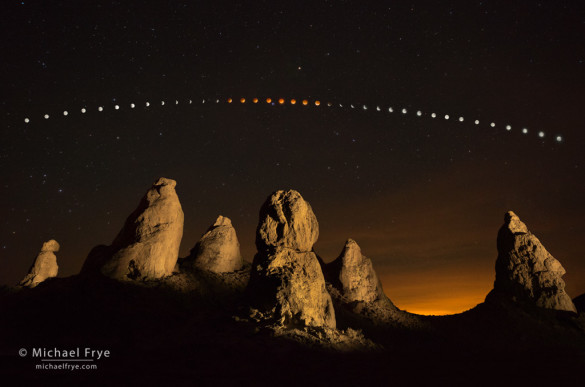
Lunar eclipse sequence, April 14th and 15th, Trona Pinnacles, CA, USA
Monday night’s lunar eclipse didn’t seem to line up well with any of Yosemite’s features, so I started looking for other locations – preferably someplace with clear, dark skies, and an interesting foreground. Death Valley came to mind, but then I thought of the Trona Pinnacles, near Ridgecrest. I’d never been there, but it seemed like an appropriately “lunar” landscape – so much so that the pinnacles have frequently been used to represent alien landscapes in sci-fi movies, including Star Trek V and Planet of the Apes.
Claudia and I drove down there on Monday and arrived about an hour before sunset. And what a great spot! I wondered why it had taken me so long to visit this striking landscape. The pinnacles are actually ancient tufa towers, like those at Mono Lake, left high and dry by the evaporation and shrinking of Searles Lake.
(more…)
by Michael Frye | Sep 27, 2012 | Advanced Techniques, Night Photography, Photography Tips
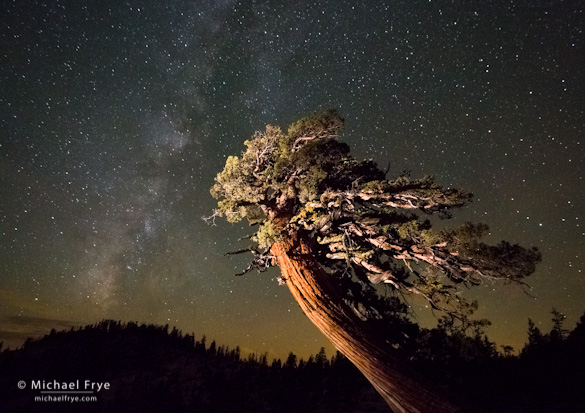
Sierra juniper and the Milky Way, Olmsted Point, Yosemite
Gear Doesn’t Matter—Except When it Does
Regular readers know that I’m not much of an equipment geek. It’s not that I don’t think equipment is important—a photographer needs good tools. It’s just that I think light, composition, technique, vision, and imagination are more important. In other words, how you use the tools is more important than what tools you use.
But sometimes the right gear can make a difference. Two weeks ago I was recording video segments for some online courses I’m working on (more about that later!), and needed a digital SLR that could record video—something my trusty old Canon 1Ds Mark II can’t do—for some “through-the-lens” views. So I called up my friend Jim Goldstein. Many of you know Jim through his popular blog and social media streams. Jim also works for Borrowlenses.com, and he set me up with a Canon 5D Mark III for my video shoot, and then asked, “Is there anything else you need?” Hmm… well I’ve been wanting to test the Canon 24mm f/1.4L lens for night photos, so yes, there was something else!
(more…)