Advanced Techniques
by Michael Frye | Dec 14, 2011 | Advanced Techniques
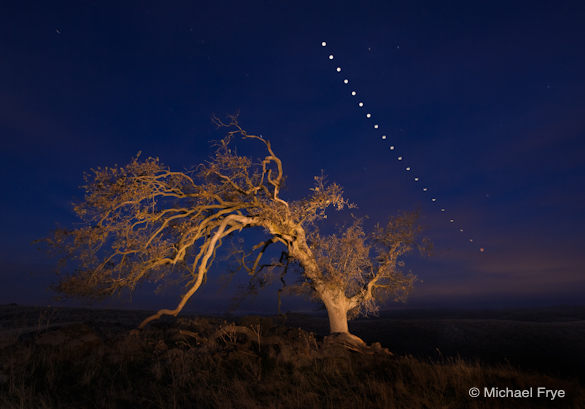
Oak tree and lunar eclipse sequence, December 10th, 2011
For me the hardest part about photographing last Saturday morning’s lunar eclipse was finding a good location. The fully-eclipsed moon would be close to the horizon in the west-northwest, so I needed a clear view in that direction, ideally with an interesting object in the foreground.
No place in Yosemite seemed to fit—too many mountains in the way. But I thought a remote region of western Mariposa County, with rolling hills and scattered oaks, might work. A week before the eclipse I scouted this area and found a photogenic oak tree on top of hill that seemed to line up with the projected path of the eclipse.
Friday night my student Erik and I got a couple hours of sleep, drove out to this spot, hiked up the hill, set up our cameras, and started our interval timers to capture a sequence of moon images ten minutes apart. We had a long wait, but it wasn’t too cold, and we enjoyed our peaceful, moonlit surroundings. A pair of great-horned owls serenaded us, and groups of coyotes howled at regular intervals. At one point Erik watched four coyotes climb a nearby moonlit hill, then saw one of them stop and howl.
(more…)
by Michael Frye | Dec 5, 2011 | Advanced Techniques, Photography Tips
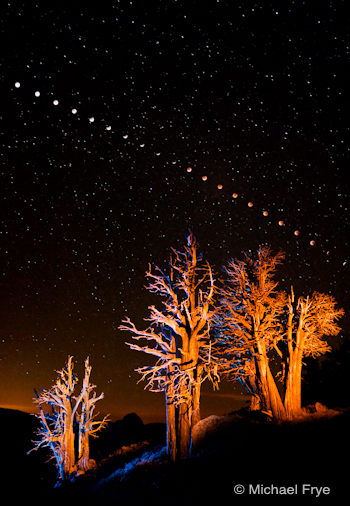
Lunar Eclipse Sequence, 1:23 a.m. to 4:49 a.m., August 28, 2007
Before getting to the topic at hand, I want to let you know that eight people have signed up for the Eastern Sierra Fall Color Workshop since I announced it last Thursday. The limit is twelve students, and I’m sure it will fill up soon, so if you’re thinking about signing up don’t procrastinate!
Okay, on to the eclipse. Before dawn this Saturday, December 10th, viewers in the Western U.S. and Canada will be able to see a total lunar eclipse. If you live in the eastern half of the U.S. unfortunately you’ll only be able to see a partial eclipse. People in most of Europe, Asia, and Australia will also be able to see a total eclipse, though in Europe it will be visible at moonrise on Saturday evening. This NASA page shows where the eclipse will be visible throughout the world, and this page shows more detail for western North America.
Moon Position
If the weather cooperates, and you want to try make your own eclipse photographs, here are some tips. (I’ve copied some of this from my post a year ago, but the information about the moon position is all new.)
(more…)
by Michael Frye | Aug 7, 2011 | Advanced Techniques, Night Photography
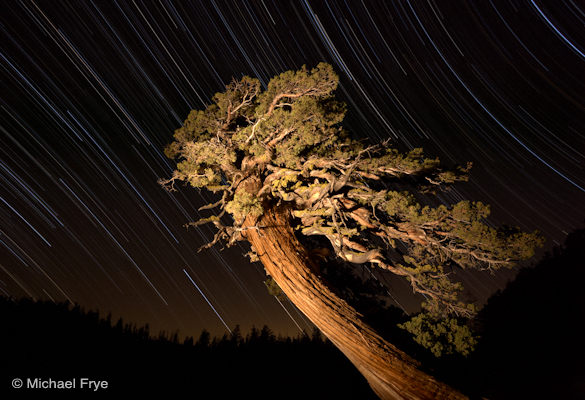
Juniper and star trails near Olmsted Point, Yosemite
Here’s a new image, made last Tuesday evening near Olmsted Point in Yosemite. My friend Mike Osborne calls this the “Bowsprit” tree. What? I didn’t get it either until he explained that a bowsprit is the bent figure with arms splayed back at the bow of old sailing ships. Okay, yeah, this does sort of resemble that.
Anyway, I “painted” this wonderful tree with a flashlight, and used the image-stacking technique to get noise-free star trails. With image stacking the idea is to take a series of short exposures and blend them together, rather than doing one long one. The total exposure time here is about 90 minutes, but one exposure that long would end up being quite noisy. Instead I took 24 four-minute exposures, with only a one-second interval between them. So each of those four-minute exposures has little noise.
(more…)
by Michael Frye | May 11, 2011 | Advanced Techniques, Yosemite Photo Conditions
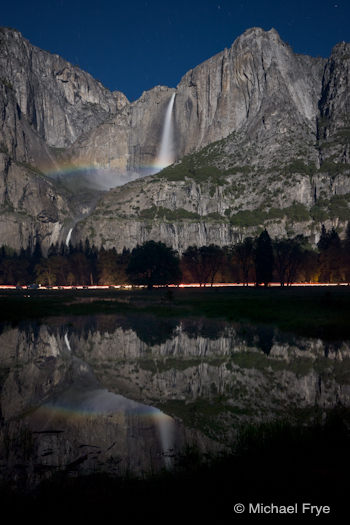
Lunar rainbow on Upper Yosemite Fall from Cook’s Meadow, May 2009
A full moon is coming up—Tuesday, May 17th, at 4:08 a.m. There should be plenty of spray in Yosemite Falls, so once again it should be possible to photograph a lunar rainbow, and I expect that many photographers will be in Yosemite trying to do just that. If you’re one of those people, last year I wrote some lunar rainbow photography tips that you might find helpful.
To learn the best times for photographing the moonbow, visit Don Olson’s web site. Good luck!
by Michael Frye | Jan 6, 2011 | Advanced Techniques, Digital Darkroom, Photography Tips, Video Tutorials
White Balance for Landscape Photographs – Part 3: A Special Problem from Michael Frye on Vimeo.
Here’s the third part of my video series on white balance, where I present solutions to a common problem in landscape photographs—finding the right white balance when mixing low-angle sunlight with blue sky.
If you haven’t seen them already, here are links to Part 1 and Part 2.
To see this video clearly, be sure that “HD” is on (the letters “HD” should be white instead of gray; if not, click on them), and click the “expand” icon just to the right of “HD.”
Hope you find this helpful; I look forward to hearing your comments! And if you like the video, please share the link.
by Michael Frye | Dec 17, 2010 | Advanced Techniques, Photography Tips
Lunar Eclipse Sequence, 1:23 a.m. to 4:49 a.m., August 28, 2007
Before getting to the topic at hand, I want to thank all of you for your support in launching my new eBook, Light & Land. The first day’s sales were amazing, off the charts, so thanks to all of you who bought a copy. And if you haven’t purchased it yet, there’s still time to get 20 percent off. See my last post for details.
So on to the eclipse… I was honored to have this lunar eclipse photo recently selected for the Natural World Exhibit at the Center for Fine Art Photography in Fort Collins Colorado. By coincidence, there will be another full lunar eclipse Monday Night—an opportunity to try making your own eclipse photograph.
Now here in California there are lots of dire weather forecasts for the next few days, with predictions of five to ten feet of snow above 7000 feet in the Sierra Nevada, and five to ten inches of rain in the foothills and Yosemite Valley. Minor flooding is possible. So there’s a good chance that we won’t see Monday night’s eclipse at all. But you never know—all it takes is a small break in the clouds. And those of you in other parts of the world may have perfect weather for this event. To see where and when the eclipse will be visible (weather permitting), visit the NASA web site. (more…)