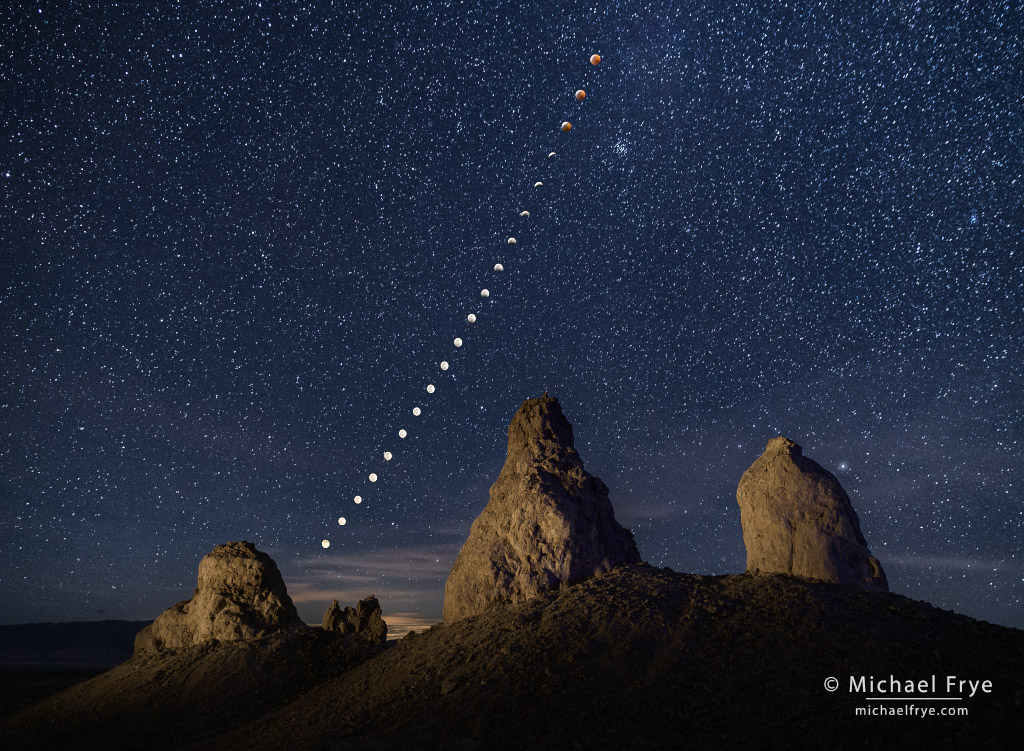
Lunar eclipse sequence, Trona Pinnacles, California, January 20th, 2019
On March 3rd people in many parts of the world (including most of North America, Eastern Asia, Australia, and New Zealand) will be able to see a total lunar eclipse. This page shows where the eclipse will be visible, as well as the timing of the event.
Here in the U.S. the eclipse will occur during the wee hours of the morning on March 3rd. So photographing the eclipse will require losing some sleep, but the fully-eclipsed moon will be fairly low in the sky, making it easier to line up the eclipse with an interesting foreground.
At my house in central California the moon will be totally eclipsed from 3:05 a.m. to 4:02 a.m., starting at 39 degrees above the horizon (to the west-southwest) and lowering to 28 degrees. That’s not super low, but not bad. Farther east, in Chicago, the total eclipse will run from 5:05 a.m. to 6:02 a.m., starting at 14 degrees high and lowering to 3 degrees (totality will end just before sunrise). Even farther east, in Boston, the total eclipse will begin just before sunrise, with the moon barely above the horizon, so you’ll need a clear view of the western horizon to see it at all. (That’s true for many East-Coast locations, especially in the far northeast.)
Planning Eclipse Photos
So how did I figure out where the moon would be for each of those locations? Well there’s an app for that. Actually several apps – and I’m sure most of my readers are familiar with some of them. To me the most useful are PhotoPills, The Photographer’s Ephemeris, The Photographer’s Ephemeris 3D, and Planit Pro.
All of these apps are helpful for photo planning, though they can be complex, so there’s a learning curve for each of them. But do you need to master every feature of these apps to use them effectively? I don’t think so. The vast majority of the time I use a few simple, powerful tools to see exactly where the sun, moon, Milky Way, or any celestial object will line up with the landscape. To me, the most helpful tools are the AR (augmented reality) modes in all these apps, and the VR (virtual reality) modes in The Photographer’s Ephemeris 3D and Planit Pro.
It’s these modes (along with a few other things) that will be the focus of my upcoming webinar, Photo Planning Made Simple. During the webinar I’ll talk about planning for eclipses, of course, (including the upcoming lunar eclipse), but also how to plan for any other situation – sunrises, sunsets, moonrises, moonsets, the Milky Way position, and much more. But we’ll stick to the things you need to know, bypassing the extraneous stuff that only gets in the way.
The webinar is coming up soon – this Saturday! But if you can’t attend live you can still watch the recording later. (The recording will be available indefinitely to everyone who signs up.) Click here to register or learn more:
For the lunar eclipse on March 3rd, here are the important moments:
Partial eclipse begins: March 3rd at 9:50 UT, 1:50 a.m. PST
Total eclipse begins: March 3rd at 11:04 UT, 3:04 a.m. PST
Maximum eclipse: March 3rd at 11:34 UT, 3:34 a.m. PST
Total eclipse ends: March 3rd at 12:03 UT, 4:03 a.m. PST
Partial eclipse ends: March 3rd at 13:17 UT, 5:17 a.m. PST
When the partial eclipse begins the moon will become a smaller and smaller crescent as the earth’s shadow seems to take a bite out of the moon. During the total eclipse the moon will look much dimmer, and turn orange or even red-orange in color. The sky will be full of stars, as if on a moonless night. Just after the total eclipse the moon will return to a slender crescent and then get larger and larger, until the eclipse ends and the moon becomes completely full again. (On the East Coast you’ll only be able to see the beginning of this sequence, up to the total eclipse.)
Of course weather always plays a big role in eclipse photography, so keep an eye on the forecasts, and be prepared to change plans if the outlook doesn’t look good for your planned location.
How to Photograph the Eclipse
I wrote an earlier post that explains in detail how to photograph a lunar eclipse (including exposures for different phases of the eclipse), so rather than repeat all that here, please just follow this link.
Happy eclipse hunting!
— Michael Frye
Related Posts: Photographing the Lunar Eclipse January 20th and 21st; A Lunar Experience
Michael Frye is a professional photographer specializing in landscapes and nature. He lives near Yosemite National Park in California, but travels extensively to photograph natural landscapes in the American West and throughout the world.
Michael uses light, weather, and design to make photographs that capture the mood of the landscape, and convey the beauty, power, and mystery of nature. His work has received numerous awards, including the North American Nature Photography Association’s 2023 award for Fine Art in Nature Photography. Michael’s photographs have appeared in publications around the world, and he’s the author and/or principal photographer of several books, including Digital Landscape Photography: In the Footsteps of Ansel Adams and the Great Masters, and The Photographer’s Guide to Yosemite.
Michael loves to share his knowledge of photography through articles, books, workshops, online courses, and his blog. He’s taught over 200 workshops focused on landscape photography, night photography, digital image processing, and printing.