
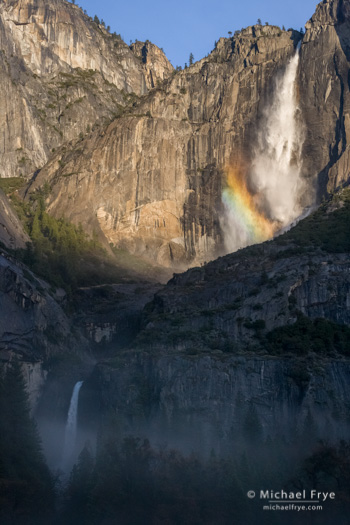
Upper and lower Yosemite Falls with a rainbow
For 20 years my wife Claudia and I lived in Yosemite Village, right underneath Yosemite Falls. In spring, when full from snowmelt, the roar from the fifth-highest waterfall in the world was the background music to our life in Yosemite Valley.
In late summer and autumn Yosemite Falls diminishes, sometimes dwindling to a wet stain on the cliff below Yosemite Point. This year it dried up even earlier than usual, a casualty of last winter’s meager snowfall.
But last week a series of warm, wet storms soaked northern California. Yosemite Valley received almost seven inches of rain between Wednesday morning and Sunday evening. Yesterday, after the storms finally departed, I drove up to Yosemite Valley, stepped out of my car at Swinging Bridge, and heard that familiar sound: the rumble of Yosemite Falls. It’s back, and so are all the other waterfalls in the Valley. It seemed more like May than December, except that the grasses were brown, and the trees were mostly bare with lingering splashes of fall color.
One of Yosemite’s photographic ironies is that in spring, when the thunder of Yosemite Falls rattles windows in Yosemite Village, the sun only hits the fall during the middle of the day. In winter the sun strikes the upper fall with beautiful, warm, low-angle light shortly after sunrise. You can even see rainbows from the right spot. But of course the flow is usually low during these colder months — except, that is, when heavy, warm rains fall, like they did last week.
I headed up to the valley early yesterday hoping to photograph that rainbow with springlike runoff in the fall. Some high clouds threatened to ruin the show, but the sun broke through at the right moment and the rainbow appeared on schedule amid the spray.
Even better, the ground and trees were so thoroughly soaked that low-lying mist covered the meadows, and when the sun hit a group of trees they would start steaming. I spent several hours happily photographing waterfalls, misty trees, swirling foam in the river, and some lingering fall color. Here are a few of my favorites from the morning.
As the runoff from the rains diminishes, and temperatures drop, the water levels will diminish, but we should have above-average flow all winter unless there’s a prolonged dry spell. Snow levels were between 8000 and 9000 feet during the recent storms, but the highest elevations must have received a lot of snow. Let’s hope we get more, and can listen to waterfalls roaring next spring.
— Michael Frye
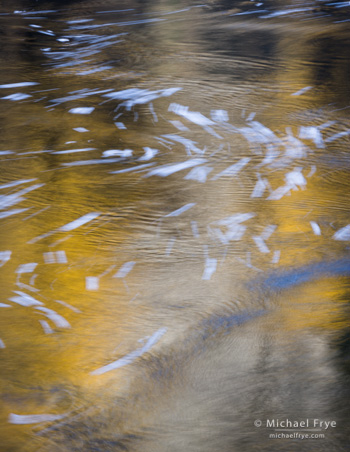
Foam and reflections in the Merced River
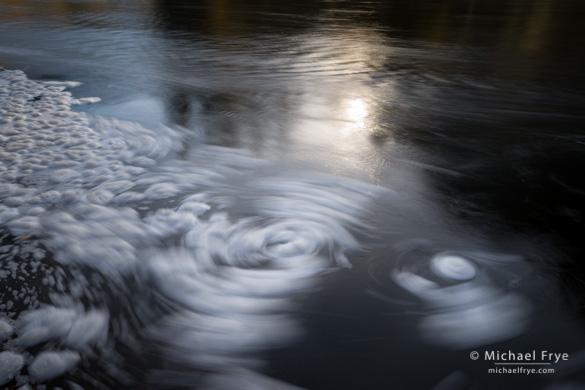
Swirling foam in the Merced River
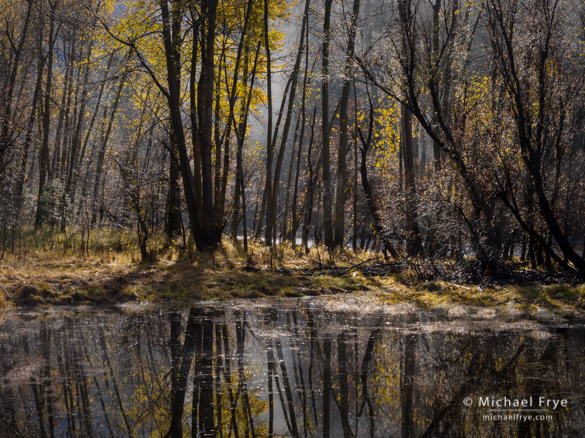
Cottonwoods reflected in a pond
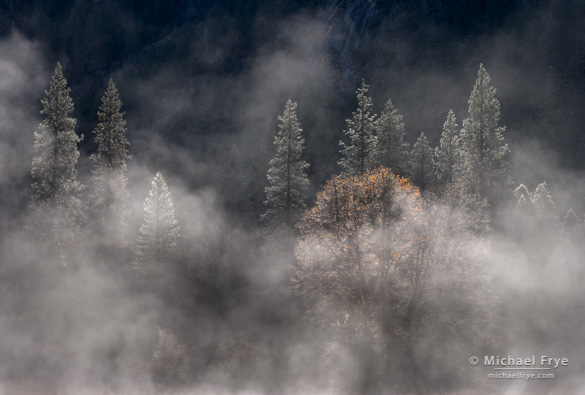
Backlit oak and pines, El Capitan Meadow
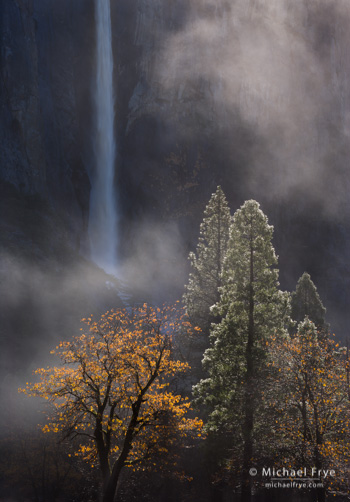
Trees, mist, and Bridalveil Fall
Related Posts: After the Storm, Is There Still Fall Color in Yosemite?; Early November Magic in Yosemite
Michael Frye is a professional photographer specializing in landscapes and nature. He is the author and photographer of The Photographer’s Guide to Yosemite, Yosemite Meditations, and Digital Landscape Photography: In the Footsteps of Ansel Adams and the Great Masters, plus the eBooks Light & Land: Landscapes in the Digital Darkroom, and Exposure for Outdoor Photography. He has written numerous magazine articles on the art and technique of photography, and his images have been published in over thirty countries around the world. Michael has lived either in or near Yosemite National Park since 1983, currently residing just outside the park in Mariposa, California.



Michael – The last two mages in this post are stunning. You have the basis for some outstanding prints, especially with the last image. Thanks for sharing. Frank
Thanks very much Frank! Glad you like the last two.
Michael,
Absolutely loved the backlit oK Nd pine photograph. Outstanding!
Thanks Jay! And I got it, despite the auto correct. 🙂
Thank you for sharing your pictures. They capture so much of what Yosemite is. I live in Utah but am originally from California and I get to Yosemite every chance I can. Looking at your pictures this morning made me so homesick for the valley. Now, I am usually in the Park in late May or early June and end of August or early September. Big water and little water. You are lucky to experience it all year !
Thanks Gail! I’m glad these photos bring back good Yosemite memories for you. Utah is beautiful too, so I’m sure you have lots to see and photograph out there.
Oak and pine!!!! Darned auto correct!!!!!
Awesome shots Michael, Love the Trees Mist and Bridalvael falls and Oak and Pines.
Thanks very much John!
The backlit oak is worth several trips to the Valley.
Thanks very much Lenya. There’s always that decision about whether it’s worth making the trip or not. You never know exactly what you’re going to get, but it’s almost always worth it.
Like the others, I really, really love your last two images of backlite trees with mist. Fantastic shots!
Thanks Richard! Glad you like those.
It sounds like everyone loves the last two images. Well, I love the first two images! Wonderfully subtle color, and some of the nicest water images I’ve seen.
Thanks very much Charlie! Subtle color — definitely your style. 🙂
Michael. I agree with Frank and just about everyone else about the last two. Well lit shots that will make some wonderful large prints. Just enough fal color left t make them very striking.
Have you ever tried those metal prints? I have seen a few and my father-in-law had one made of an artist with yosemite falls in the background and it is really striking. Just jumps out at you. Kind of reminds me of when Cibachrome came out. It was expensive, but the few I had made from my slides sure made them pop. Even bought a kit to make my own and had some success, but had a hard time getting the color balance spot on w/o any color analyzer, as I was mostly a B&W darkroom guy.
Aram
Aram, thanks a lot, I’m glad you like the last two. I haven’t made any metal prints myself, but I’ve seen some from other photographers. They are very striking. I’m not sure they’re my style, but I’ll try one sometime.
As several others, love the last two of those backlit oaks and fog. Glad you ventured up to Yosemite and shared your talent with us who can’t get up very often. Amazing how much water is flowing in Yosemite Falls.
Thanks Denise, and the water volume is indeed amazing for December. I’ve seen big flows after autumn rains before, but I can’t remember seeing that much water at this time of year.
Striking set of images. Thank you, Michael. The last two are my favorite also. I enjoyed each one, immensely!
PS, I just went back for the third time. Your backlit images are captivating!
Amazing pictures. I STILL have yet to make a trip to Yosemite and I am less than 3 hours away. I know, it’s a crime! For someone who has never gone, when would be the best time to go?
Thank you Carol — and you don’t have to wait for the perfect time, just go! For someone who’s never been to the park before I usually recommend going in spring when the waterfalls are full. But they’re full now, at least for a little while longer. And you live close enough to keep coming back. 🙂
Those are stunning images! Thank you for sharing what you captured with us.
Thanks Kristal!
The images are amazing Michael, but your description of the sound of Yosemite Falls and your recent trip brought me back to my first time seeing the valley. My uncle reserved one of the cabins on the valley floor (now gone and back to meadow) for our stay. My wife and I sat on the porch watching the the falls and listening to the roar for quite a while that night. Your writing brought that memory back in full force. Thanks for sharing!
Thank you Mark! I’m glad this brought back some good memories for you, and thanks for sharing that story.
Michael, the last shot is really special. The rim light on the foreground trees, the translucency of the mist around Bridalveil. I can’t really identify the viewpoint — is it one of your personal spots or may one inquire?
Thanks as usual for stirring images to lighten the day.
-eric
Thanks Eric — I really appreciate that. This was taken from a well-known spot, Location 4 in my Photographer’s Guide to Yosemite book and app, Bridalveil View. When you go past El Cap Meadow on Southside Drive, the road then drops down a little bit while negotiating an s-curve, then there’s a turnout on the left with a view across the river toward Bridalveil Fall. That’s it.
Michael,
I have to agree with the others, the last two shots really grabbed my attention. But I will also throw in a plug for the swirling foam… Nice capture. Every time you share, I get a “wish I had been there” moment or two ;-).
Doug
Thanks very much Doug!
So beautiful! I was there in late October for fall color, but I’d swap my photos for these!
Thank you Cheryl!
Thank you for bringing moments of my favorite season, sound and smell forward.
You’re welcome Sharon — thank you!
Hi Michael,
So glad to see Yosemite Falls coming back to life on the Yosemite Conservancy webcam this past week.
The vast number of really incredible waterfalls in Yosemite National Park is what makes that place so special to me.
Can’t imagine going into the Valley and not hear the THUNDEROUS ROAR of waterfalls.
Paolo
Jacksonville, FL – Where there are no waterfalls ;-(
Paolo, it’s easy to go into Yosemite Valley and not hear waterfalls anytime from July to February! They’re quite seasonal. Of course there are no waterfalls in Florida, as you need some hills — but I’ve been to your state, and there are other beautiful things there. 🙂
amazing images michael. what a time to be in yosemite!
Thanks Faith! There are a lot of amazing times here, and I’m so lucky to be able to witness some of them.
Hi Michael,
Nice pictures, however, my eyes totally missed the bridal fall on the last pic on first look, perhaps a local exposure adjustment would have helped? But again it could be my monitor. On a related note, when can we expect the new Light & Land ebook? I honestly learnt to use the develop module to right way from watching your videos and I am looking forward to your new ebook. Thanks.
-Harish
Thanks Harish. Personally I think the tone of Bridalveil Fall is just right, so maybe it is your monitor. 🙂 I can’t announce any dates for any ebooks at this point.
Michael,
Just outstanding !! I also have to place my votes on the photos of the backlit trees. Your images make it so easy to relive my visit of a year ago.
Regards, Dale
Thanks Dale! Glad these bring back memories.
Hi Michael! I was in the Yosemite Valley the first part of November for the first time in my life and was disappointed that the falls had dried up. On our way back to BC last week we encountered that wonderful rain storm that revised the falls. Good to hear the valley got a good soaking as it was really dry.
Jim, it’s normal for the falls to be very low in autumn, but this year was even drier than normal. I hope you’ll be able to come back in the spring some time.
Hi Michael,
I know we’ve talked about fog and mist (irresistible to me!) before…and the last two don’t disappoint. I think they are my favorite of this series. You are so fortunate to live so close by.
Thanks Vivienne, and I am fortunate, absolutely.
Hi Michael – beautiful pictures as always and very nice article. I’m curious about your shooting parameters. When I mouse-hover over your images, all are listed as f/22 except for the first one at f/13. If that’s correct, I assume that your first priorities were slow shutter speeds to get the dreamy/blurry effects and max depth of field? Over the last few years, as I’ve read more and more about digital sensors and optical performance of lenses, I’ve been reluctant to shoot landscapes at even f/16 for fear of diffraction and reduced image quality, especially now that I’m using a Nikon D800E. Any thoughts on the matter? Thanks.
Thanks Andrew. You bring up a good question — one I was sure I’d get when I added the plugin to show EXIF data. Yes, there’s a lot of information all over the internet about lens performance, and how you should never use small apertures like f/22 or even f/16 because of diffraction. But most people never actually test this for themselves. I have, and with the lens in question, my Canon 70-200mm f/4, the sharpest aperture in the corners of the image is f/22. So I use f/22 unless I have a reason not to. For the first image of Yosemite Falls I needed a shutter speed of 1/125th of a second to freeze the motion of the waterfall, so f/22 was impractical, which was why I used f/13. Even then I had to push up the ISO to get the shutter speed I wanted.
A few more thoughts about this: First, performance of individual lenses varies. If someone tests a copy of a particular model lens and says that its sharpest aperture is f/8, that doesn’t mean the same will be true of your copy. Second, are they looking at the corners, or just the center? I could care less about sharpness in the center. The weakest link, the least-sharp place on any lens, is the corners, and that’s what I’m most concerned about. Bottom line: there’s no substitute for testing this stuff for yourself, and make sure you’re looking at the corners, not the center. (And you should test a variety of focal lengths for zoom lenses.)
So let’s say that you test one of your lenses and determine that it’s sharpest aperture is f/11. Does that mean that you should always use it at f/11? Of course not. Photography involves compromises. Let’s say you’ve composed an image with lots of depth of field, and you need f/22 to get it all in focus. If you use f/11 instead, because you’re afraid that the lens sharpness will suffer at f/22, then part of the photograph — the part you’ve focused on — will be really sharp, but the rest of it will be fuzzy. If you use f/22 then it will all be in focus, but slightly soft overall because of the diffraction. Personally I wouldn’t hesitate to choose f/22. The out of focus areas at f/11 will look softer and worse than the slight overall degradation at f/22.
Of course this depends on how soft and degraded the image becomes at f/22, and you can only determine this by testing it yourself. And this brings me to another point: zooming into 100 percent, or 1:1, is a bad way to judge how sharp a print will be. Zooming into 1:1 is good for checking relative sharpness — how one aperture compares to another, for example — but with a 20 megapixel camera and average monitor resolution it’s the rough equivalent of taking a closeup look at a 30×40 print. With your D800e it’s probably the equivalent of looking at a 40×50 print or larger. Viewing at 50 percent, or 1:2, is closer to viewing a 16×20 or 20×24 print for most people, and for you it might even be equivalent to looking at a 24×30 print.
But by far the best way to judge how sharp a print will be from a particular camera with a particular lens at a certain aperture is… to make a print! There’s just no substitute.
With your high-resolution camera, you feel that you must use the very sharpest apertures on your lenses to get the most out of it. But you could look at it another way: with all that resolution you don’t need to always have the sharpest aperture to get sharp prints. You have pixels to burn, and you may actually get sharp quite sharp prints even at f/22. They’ll almost certainly be sharper than prints made with your previous camera at any aperture. I remember when I got my first medium-format camera I and looked at transparencies through a loupe they were soft compared to my 35mm slides, because my Nikon 35mm lenses were sharper than my Mamiya 645 lenses. But prints from the Mamiya were definitely sharper. The lens softness was more than made up for by not having to enlarge the transparency as much. I think a similar principle applies to your D800.
It really comes down to how you will use the photographs. If you plan on making big prints then small differences in lens sharpness matter, but I still don’t think that consideration overrides all others. Most people never make big prints, and many people never make prints at all these days, so there’s no need for them to worry about these small differences in sharpness.
Michael – Thank you so much for such a thoughtful and extensive reply. I knew that I was probably going to invite a solid response with my questions, so I appreciate your very reasoned explanations. You’ve motivated me to do more testing of my (mostly Nikon) lenses at various apertures and focal lengths and see what I find for myself. And I wholeheartedly agree that how you use your images should help guide what’s important. With the proliferation of information available on the Internet, one can easily get too worried about measurements and pixel peeping at the expense of other considerations. What I am trying to attain is gaining enough knowledge and experience so that I understand what tradeoffs I’m making – your viewpoints add to that.
“What I am trying to attain is gaining enough knowledge and experience so that I understand what tradeoffs I’m making…”
That’s well put — exactly right.
This is SO *rich* in all kinds of beauty, Michael. I’m wordless. Well, briefly.
But the top picture, besides that rainbow caught that way, the lower Fall has a quality like an echoing phrase in music, barely heard but as important for what it is. Positioning is gorgeous.
In the next two, colors and movement are beautiful. I love how all this is caught in-camera, in Time.
Then you got the river reflection as another echo – of color.
And in the next two, the muted colors (I don’t know why those are so beautiful to me but they are, in an era of overdone colors as if life’s colors were not enough), this time with the movement of the mist and, in that last one, of the waterfall too.
The compositions are so ‘right’ — I love your stuff but this set goes even beyond the usual inspiring stuff, all on ONE day too.
Your musical descriptions top it off.
Some friends are going up this weekend. Lucky them, if they get close to what you saw. Thanks for this.
Thank you very much Andrys for all the kind words! I really appreciate that, and I’m glad you enjoyed the photographs.
And thanks for adding the Exif descriptions!
You’re welcome. 🙂
Great photos you have done a great job in capturing the beauty of the place.
Thanks!
Michael, I discovered you today in my local library, where I was looking for photo books on Yosemite. I haven’t put down your Photographer’s Guide since!
I have reservations in the Valley for Feb 7-10. Will that be too early for the Horsetail firefall photo?
Many thanks for this info, and any other current conditions you are aware of.
Sylvia
Glad you like the book Sylvia! 🙂 Yes, Feb. 7-10 is a little early for Horsetail Fall. You can get nice color on Horsetail then, but not the dramatic effect where it looks like the waterfall is the only thing that’s lit.
But it’s still a great time of year. The book (or iPhone app) will tell you about the best locations for February, but I’ll mention a couple of things. You should still be able to see a rainbow on Upper Yosemite Fall just after the sun first hits it in the morning, from the very eastern end of Cook’s Meadow. It’s a good time of year for morning light on El Capitan from near Cathedral Beach, and for sunset light on Half Dome from any of the Half Dome views (Cook’s Meadow, Sentinel Bridge, Yosemite Lodge river bend). A clearing storm is great from Tunnel View, Cathedral Beach (morning), or Valley View (afternoon).
Good luck!
Have now consumed the definitive Horsetail timing discussion (https://www.michaelfrye.com/2012/01/26/the-best-time-to-photograph-horsetail-fall-revised/), where you concluded last year: “So I’ll say February 16th through 23rd until I gather more information.:
I’m flexible on my Feb trip dates. What do you think the best dates are this year?
Thanks again!
Sylvia, my answer hasn’t changed since last year: Feb. 16-23. I think a few days after that can be good as well. If you go during that time be prepared to compete with hundreds of other photographers for the limited viewing spots.
Thanks! I have changed my reservations, so I have four nights in the window. And I’ll be prepared to arrive early, with sharp elbows and a big smile.
Do you have any photos posted of the photographer mobs at Rowell’s View and Walklet’s View? I’m just wondering how the “front row” gets established at each location.
Also, my response to your question “How do you make an original photograph of something that thousands of other people have photographed?” is: I make photos for myself, and I enjoy the photography process as much as, or more than, the resulting image. That picture will be original — a snowflake — for me because I planned it, held my position, watched ravens fly overhead, felt the cold descend as the day ended, and lived that moment completely.
No, I don’t have any photos of the crowds, and I don’t think they would help if I did, as it’s not like a open field where you can see everyone. Get there early!
Hey Michael,
I’ve been looking for an image that could be printed on Duratrans in a lightbox about 80 inches high by 26 wide, a tough ratio, I know. It looked like your last Yosemite shot in this post in the fog might be able to be cropped at that ratio and still be beautiful.
It would go in our entry in SmugMug so everyone who enters and exits would see it. Any interest in selling us the rights for that usage?
Thanks,
Chris
Chris, yes, I’d be happy to work out an arrangement for selling rights for that usage. I’ll send you an email.