by Michael Frye | Jan 27, 2010 | Critiques
Thanks to everyone who submitted photographs for this critique. 26 people uploaded images to Flickr, and there are some outstanding images in the collection. I had to pass over a lot of interesting choices, but I’m keeping several in mind for future critiques.
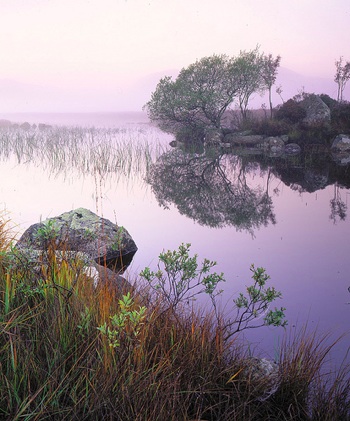
I chose this image mostly for aesthetic and instructive reasons, but also because the international flavor appealed to me. The photographer, Tim Parkin, lives in Leeds, UK, and the photograph was made at Lochan Na h’Achlaise (which Tim says roughly translates as ‘Loch of the armpit’) in Rannoch Moor, Scotland. Also, I like the title Tim used on Flickr—“That Damed Loch”—although his official title isPinks, Lochan Na h’Achlaise, Rannoch Moor.
I love the soft, subtle, color palette of this photograph, with pinks, golds, and hints of green. Many photographers would be tempted to pump up the saturation, but I think that would make this image look garish and fake, and lose some of its attractive, quiet feeling.
The composition is well seen and thought out. The main focal point is the shrub on the island just right of center, and my eye moves from that down to the smaller shrub, grasses, and rocks in the foreground. Tim was careful to keep separation between everything in the foreground and the reflections in the water, with the exception of the unavoidable merger between the three tall grasses just left of center and the reeds behind them.
The small foreground shrub echoes the shape of the larger one in the background, adding some repetition and tying the foreground and background together. I often see random foregrounds that seem stuck on, included only because the photographer felt that a foreground was obligatory. If you’re going to include a foreground it has add something to the image and tie in with the background somehow, either with similar lines and shapes, or by leading the viewer’s eye into the distance. Here the foreground definitely adds interest, and echoes shapes in the background. (more…)
by Michael Frye | Jan 25, 2010 | Yosemite Photo Conditions
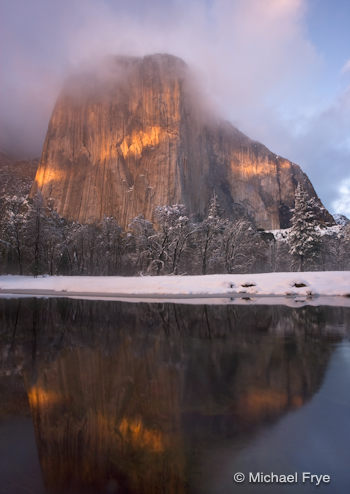
Sunbeams on El Capitan Saturday evening
Our workshop group had an adventure last week. It snowed off and on (mostly on) from Monday through Friday morning. The power went out Wednesday afternoon, so we did print critiques in the Ahwahnee Hotel’s Winter Club Room. The temperature hovered just around freezing in Yosemite Valley most of the week, so the snow melted during lulls in the precipitation, and by Thursday afternoon there were only about six inches on the ground. But that night the temperature dropped, and Friday morning I measured 16 inches on the railing outside The Ansel Adams Gallery.
A week of heavy, wet snow was apparently too much for many trees and limbs, and during the night Thursday and all day Friday the valley was filled with the sound of cracking, falling branches. Out in Cook’s Meadow Friday morning we could hear and often see limbs or whole trees falling every few minutes. The National Park Service had to close all the roads because they couldn’t keep up with the tree removal; they’d no sooner clear a stretch of roadway when another tree would fall across it. They issued warnings telling everyone to stay inside. Several of my workshop students were evacuated from their rooms at Yosemite Lodge because of dangerous limbs, but luckily there were other rooms available in safer buildings.
My workshop students endured all this without complaint—in fact they were excited to see Yosemite covered in snow. We found ourselves trapped in the east end of Yosemite Valley Friday, but no one minded because it was beautiful. The cliffs and trees—the ones that were still standing—were decked in white, and the sun broke through briefly in the morning. We just had to avoid walking under branches!
The roads reopened Saturday morning, after a closure of more than 24 hours. Saturday afternoon the skies cleared, and we saw so
by Michael Frye | Jan 15, 2010 | Critiques
I’m starting a new feature in this blog: a weekly photo critique. Every Tuesday or Wednesday I’ll pick a photograph submitted by one of my readers, write a detailed critique, and invite other readers to post their comments as well.
I’ve always felt that portfolio reviews are one of the most valuable parts of my workshops—perhaps the single best teaching tool. Everyone gains insights into their photography, regardless of who’s work is being reviewed. This new blog feature give you the chance to have one of your photos critiqued for free. But more importantly, I hope every reader will learn something.
I’ll post the first critique on January 26th or 27th. If you want your images considered for a critique, post it to the Flickr group I’ve created for this purpose. (You’ll have to join Flickr, but it’s free and easy). Photographs will be chosen for their instructive value, not necessarily their quality. Please, no more than five images per person per week!
by Michael Frye | Jan 13, 2010 | Announcements
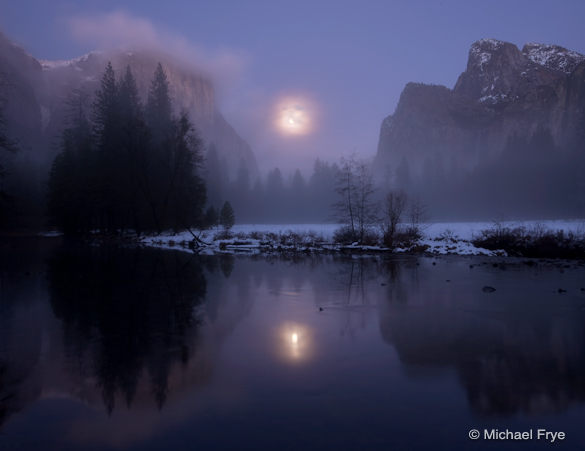
Rising Moon, Gates of the Valley
I’ve just launched another blog called 25 Years in Yosemite: A Photographer’s Journal. While this blog is written for landscape photographers, the new blog is for anyone interested in Yosemite. Each week I’ll post a short essay telling the story behind a photo, talking about the park’s natural history, or relating a personal experience from living in or near Yosemite for over 25 years. I’ll take readers through an entire year in the park, following the seasonal changes as they happen. Learn the story behind this photograph in the latest post.
by Michael Frye | Sep 12, 2009 | Yosemite Photo Conditions
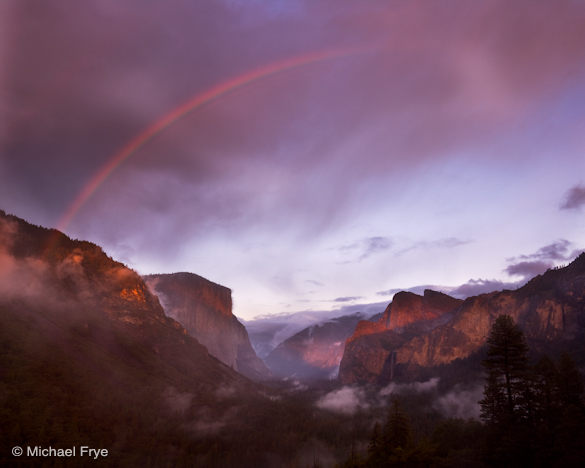
Rainbow over Yosemite Valley from Tunnel View, October 4th, 2008
As the days get shorter and cooler, the photo opportunities in the Yosemite area get hotter. It’s time to take a look at what to expect during the next few months.
September
 You won’t find much autumn color in Yosemite before October, but the indian rhubarb in Bridalveil and Leidig Meadows can add an early splash of yellow, as in this photo from the west end of Leidig. Near the fall equinox on September 22nd, and for a couple of weeks afterward, the sun sets at a good angle for Tunnel View, lighting both El Capitan on the left and Cathedral Rocks on the right. The two or three weeks before the spring equinox are even better, as there’s usually water in Bridalveil Fall, but fall can be great in the right weather conditions, like last year when I saw the rainbow at the top of this post.
On the east side of the Sierra Nevada the high-elevation aspens usually start turning yellow in late September. The Bishop Creek area, west of Bishop, and Convict Lake, just south of Mammoth Lakes, are two of the early season hot spots. The road to Virginia Lakes, north of Lee Vining, can also have early fall color.
October
 In a typical year, the aspen color show progresses down the mountainsides on the east side of the range and reaches the lowest elevations near the third week of October. There’s no real peak, because the timing of the best color depends on the location. I prefer photographing the larger trees at lower elevations, so the third week is often my favorite time, but there’s usually plenty to photograph earlier in the month as well. Some of my favorite spots are Lundy Canyon, Lee Vining Canyon (right), and the June Lake Loop.
The maples, dogwoods, cottonwoods, and oaks in Yosemite Valley usually turn a bit later. The peak color typically arrives around the end of October or beginning of November. Dogwoods can can often be found turning gold or even red by mid-October at higher elevations along Highway 41, Highway 120 west of Crane Flat, and in the Tuolumne Grove.
Blueberry bushes lining the shores of Siesta Lake along the Tioga Pass Road also turn red and orange near the middle of the month (below). From Taft Point, a one-mile hike from the Glacier Point Road, the late-afternoon sun strikes El Capitan at a great angle.

November
This might be my favorite month in Yosemite Valley. The peak autumn color frequently arrives at the beginning of the month and yellow and gold leaves often linger for weeks afterward. Frost and ice begin forming in the meadows and along the creeks and rivers, and sometimes an early snowfall spices up the landscape. Sunlight has already reached winter angles, raking across the face of Half Dome in the late afternoon and turning El Capitan gold at sunset.
For more detailed information, including directions to most of the locations mentioned here, pick up a copy of my book The Photographer’s Guide to Yosemite.
Addendum, September 2011: Now The Photographer’s Guide to Yosemite is available as an iPhone app!