In the Moment:
Michael Frye's Landscape Photography Blog
by Michael Frye | Feb 9, 2010 | Light and Weather
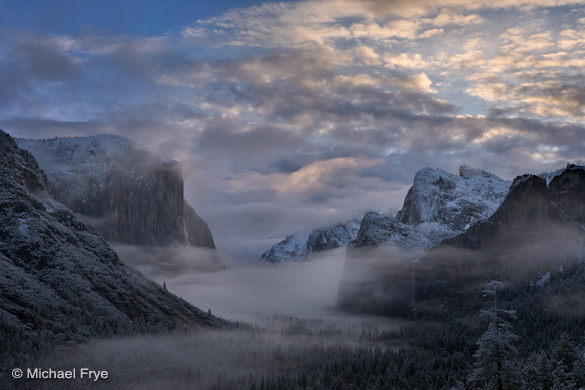
Sunrise from Tunnel View, Sunday morning
In my last post I wished for the storm to clear right around sunset on Sunday. It didn’t quite work out that way—it cleared at sunrise instead. My private workshop student and I photographed a beautiful sunrise from Tunnel View, then moved to Cathedral Beach and Swinging Bridge. I always hope for mist, as it adds so much mystery and mood to photographs of Yosemite Valley. Sunday we had almost too much mist; massive cliffs like El Capitan were completely obscured for long stretches of time. But I’m not complaining! It was a great morning.
But where were all the photographers? We saw only a few other tripods all morning—and it was a weekend. Maybe they’re all waiting to come next week for Horsetail Fall.
by Michael Frye | Feb 1, 2010 | Yosemite Photo Conditions
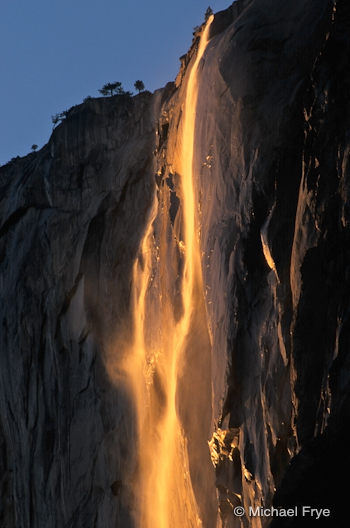
It’s February, so Horsetail Fall season has nearly arrived. Herds of photographers will soon be standing tripod-to-tripod hoping to catch that magical neon glow on this ephemeral slice of water.
Conditions have to be just right to capture a classic Horsetail Fall image: Sufficient water has to be flowing, and the skies need to be clear in the west to allow the setting sun to light the waterfall. It looks like the first condition will be met, as there’s plenty of snow on top of El Capitan to feed Horsetail. How clear the skies will be is anybody’s guess at this point. The ideal scenario would be a stretch of warm clear days during the peak window of light, but that seems unlikely in this El Niño winter.
About that peak window: I posted an article on my website last year describing how I used the Yosemite Association’s web cam to determine the optimum window of light for Horsetail Fall. My conclusion was that the peak day occurred about 60 days after the winter solstice, with the best light stretching from about seven days before that to three days after that. I’ve since learned that the earth wobbles a bit in its orbit, so the sun doesn’t set at exactly the same angle 60 days before the solstice as it does 60 days after the solstice. So I now use the angle — the azimuth — of the setting sun as the best way of determining when the peak day will be. This year February 18th comes closest to the ideal angle, with the window of best light stretching from about February 11th through February 21st.
There are basically two good spots to photograph Horsetail: near the El Capitan picnic area along Northside Drive, and along Southside Drive about .8 miles east of the Cathedral Beach picnic area. I prefer being near the El Capitan picnic area, but both locations have their virtues.
Many people have asked me if I’ll be doing one-day Horsetail Fall workshops again this year with The Ansel Adams Gallery, but I’ll be attending the North American Nature Photography Association’s (NANPA) Summit in Reno from February 16-19, so I’ll miss most of the Horsetail Fall craziness. The Gallery will be hosting a couple of afternoon photo classes with their staff photographers during that time, and if conditions are right they will lead their groups to good spots for Horsetail Fall.
Even though I might miss out, I hope we get some clear sunsets between February 11th and 21st, as that would make many other photographers happy! Good luck to all of you with Horsetail aspirations this year.
by Michael Frye | May 9, 2009 | Photography Tips, Yosemite Photo Conditions
 Last night I joined the throngs in Cook’s Meadow to photograph the lunar rainbow on Upper Yosemite Fall. There were at least 100 photographers around the meadow, and probably many more at the bridge below Lower Yosemite Fall. Like Horsetail Fall in February, lunar rainbows have become a photographic phenomenon. Until recently the most popular place was at Lower Yosemite Fall, but since Don Olson published specific times for seeing the “moonbow” from the Sentinel Bridge in Cook’s Meadow this spot has attracted lots of photographers. The big advantage is that it’s dry! At the bridge below Lower Yosemite Fall it’s impossible to keep mist off the front of the lens.
You can’t really see a lunar rainbow with the naked eye. Our eyes don’t render color very well in the dark, so at best you can see a bright arc and maybe a hint of color. But the color is there, and film or digital sensors capture it well. One of the reasons that more people haven’t photographed lunar rainbows from Cook’s Meadow in the past is that you can’t really see it from there. With film you’d just have to guess about the position and wait to find out whether you were right. With digital sensors it’s easy to just take a photo and see the position of the rainbow.
Last night the moon was bright enough that I could see the rainbow fairly well. Along with everyone else I watched it move down the fall as the moon rose. When the rainbow fell too low, most people packed up (it was 11:30 p.m. after all), but I followed the moon westward and saw an even more vivid rainbow from near the Yosemite Chapel. This photograph was made from that spot. Rainbows form a circle around a spot opposite the light source—sun or moon. Lunar rainbows can be seen on any waterfall that gets moonlight if you position yourself properly. In fact I photographed a lunar rainbow on Castle Geyser in Yellowstone many years ago. Maybe I’ll put that image in another post.
Long exposures with digital cameras can create lots of noise, but newer models handle this pretty well. You’re usually better off making a long exposure at a low ISO than a shorter exposure with a higher ISO. But with lunar rainbows you don’t want to make the exposure too long or the bands of color will blend together. I used a six-minute exposure at f/4 and 100 ISO for the image above. Trying to lighten a dark image will exaggerate noise, so it’s best to make the photograph as light as possible without overexposing it. Don’t rely on just how it looks on your LCD screen. Since it’s dark, the screen will look bright even if the image is underexposed. Use your histogram.
Having said that, a nighttime photograph shouldn’t be too bright. You don’t want it to look like it was taken under midday sunlight. I actually darkened this image—especially the sky—in software to give it more of a nighttime feeling.
by Michael Frye | Feb 28, 2009 | Yosemite Photo Conditions

It’s still winter in Yosemite, but spring has arrived at lower elevations. Poppies have exploded along the Merced River west of the park. They’re blooming across the river from Highway 140 between Briceburg and the rock-slide detour. The largest, densest patches have sprouted in places burned by the Telegraph Fire last summer, although other poppies are starting to appear in the usual spots further east in the canyon.
I used a 200mm lens to make the image above on my way back from Yosemite this morning. Unfortunately there’s no easy access to the poppies from 140, as they’re all on the opposite side of the river, but it’s possible to photograph them from near the road with long lenses.
The best light on Horsetail Fall is over. In early February the water flow in Horsetail was too low for good photographs. Later in the month the flow increased, but clouds blocked every sunset except one, on February 19th. Consider yourself lucky if you photographed it that day! There were many disappointed photographers in Yosemite this past month. The light on Horsetail in early March can be nice, with a golden glow late in the day, but it’s not the neon orange light that everyone is after.
Water volume in all the Yosemite waterfalls is gradually increasing, and should continue to increase during March and April. A lot of snow has melted, although most of the valley floor is still snow-covered. The forecast is calling for a series of storms next week, which is good news, as we still need more rain and snow.
by Michael Frye | Feb 15, 2009 | Yosemite Photo Conditions

The next in a long series of winter storms is due to arrive in Yosemite tomorrow. This one is expected to be warmer than the previous two or three; the forecast calls for a snow level of 5000 feet, so it will probably rain at 4000 feet in Yosemite Valley. But the snow level often drops at the tail end of a storm, so it’s possible that the valley floor will get a dusting of fresh snow on Tuesday. Those of you living in the Bay Area who’ve already been drenched by rain may be surprised to hear that we’re not expecting this storm until tomorrow, but it’s stalled and moving slowly.
This past week it snowed in Yosemite on Monday, Wednesday, and Friday, with some misty, clearing-storm interludes in between. I took the photo above on Monday afternoon from Tunnel View. I don’t often make black-and-white images, but this scene was perfect for it. Sunrise yesterday morning looked spectacular on the Turtleback Dome web cam, and I was sorry I didn’t make it up there.
There is now plenty of snow on top of El Capitan to feed Horsetail Fall, but temperatures have been cold, so melting has been slow. We need at least a few warm clear days to get the flow going. The forecast calls for some dry days later this week, but I don’t know whether that will be enough.
By the way, you can find links to the National Weather Service’s Yosemite forecast and the Yosemite web cams on the right.