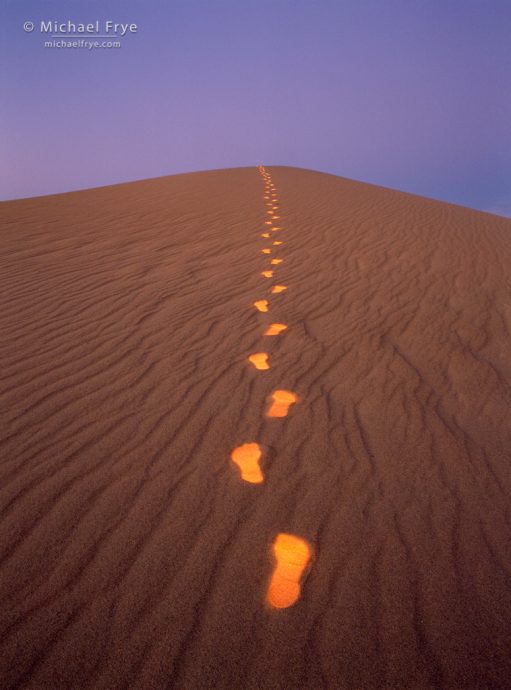
This photograph is from October of 1995 – deep in the archives.
Most of my photographic ideas arise spontaneously, as I react to the light, weather, and my surroundings. But sometimes an idea pops into my head at home, or while driving, or, especially, while falling asleep.
The idea for this footprint image was one of those occasions when an idea just popped into my head, though I don’t remember exactly where or when. I had been experimenting with light painting at dusk and at night, using flash and flashlights, and somewhere during that time I thought, “Wouldn’t it be cool to show a line of footprints on a sand dune, and use a flashlight to make the prints glow?”
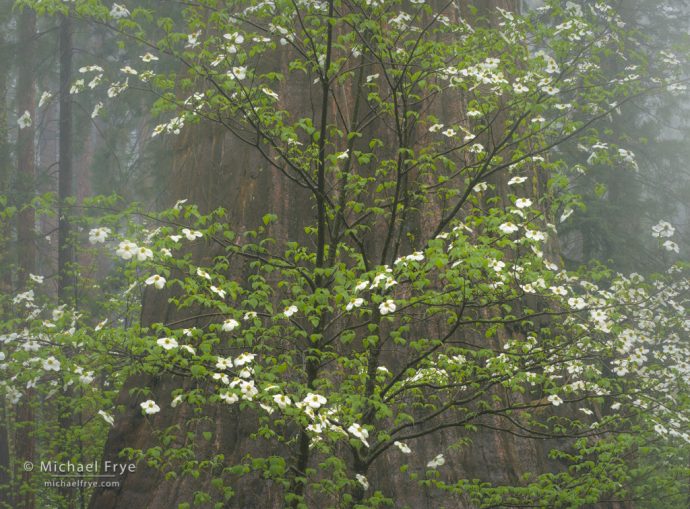
Dogwood and giant sequoia in the fog, Sierra Nevada, California. Fog is a wonderful complement to forest scenes; here, some ephemeral fog lasted just long enough for me to capture this image. 70mm, polarizer, 0.7 seconds at f/16, ISO 100.
People seem to love trees and forests. I know I do.
But forests can be difficult to photograph. Natural forests are usually a study in chaos, with haphazard arrangements of branches, trunks, logs, and leaves. There’s an organic order to all that, with trees and understory plants growing to take advantage of small patches of sunlight, and a cycle of birth, growth, death, and decay.
But visual order can be hard to find amid all that clutter. The chief challenge in photographing forests is usually finding a way to simplify things, and make order out of chaos.
The Out of Chicago Live online photo conference last month was so much fun. I think everyone who participated relished the opportunity to focus their attention on photography for a few days, rather than on the coronavirus. And the lineup of speakers and presentations was outstanding. I got to see some of the presentations live, but there were many, many others that I missed, so I’ve been catching up by watching the recordings of the sessions.
And you can do that too, even if you didn’t attend the conference as it was happening. Every session was recorded, so you can enroll in the conference after the fact and see them all – over 100 sessions, including presentations, tutorials, panel discussions, and image reviews. You can find more information, including a complete list of every session, here:
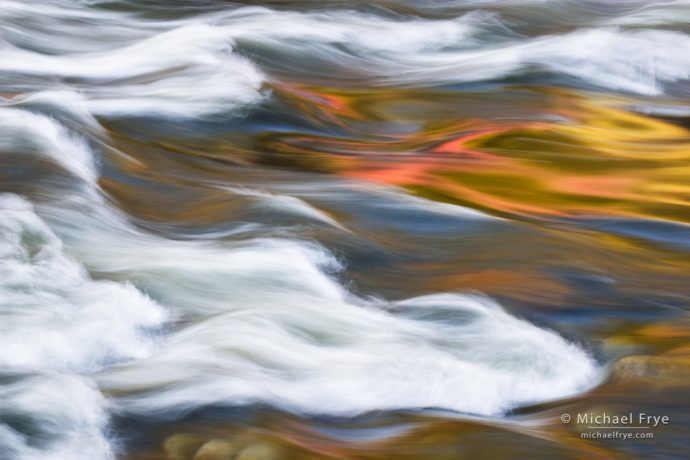
I made this photograph in March of 2004, with a 6-megapixel Canon 10D. That was my first digital camera, purchased only about nine months earlier, in the summer of 2003. The low resolution made this camera unsuitable for “serious” work, so for about two years I carried around both the Canon 10D and my Mamiya 645 film camera. I used the Canon for snapshots, and, when time allowed, to capture digital versions of my film images, so that I only had to scan the film captures when I really needed the extra resolution (like when making prints, or sending files to publishers).
I quickly learned to love digital capture. It was just so much easier: I could see the results right away, use the histogram to check the exposure, and magnify the image to see if everything was in focus. When photographing moving water I didn’t need to guess about the right shutter speed because I could try several, see the effects immediately, and dial in the shutter speed that best suited the situation. I found that the digital camera invited experimentation and creativity, because I didn’t have to pay for film and processing, and could see and refine the results of an experiment in the field. And, as if all that wasn’t enough, the dynamic range far exceeded transparency film, so the resulting images looked less harsh and more luminous. Resolution aside, when I compared images from my Mamiya and my Canon, I almost always preferred the ones from the Canon.
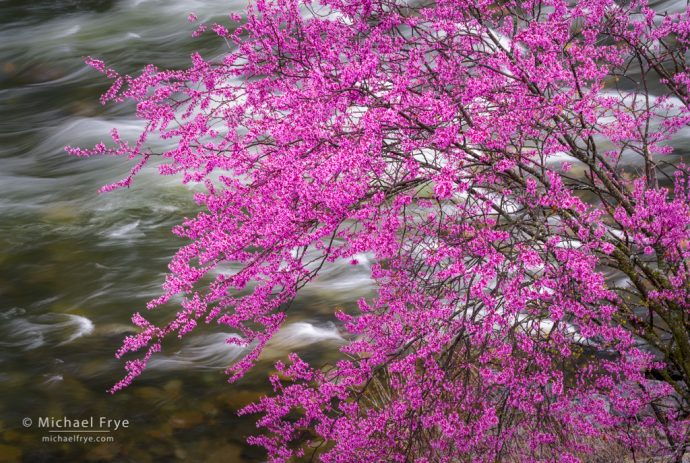
Redbud above a rapid in the Merced River, California
My mother grew up in the Panama Canal Zone, in the hills above Panama City, running and playing all year in the tropical weather, watching sloths in the trees outside her bedroom window, shaking her shoes out each morning to make sure there were no scorpions inside.
When she was 13 years old her family moved to Queens, New York, but later, in the early years of her marriage, she and my father migrated to the outer suburbs, and once again she was surrounded by nature. She would often point out beautiful things she noticed to my brothers and me: the first buds of spring, a sunset, ice-coated branches, a bird singing, autumn leaves starting to turn…
I’ve been using Lightroom since Adobe released the beta version in 2006. Over the years I’ve learned many shortcuts, and in this video I share some of my favorite tips – things I use all the time to streamline my workflow:
We will never sell or share your email address with anyone. Read our complete Privacy Policy.
Subscribe to My Blog:
Success! Now check your email to confirm your subscription.