by Michael Frye | Jan 5, 2025 | Announcements
The votes are all in and counted, and here are my top photographs of 2024!
We had a great response this year: 627 people looked through my initial selection of 45 images and voted for their favorites. A big thank you to everyone who took the time to look through these photographs and voice your opinions! I also really appreciate the kind words so many people posted in the comments or sent by email. I wish I could respond to everyone, but please know that I’ve read them all and am very grateful for all your support.
(more…)
by Michael Frye | Dec 29, 2024 | Light and Weather
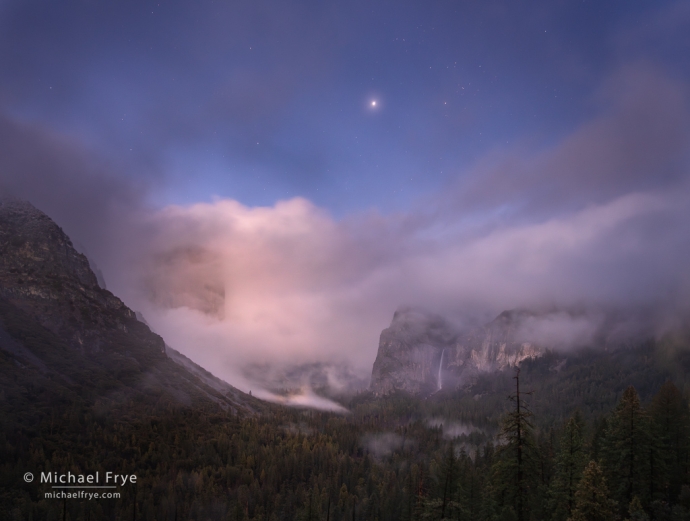
Yosemite Valley at dusk with stars and Jupiter, Yosemite NP, California. This storm cleared just after sunset. It was dark enough for stars to appear, but with a post-sunset glow still lingering on El Capitan. 25mm, 10 seconds at f/4, ISO 2000.
We’ve stayed close to home this month, but I’ve been making lots of photographs. I previously posted photos of fog in the foothills, and ice in Yosemite. But I’ve also been able to photograph Yosemite with clearing storms, and mist, and a moonrise, and with just ordinary, beautiful winter light.
Yosemite Valley is small – only seven square miles. This tiny area is renowned for its grand scenery, but it also contains a wonderful variety of beautiful details and intimate landscapes. No matter how many times I go back, I always find new things to photograph – or find that the same spots look new, and different, under different conditions. There’s always something to photograph there, if I look.
(more…)
by Michael Frye | Dec 22, 2024 | Light and Weather
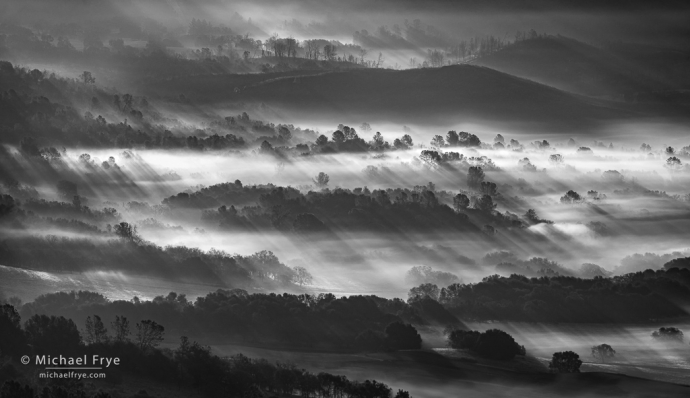
Fog and sunbeams, Sierra Nevada foothills, California. I made this image Wednesday morning, after the sun rose high enough to rake across these layers of fog and trees. In color it was all one note, with everything a pale gold color. Since it was monochromatic anyway, I tried it in black and white, and liked that much better. I think the color distracted from the main story of the photograph, which is about the layers, patterns of light and dark, and tree shadows. 321mm, 1/200 sec. at f/11, ISO 100.
California’s Central Valley is often filled with fog in winter. Usually a shallow layer of fog forms during the night, then burns off the next morning as the sun warms the air. There’s a temporary, low-level inversion during the night and early morning, where the air near the ground is cooler than the air higher up, but when the sun penetrates the fog and warms the ground the inversion ends.
Sometimes, however, the fog in the Central Valley is so thick it doesn’t burn off. The weak sunlight on short winter days never penetrates the fog layer completely, so the fog lasts all day, and into the next night. If the fog persists for a couple of days the inversion will grow deeper (it can get up to two- or three-thousand feet deep), and the fog will gradually lift off the ground into a low overcast, or stratus deck. And then that higher-altitude fog layer will push up into the Sierra foothills. A stratus deck like this can last for several days, or even a week, until a disturbance in the atmosphere (like a storm, or even a weak, dry front) mixes the air and ends the inversion.
(more…)
by Michael Frye | Dec 15, 2024 | Advanced Techniques, Composition
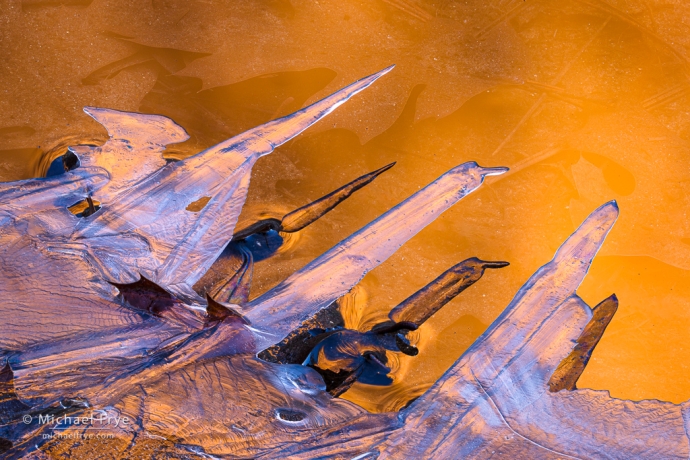
Ice fingers, Yosemite NP, California. 400mm, 1 second at f/16, ISO 100; 18 focus-stacked frames blended with Helicon Focus Pro. I needed to photograph this detail at an angle to get the orange reflections, requiring focus-stacking to get everything sharp. (It’s a reflection of a cliff lit by the setting sun.)
Last Thursday, Friday, and Saturday two smaller storms moved through the Sierra, bringing rain and higher-elevation snow. But for a couple of weeks before that it had been dry and warm – reaching the upper 60s at our house in Mariposa.
Early last week, as we were starting our workshop in Yosemite Valley, temperatures cooled off a bit, allowing ice to form along the banks of the Merced River. It’s always fun to photograph ice like this, with its beautiful patterns, designs, and colors. But it can be challenging, both technically and creatively.
(more…)
by Michael Frye | Dec 1, 2024 | Light and Weather
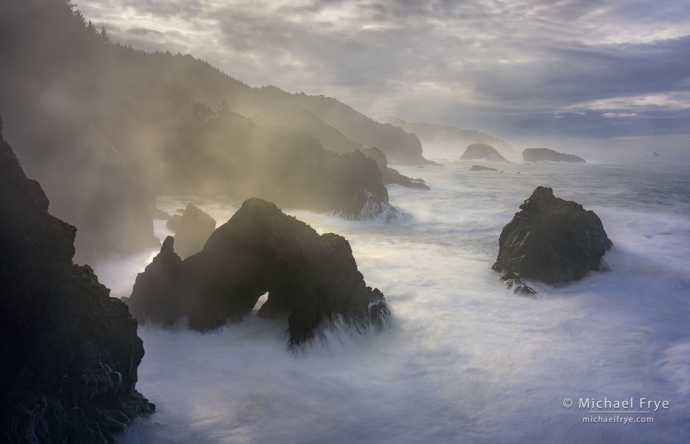
Sunlight breaking through clouds and fog, Oregon Coast. During our workshop we waited out a brief-but-heavy rain shower by sheltering underneath a dense tree canopy. After we emerged clouds blocked the sun for awhile, but eventually sunlight broke through and backlit the wave-generated mist for a few beautiful minutes. 28mm, 3 seconds at f/11, ISO 100, ND filter.
Sometimes I’m out with my camera on a clear, sunny day, and a passerby says, “What a beautiful day for photography!” I just smile and agree; there’s no point in discussing the finer points of landscape photography with a passing stranger.
And of course you can make good photographs on clear, sunny days. Those conditions are perfect for many subjects and scenes. But landscapes are usually more interesting and photogenic with clouds, fog, mist, snow, or rain – and the light that weather helps create, like sunbeams, rainbows, dappled light, colorful sunsets, and so on.
(more…)