by Michael Frye | Oct 29, 2014 | Photography Tips, Vision and Creativity
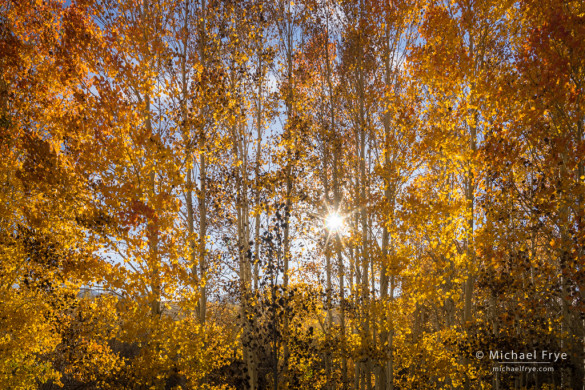
Late-afternoon sun in an aspen grove, Eastern Sierra. Backlight makes autumn leaves glow, but to avoid lens flare you have to either shade the lens (if the sun is out of the frame), or partially hide the sun behind a tree, as I did here.
Light is a vital aspect of any photograph, and always the first thing I think about when deciding where to go with my camera. The more you understand light, the better your photographs will be.
Any kind of light can work for fall color – under the right circumstances. But some kinds seem to work better than others. While photographing and leading workshops in the eastern Sierra, I was usually looking for backlight or soft light on the aspens – or best of all, soft backlight.
(more…)
by Michael Frye | Oct 24, 2014 | Yosemite Photo Conditions
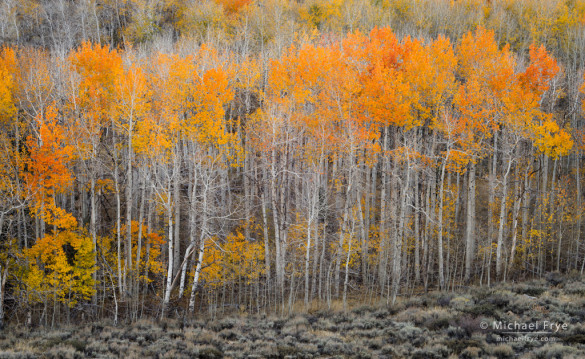
Aspens near Lee Vining, Sunday afternoon
Claudia and I got home last night after our two Eastern Sierra Fall Color workshops. We had a great time, as always. Both groups were really nice, the color was great, and some clouds added interest to sunrises and sunsets.
The color on the east side was a little early this year. When we left yesterday the lower-elevation areas like June Lake Loop, Lee Vining Canyon, and lower Lundy Canyon were at about peak. Mid- and high-elevation aspens were past peak, but you could still find colorful patches mixed with the bare trees (a photogenic combination, in my opinion). I’m sure there will still be good color in those lower-elevation spots this weekend, but probably not far beyond that.
On the drive home I made a short detour through Yosemite Valley to check on the color, and things are progressing slowly there. The bigleaf maples on the south side of the valley are starting to turn. There’s a nice patch of yellow along Southside Drive, underneath Middle Cathedral Rock (across from El Capitan). The maples in this area are perhaps 60 percent yellow and 40 percent green. Some maples near Pohono Bridge and the old dam are turning as well, but those areas are still predominantly green.
Elsewhere in the valley there’s little color so far. The oaks, cottonwoods, and dogwoods are showing just tinges of yellow and gold here and there. The maples will probably reach their peak in about a week or so, but it looks like the oaks, cottonwoods, and dogwoods won’t turn until the first or second week of November. Maybe we’ll get a dusting of snow during the peak color, like we did two years ago…
— Michael Frye
Related Posts: Back in the Sierra; Early November Magic in Yosemite
Did you like this article? Click here to subscribe to this blog and get every new post delivered right to your inbox!
Michael Frye is a professional photographer specializing in landscapes and nature. He is the author or principal photographer of The Photographer’s Guide to Yosemite, Yosemite Meditations, Yosemite Meditations for Women, and Digital Landscape Photography: In the Footsteps of Ansel Adams and the Great Masters. He has also written three eBooks: Light & Land: Landscapes in the Digital Darkroom, Exposure for Outdoor Photography, and Landscapes in Lightroom 5: The Essential Step-by-Step Guide. Michael written numerous magazine articles on the art and technique of photography, and his images have been published in over thirty countries around the world. Michael has lived either in or near Yosemite National Park since 1983, currently residing just outside the park in Mariposa, California.
by Michael Frye | Oct 14, 2014 | Yosemite Photo Conditions
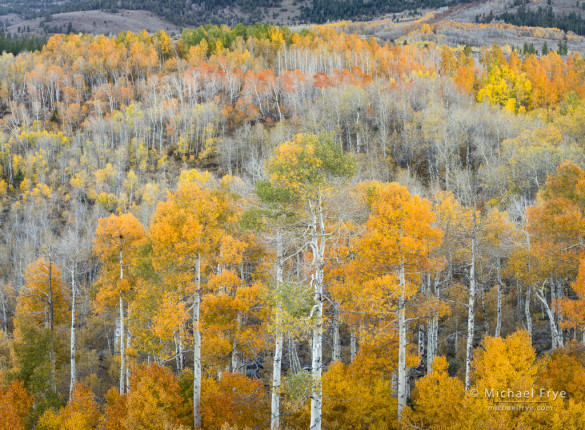
Aspen-covered hillside, yesterday afternoon, near Bridgeport, California
I’m back on the eastern side of the Sierra Nevada, my home mountains, getting ready for our upcoming workshops. There’s some great color over here. I made this photograph yesterday afternoon up near Bridgeport, and especially liked the mix of colors on this hillside, with yellow, gold, orange, and green.
Overall, the color looks pretty typical for mid-October. The higher elevation aspens are mostly bare, but the lower-elevation trees are a mix of green, yellow, and orange. The color progression might be a little earlier than average, but not much. If there’s anything unusual, it’s that some typically early-changing groves are still mostly green, while other groves that usually turn later have progressed further.
(more…)
by Michael Frye | Oct 7, 2014 | Travels and Stories
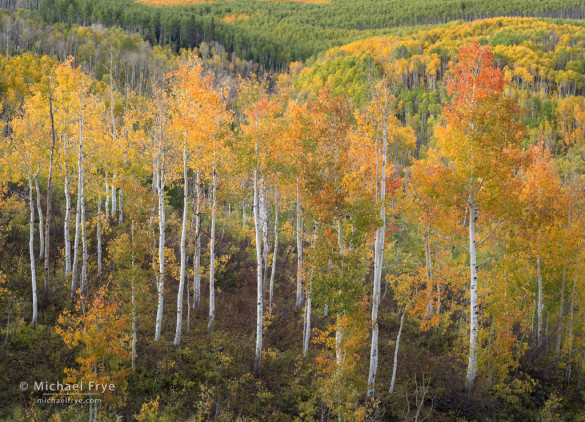
Autumn colors, Gunnison NF, CO, USA
I love photographing aspens. Their autumn color is wonderful, but it’s also those tall, straight, white trunks that make them so compelling.
It’s been a long-time dream of mine to photograph aspens in Colorado in the fall, but various obligations and commitments kept me from going. This year, however, Claudia and I found a brief time slot and decided to go. And we’re so glad we did, as it’s just beautiful here. Some high-elevation areas, like Crested Butte, are past peak, and others seem to be turning late, but we’ve found some wonderful color in several places, and an endless supply of great photo subjects. Here are some photographs from the past few days, and I’ll post more when I get a chance.
(more…)
by Michael Frye | Oct 5, 2014 | Night Photography
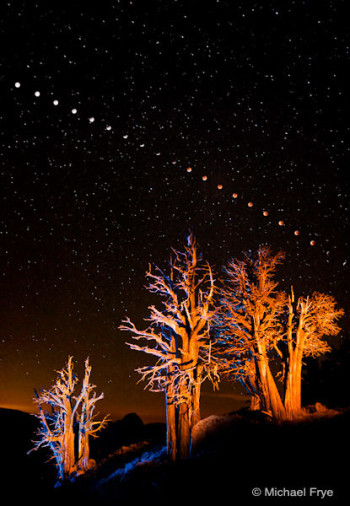
Lunar Eclipse Sequence, 1:23 a.m. to 4:49 a.m., August 28, 2007, Yosemite National Park, California
Lunar eclipses are spectacular events to see and photograph. I’ve been lucky enough to capture several lunar eclipse sequences over the years, including this one from Yosemite in August 2007.
We’re all going to get another chance at photographing an eclipse soon: a total lunar eclipse will be visible throughout North America early Wednesday morning, October 8th.
In the western half of the U.S. the entire eclipse sequence will be visible, from full moon, to partial eclipse, to total eclipse, and back to full again. In California the moon will be high in the sky to the west-southwest at the beginning of the sequence, then sink near the horizon to the west by the end of the sequence. The moon’s path will actually be somewhat of similar to path in this photograph, except that the eclipse will be higher in the sky and a bit further to the right, and the angle of the moon’s path will be steeper.
On the east coast the moon will set when its fully eclipsed, so it won’t be visible as its coming out of the eclipse. But that means the moon will be near the horizon when its fully eclipsed, where you might be able to photograph it next to an interesting foreground object as the dawn lightens the sky. It should be just north of due west as it sets.
For precise guidance about the moon’s position in relation to the landscape, I recommend consulting PhotoPills or The Photographer’s Ephemeris. Here’s the timing for the eclipse:
(more…)