by Michael Frye | Jan 13, 2010 | Announcements
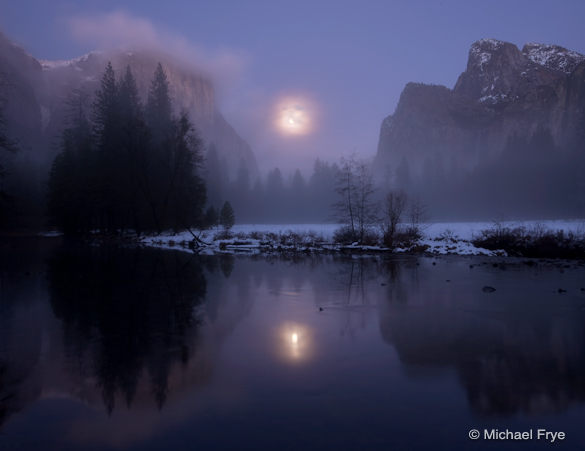
Rising Moon, Gates of the Valley
I’ve just launched another blog called 25 Years in Yosemite: A Photographer’s Journal. While this blog is written for landscape photographers, the new blog is for anyone interested in Yosemite. Each week I’ll post a short essay telling the story behind a photo, talking about the park’s natural history, or relating a personal experience from living in or near Yosemite for over 25 years. I’ll take readers through an entire year in the park, following the seasonal changes as they happen. Learn the story behind this photograph in the latest post.
by Michael Frye | Jan 10, 2010 | Announcements
I’ve moved the blog to my own domain and given it a new name—In the Moment: A Landscape Photography Blog. Here’s the address:
https://www.michaelfrye.com/
To subscribe, go to the new location and click on the subscribe button:
I have a lot of exciting plans for the new blog, so I hope you’ll join me there!
by Michael Frye | Jan 10, 2010 | Announcements
Welcome to the new location for my blog. This new domain will allow me to include more photographs, show them larger, and improve the overall experience for you, the reader. Click on the subscribe below or to the right (the one that looks like this:  ) to have it all come to your inbox.
I’ll have more exciting announcements soon!
by Michael Frye | Jan 8, 2010 | Announcements
 Before they’re completely gone I want to extend an invitation to friends and readers to receive a free copy of my 2010 Yosemite Meditations Mini Calendar. Just visit my new Facebook page, become a fan, email me with your mailing address, and I’ll send you a calendar—while supplies last. (This offer is only available to U.S. residents.)
by Michael Frye | Jan 5, 2010 | Announcements
In December Jim Goldstein interviewed me for his podcast, “EXIF and Beyond,” and now the podcast is up and available for download. While you’re there be sure to check out Jim’s excellent blog and his many other fascinating podcasts.
by Michael Frye | Jan 1, 2010 | Announcements
 I hope all of you have a great year in 2010.
by Michael Frye | Dec 22, 2009 | Announcements
After I sent off the text and images for this book some errors crept in. The most prominent is on page 43, where the diagram “Zones and Histograms” shows more dynamic range than any digital camera can produce. I’ve posted corrections on my web site, including an image that you can print and tape over the erroneous diagram on page 43.
by Michael Frye | Dec 17, 2009 | Announcements

My new book, Digital Landscape Photography: In the Footsteps of Ansel Adams and the Great Masters, will be available in January. In this volume I look at the techniques of some past masters of landscape photography—particularly Eliot Porter, Edward Weston, and Ansel Adams—and explore how those techniques could be adapted to digital photography today. The book includes some examples of Porter, Weston, and Adams’ work, as well as at least 100 of my own images. This excerpt from the Introduction explains the theme:
I am sure the next step will be the electronic image, and I hope I shall live to see it. I trust that the creative eye will continue to function, whatever technological innovations may develop.
When Ansel Adams wrote this, digital photography was in its infancy. Today most photographs are captured on digital sensors, and film consumption has dwindled. In this digital age, do the landscape masters of the past like Adams, Edward Weston, and Eliot Porter still have anything to teach us? Can the lessons they learned through trial and error with film, paper, and chemicals still apply to photographers checking the histogram on their camera’s LCD or making a Curves adjustment on their monitor?
The answer is yes. When Ansel Adams developed the Zone System with Fred Archer in 1940, he gave photographers a tool great for controlling their images—but only with black-and-white film, and only with view cameras, where sheets of film could be processed individually. Today any photographer with a digital camera can have even more control—even in color.
Such unprecedented power creates wonderful opportunities, but can also lead to confusion. How do you apply these controls? How far should you go? Do you have to start from the beginning? No, because while the tools may be different, the basic principles that Weston, Porter, and Adams developed still apply.
The first chapter covers the technical foundation like image quality, sharpness, depth of field, and exposure, including how to apply the Zone System to digital cameras, and how to expose for optimum results with HDR. Chapter 2 is devoted to light and composition: directing the eye, using contrast, basic and subtle aspects of light, compositional rules and when to break them, patterns, repetition, and capturing a mood. The third chapter delves into the digital darkroom, including editing, developing a workflow, converting color images to black and white, adjusting black points, white points, and contrast, dodging and burning, and expanding the contrast range with HDR or manual blending in Photoshop.
In the end, the book is a comprehensive look at digital photography techniques from capture to print, with Adams, Weston, and Porter’s insights guiding the way. It’s available for pre-order from Amazon.
by Michael Frye | Dec 14, 2009 | Digital Darkroom, Photography Tips

Back in the dark ages of film, I carried several graduated neutral-density filters. They were both hard to pronounce and hard to use. First I had to decide which one to pull out—one, two, or three stops? Hard edge or soft? Then, after mounting one on the lens, I struggled to adjust it. The transition—the “graduated” part of the filter—could be almost impossible to see through the viewfinder. The light often vanished while I was still fiddling.
With my first digital camera I realized that graduated filters were no longer necessary. I could recreate the same effect in Photoshop, with more ease and control. And now the latest versions of Lightroom and Adobe Camera Raw even have built-in graduated filter tools. The photographs above show a before-and-after version done with Lightroom—original on the left, digital graduated filter applied on the right to lighten the foreground.
My latest article in the December issue of Digital Photo magazine (formerly PC Photo), titled Digital Graduated Filters, describes how to use the Graduated Filter tools in Lightroom and Camera Raw, plus how to achieve the same effect with Photoshop. The article isn’t on the their web site, but you can find the magazine at newsstands now. I have a related article on my site with some, but not all, of the same material.