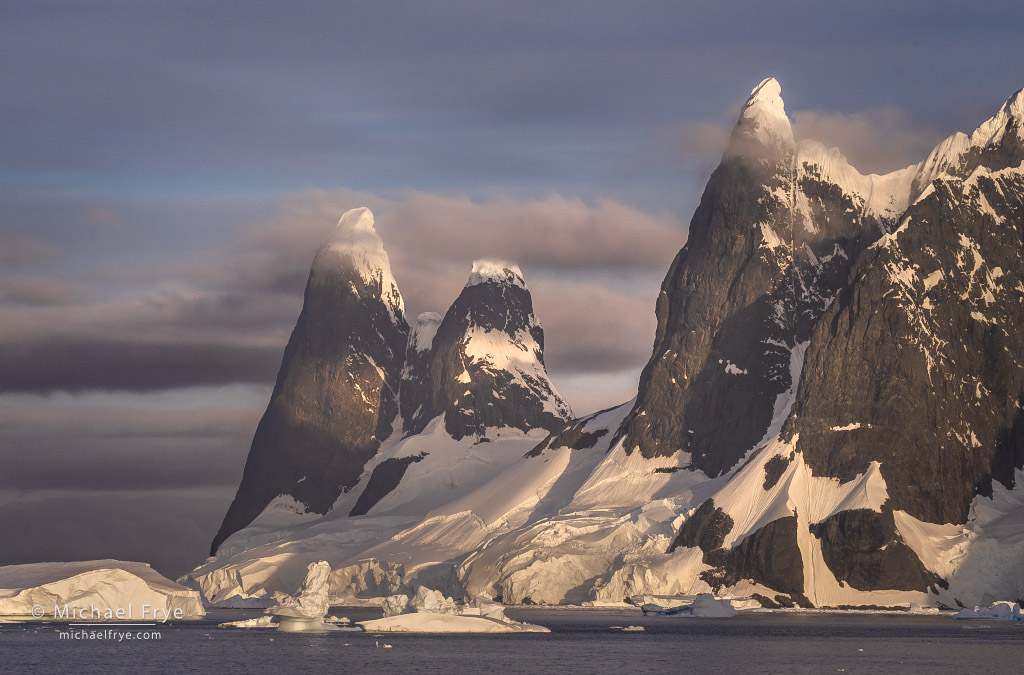
Snow-capped spires, Antarctica. 158mm, 1/500 sec. at f/11, ISO 500.
It’s taken me a long time to go through all my photos from our January trip to Antarctica – all 41,000 of them! I previously posted images of natural ice sculptures, and penguins. But this time I thought I’d focus on wider landscapes, and the beautiful Antarctic light.
Antarctic light is special. When we arrived in early January the sun rose at 2:45 a.m., and at an azimuth of about 160 degrees. That’s just a tad to the east of due south (180 degrees). Then the sun carved a low path through the sky to the east, north, and west, finally setting (at midnight) just a little bit west of where it rose, at an azimuth of about 200 degrees. It never got truly dark.
But the best part was that sunrises and sunsets were long, lingering affairs. Beautiful golden light lasted hours.
Of course skies could be overcast, which would snuff out that golden light. It could rain or snow. Last year we were actually enveloped in fog for a day and a half (which I loved). Sometimes – rarely – we had a completely sunny day or two.
But often we’d get a mix of sun and clouds. We frequently saw clear skies over land, where glaciers and icecaps created cool downdrafts that inhibited cloud formation, while the waterways were covered with clouds. (We observed the same thing in Greenland last September.)
This mix of sun and clouds was often quite beautiful, with dappled, chiaroscuro light, sunbeams, or dramatic clouds. But sometimes the most interesting light was in the distance, at places where land and water met. So my 100-400mm lens got a workout focusing on that light against distant slices of mountains and clouds.
Most of these photos were handheld, of course, either from our ship (the Hans Hansson) or a zodiac. Handholding with a long lens required reasonably fast shutter speeds, which in turn sometimes required pushing up the ISO. But modern noise-reduction tools have become so good that I don’t worry about that much. I know I can still get sharp, noise-free results that will hold up even in a large print. It’s actually quite liberating.
Of course I would still try to keep the ISO as low as possible, which meant using as slow a shutter speed I could get away with to avoid pushing up the ISO more than necessary. But a rocking boat with a telephoto lens is a recipe for blurry photos, even with image stabilization, so at longer focal lengths I kept the shutter speed high – at least 1/350th of a second.
I also kept the camera in continuous shooting mode, and fired off bursts of three or four frames at a time. Often the first and last frames of a burst would be a little soft, because pressing or releasing the shutter button would cause some movement. But the middle frames, where I was holding the camera steady, would be sharp. Using that technique meant having more photos to edit, but it was worth it to get sharp images with as little noise as possible.
Photographing from a moving boat can also sometimes require making quick decisions about composition. I actually started my career photographing mostly wildlife, and with moving subjects like animals you often have to make instantaneous decisions about composition – where to place the animal in the frame, whether to include its surroundings, how much of those surroundings, and so on. That training has helped me with landscape photographs. Even on land I sometimes have to make fast compositional decisions before the light changes. And a moving boat can force you to make those choices almost instantaneously.
I think any kind of cross-training you can do as a photographer is helpful. Practicing street photography can help your nature photographs. Learning studio lighting will increase your understanding of natural light. Composing landscape photographs can help you make better compositions with wildlife images, and vice versa. It’s all photography, and while there are certain skills that might apply more to some genres than others, there’s a lot of crossover, and the most essential elements are the same.
I used all those varied skills in Antarctica while photographing the abundant wildlife, or composing landscape images from a moving platform. But it was all a lot of fun, as there were photographs everywhere, with an endless array of spectacular landscapes to go along with that Antarctic light. Sometimes during a long, lingering sunset I stayed on deck for hours, unable to tear myself away for fear of missing something. Except that occasionally, when things got really good, I’d go below and encourage people who weren’t already on deck to get out and photograph the magic light!
— Michael Frye
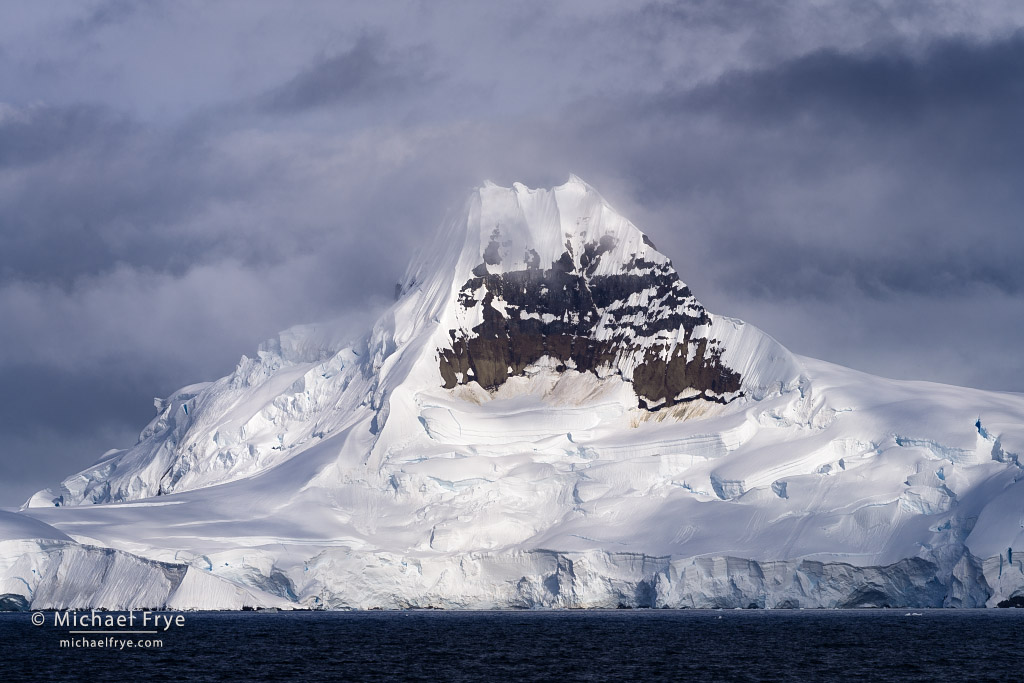
Peak, glacier, and clouds, Antarctica. 241mm, 1/350 sec. at f/11, ISO 100.
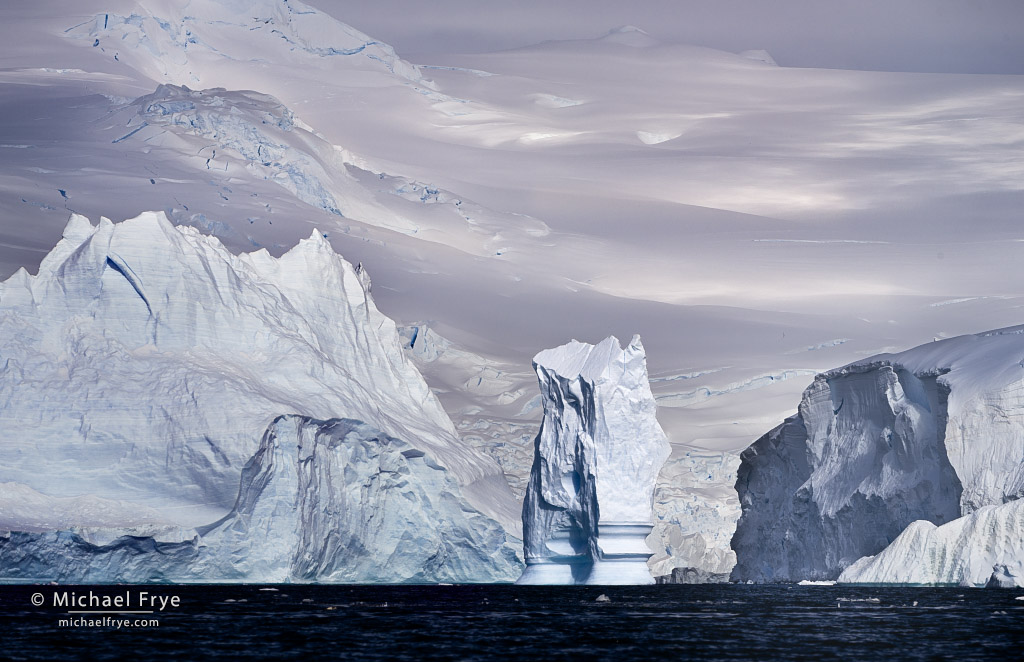
Ice tower and icefield, Antarctica. 315mm, 1/750 sec. at f/11, ISO 100.
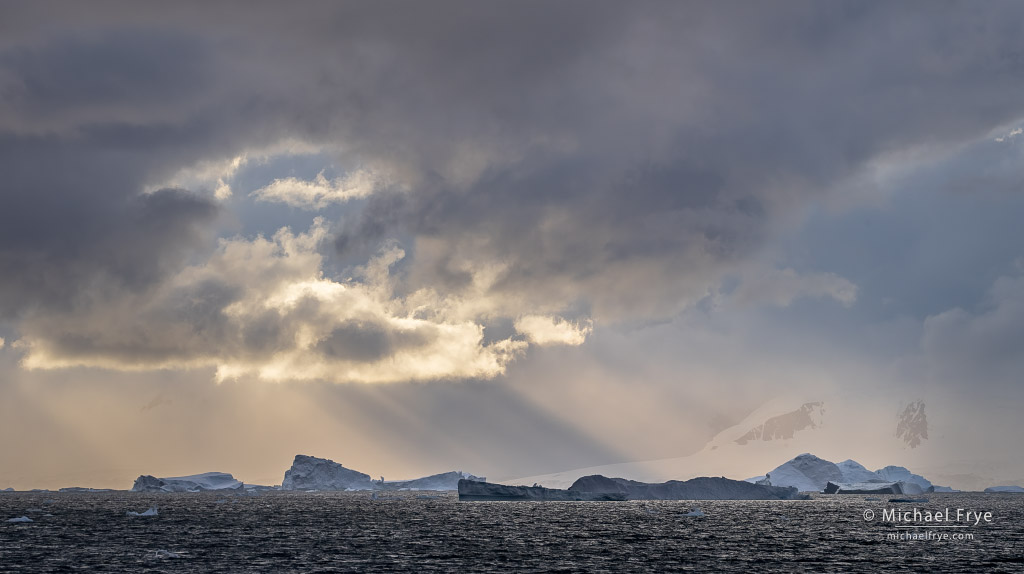
Clouds, sunbeams, and icebergs, Antarctica. 196mm, 1/750 sec. at f/11, ISO 640.
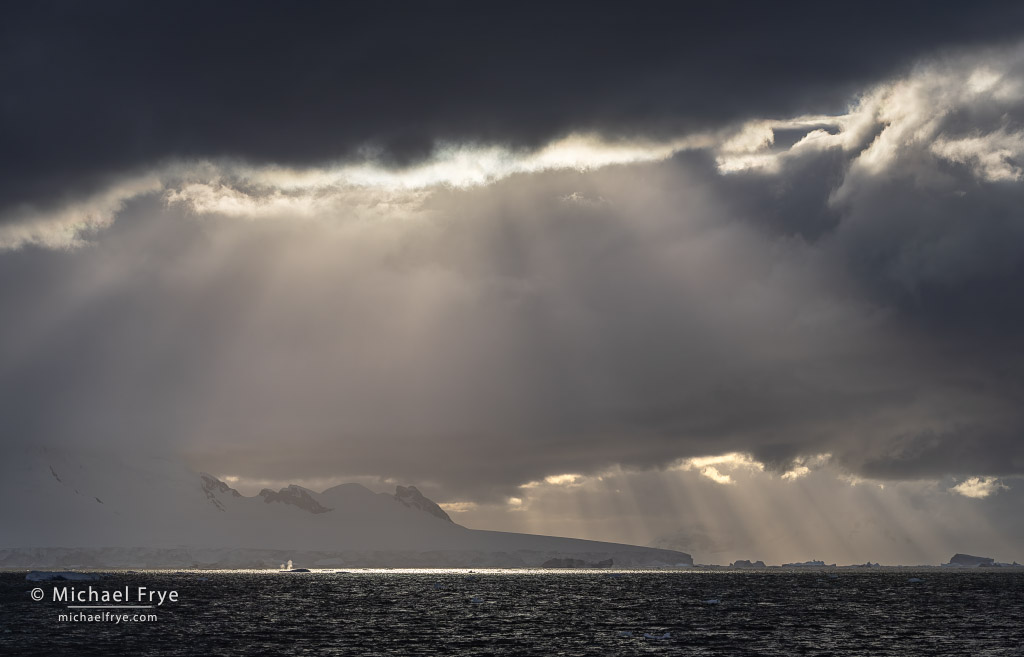
Clouds, sunbeams, and whale spouts, Antarctica. 100mm, 1/750 sec. at f/13, ISO 100.
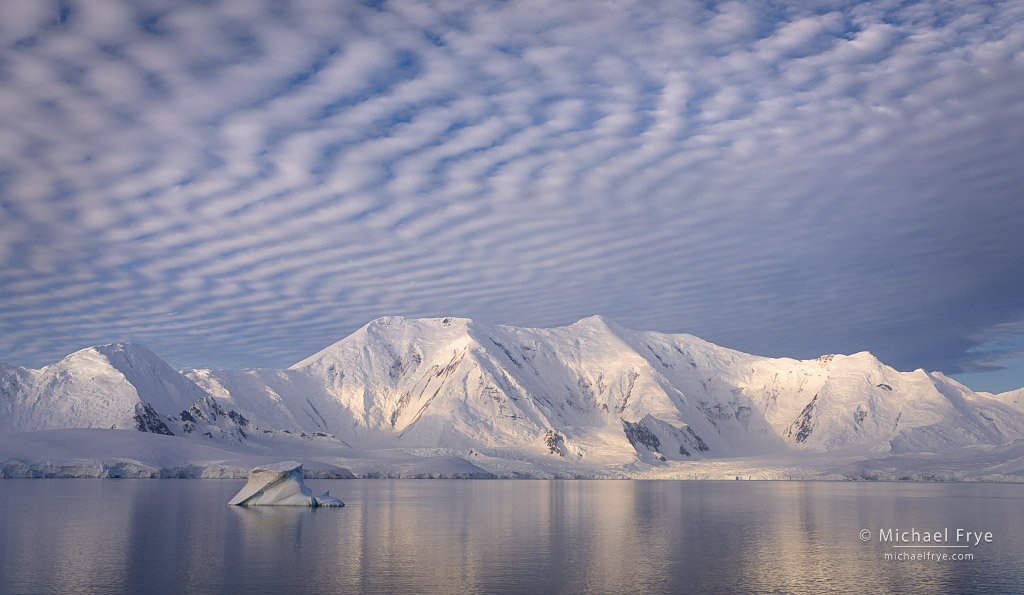
Ice-covered mountains under a mackerel sky, Antarctica. 37mm, 1/125 sec. at f/11, ISO 100. (This was actually photographed from land, with a tripod.)
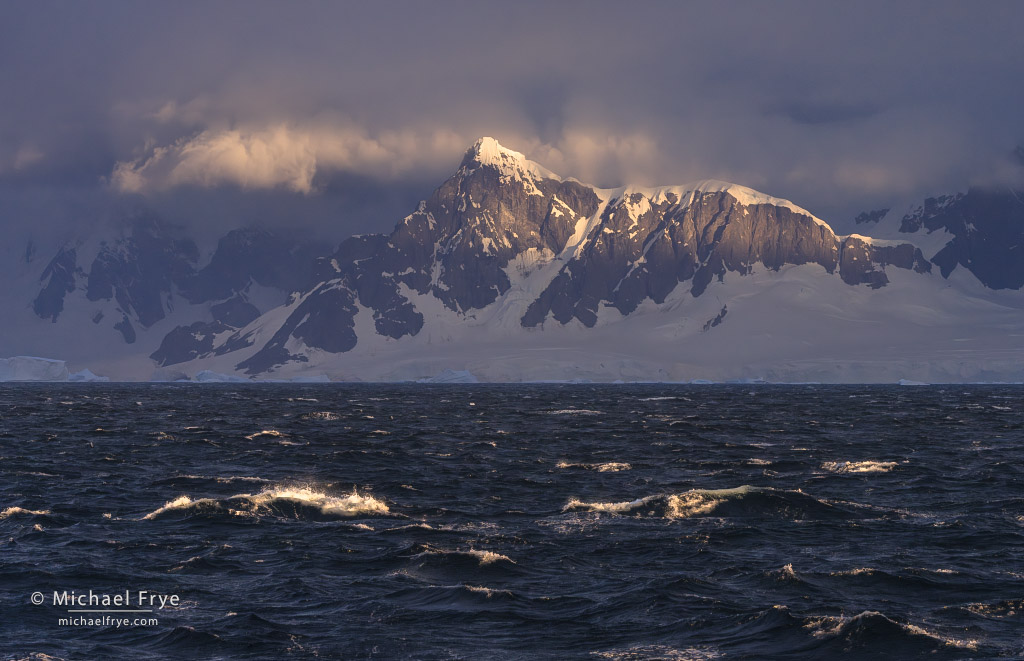
Mountains and whitecaps, Gerlache Strait, Antarctica. 203mm, 1/750 sec. at f/16, ISO 3200. I wanted to ensure that both the foreground waves and background peak were in focus with this long lens, so I stopped down to f/16. Waters were rough, as you can tell, and the ship was pitching, so I set my shutter speed to 1/750 sec. to ensure getting sharp handheld images. Those settings, plus the low light levels late in the day, meant pushing the ISO up to 3200 to get the right exposure, but Adobe’s Denoise did a great job of dealing with the noise.
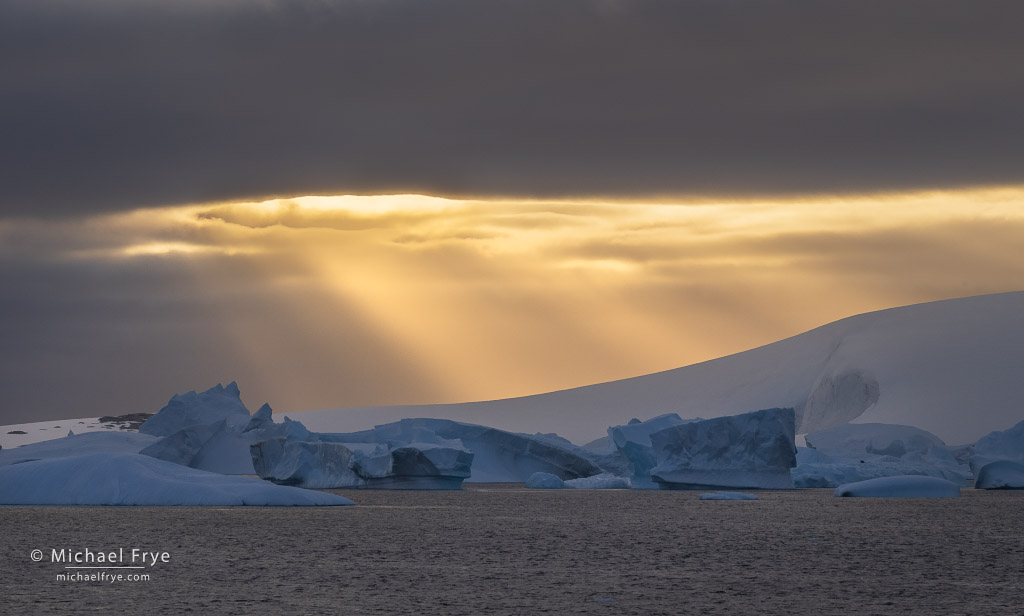
Icebergs and sunbeams, Antarctica. This was a handheld bracketed sequence – three shots, two stops apart. I used Lightroom’s HDR merge with “Auto-Align” checked to blend the three exposures, and it worked perfectly. 244mm, shutter speeds from 1/250 sec. to 1/4000 sec. at f/16, ISO 320.
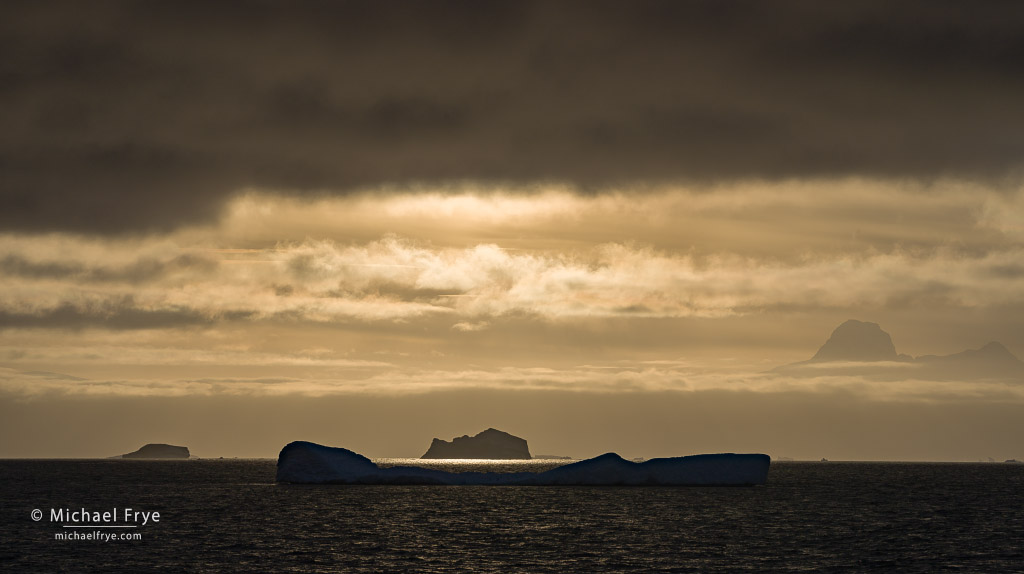
Icebergs and mountains at sunset, Antarctica. 156mm, 1/1000 sec. at f/16, ISO 100.
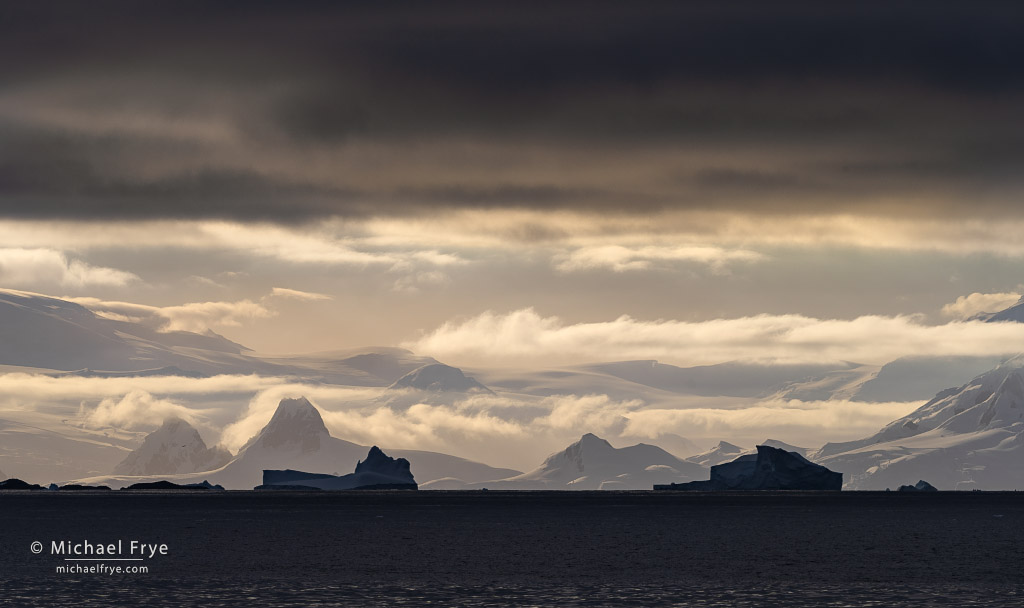
Mountains, clouds, and icebergs, Antarctica. 274mm, 1/750 sec. at f/11, ISO 160.
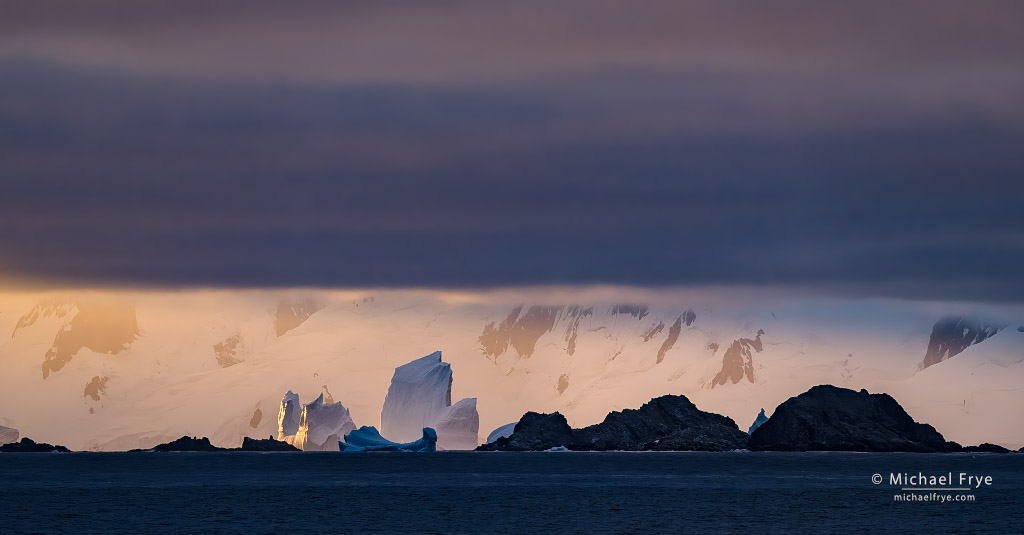
Rocks and icebergs at sunset, Antarctica. 400mm, 1/750 sec. at f/8, ISO 1600.
Related Posts: Ice Sculptures; One Day in Antarctica; Leaping Penguins
Michael Frye is a professional photographer specializing in landscapes and nature. He lives near Yosemite National Park in California, but travels extensively to photograph natural landscapes in the American West and throughout the world.
Michael uses light, weather, and design to make photographs that capture the mood of the landscape, and convey the beauty, power, and mystery of nature. His work has received numerous awards, including the North American Nature Photography Association’s 2023 award for Fine Art in Nature Photography. Michael’s photographs have appeared in publications around the world, and he’s the author and/or principal photographer of several books, including Digital Landscape Photography: In the Footsteps of Ansel Adams and the Great Masters, and The Photographer’s Guide to Yosemite.
Michael loves to share his knowledge of photography through articles, books, workshops, online courses, and his blog. He’s taught over 200 workshops focused on landscape photography, night photography, digital image processing, and printing.