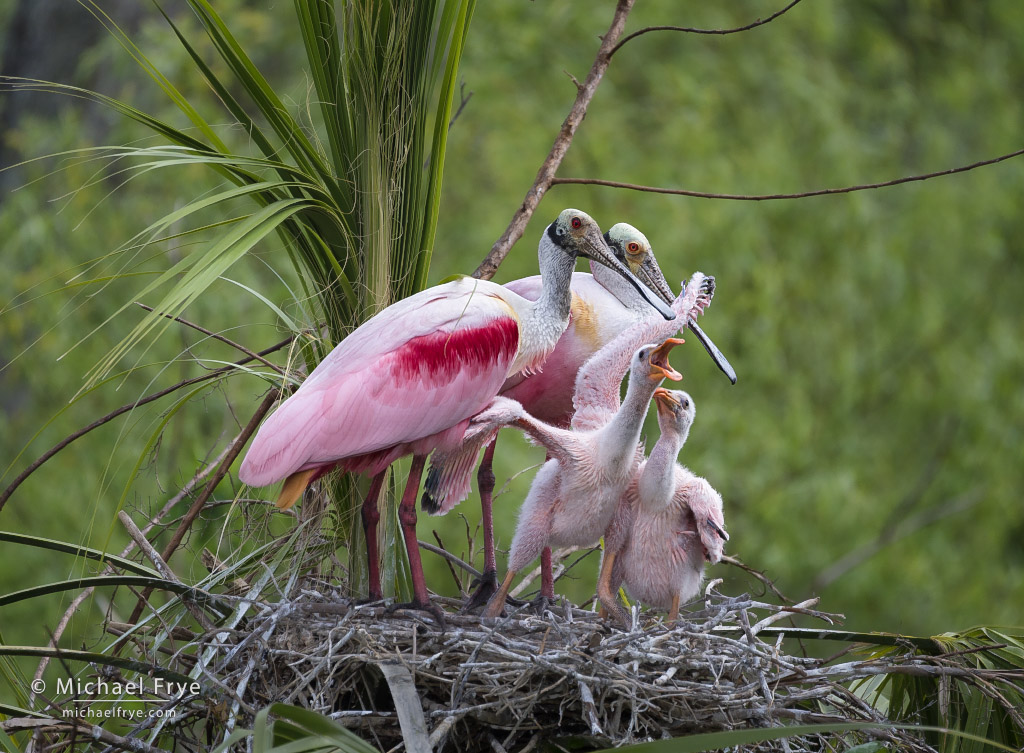
Roseate spoonbill nest with adults and nestlings, or “teaspoons”. It required patience to get the right light (soft light as a cloud passed over the sun), with all four birds in good positions, and their eyes all visible. Having the one nestling spreading its wings and opening its beak (begging for food) was a bonus. I composed this to include some of the saw palmetto the nest was built around to show the environment. 400mm, 1/1500 sec. at f/5.6, ISO 640.
Claudia and I recently returned from Florida, where I was one of the instructors at the Out of Merritt Island Bird Photography Conference. What a great event! This was the first time the Out of Chicago team has put on a bird-photography conference, and it was a lot of fun. My fellow instructors were all fantastic, the participants were super-nice – and eager to learn – and, as usual, the Out of Chicago team did a great job organizing the conference.
And then, of course, there were the birds. I had photographed birds in Florida briefly in 2002, but this was the first time I’d been back since then, and the first time I’d made a trip to Florida specifically focused on bird photography. And it’s a wonderful place for birds. There’s an incredible variety of species – and photogenic species at that – plus so many of the birds are easily approachable.
In Florida, species that would fly away at the first sight of a human in other parts of the country will allow you to practically walk right up to them. It’s pretty amazing. And it was an ideal place to hold a conference like this, since there were endless opportunities, and people could concentrate on learning lighting, composition, action, camera settings, and technique, rather than worrying about how to get close to a bird.
My fellow instructors in this conference all had different styles and approaches to photographing birds, which was cool to see, and I learned things from all of them. My teaching partner for the field sessions during the conference was Ray Hennessy, who is an amazing photographer and wonderful teacher. It’s rare to find people who are both good at what they do, and good at teaching it as well, but Ray is one of those rare birds (pardon the pun).
Although Ray and I have different styles in many ways, we definitely have things in common. Ray is known for his “small-in-the-frame” wildlife photos, where the animal isn’t necessarily filling the frame, and he’s using the animal’s surroundings to create something artistic, and add to the photograph’s mood.
And I try to do that as well. If you’re a regular reader of this blog you know that I like to make landscape photographs that convey a mood or feeling. And I try to do the same with wildlife images. I bring my landscape-photography sensibilities to photographing animals, which means trying to capture a mood, and, if possible, tell a story about the place – the habitat the animal depends on for breeding, resting, and feeding. That could be just a small slice of the animal’s surroundings, or it could be a much larger piece.
But I’m not averse to taking closeup photos of birds either. While I may look for certain things, the animals, light, clouds, wind, and surroundings dictate what’s possible. So I try to be opportunistic, and take what the situation gives me. If there’s an opportunity to create something moody, or something that shows the animal’s habitat (or both), great. But I’m not going to pass up the chance to photograph some interesting behavior or action, or just show a beautiful bird in beautiful light.
So here are some of my favorite photographs from Florida. I hope this selection shows some of the wonderful variety of birds, behaviors, and situations we encountered on the trip. It was a special treat to photograph these birds, both while scouting before the conference, and then during the conference alongside the participants and my fellow instructors. I hope we get to do it again.
— Michael Frye
P.S. Wildlife photography often requires fast shutter speeds to freeze motion. And that frequently means pushing up the ISO, which, of course, can produce noise. But you can encounter noise with landscape photos as well – at night or dusk, or when you need to fast shutter speed to freeze the motion of windblown branches, or in low-light situations where you can’t use a tripod and have to handhold the camera.
My next webinar addresses all the ins and outs of sharpening and noise reduction, and there’s still time to get the early-bird discount. Use the code SHARP20 to get 20% off until midnight tonight (Sunday, March 21st). Click here to sign up or learn more:
It’s All About the Details: Taking the Mystery out of Sharpening and Noise Reduction
May 18th, 2026
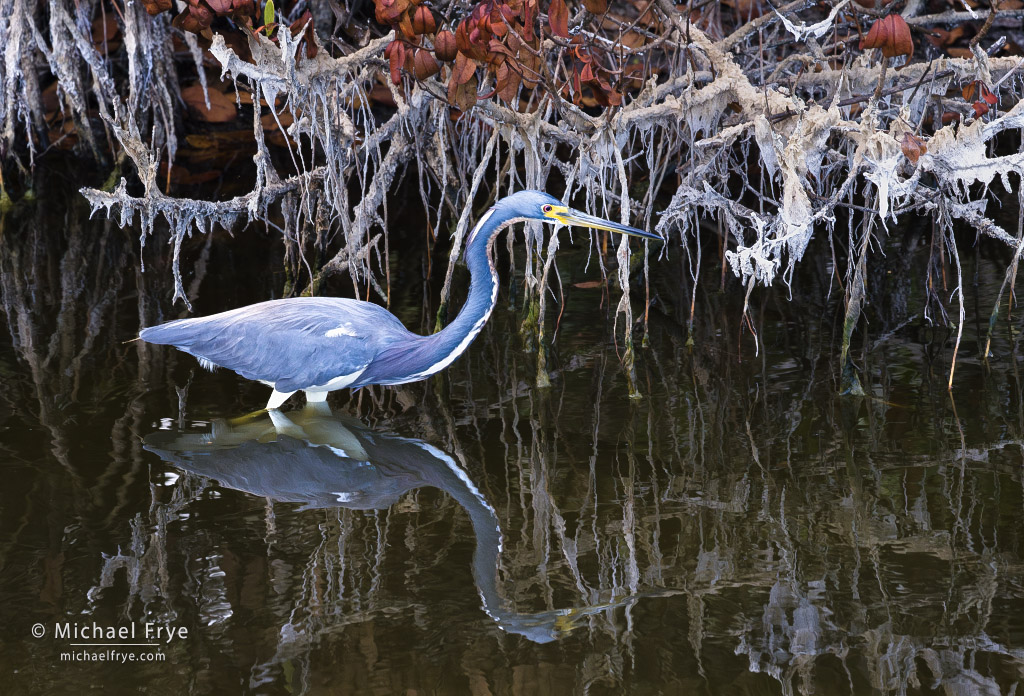
Tri-colored heron and black mangroves, Florida. I’m always looking for interesting surroundings for wildlife subjects to add interest and show where the animal lives. A recent freeze had caused the mangrove leaves along this waterway to turn rusty, creating photogenic patterns and colors. As this tri-colored heron moved along the bank, fishing, I picked a spot ahead of its path with some nice vegetation, sat down, and waited for the heron to move into position. 327mm, 1/350 sec. at f/11, ISO 2500.
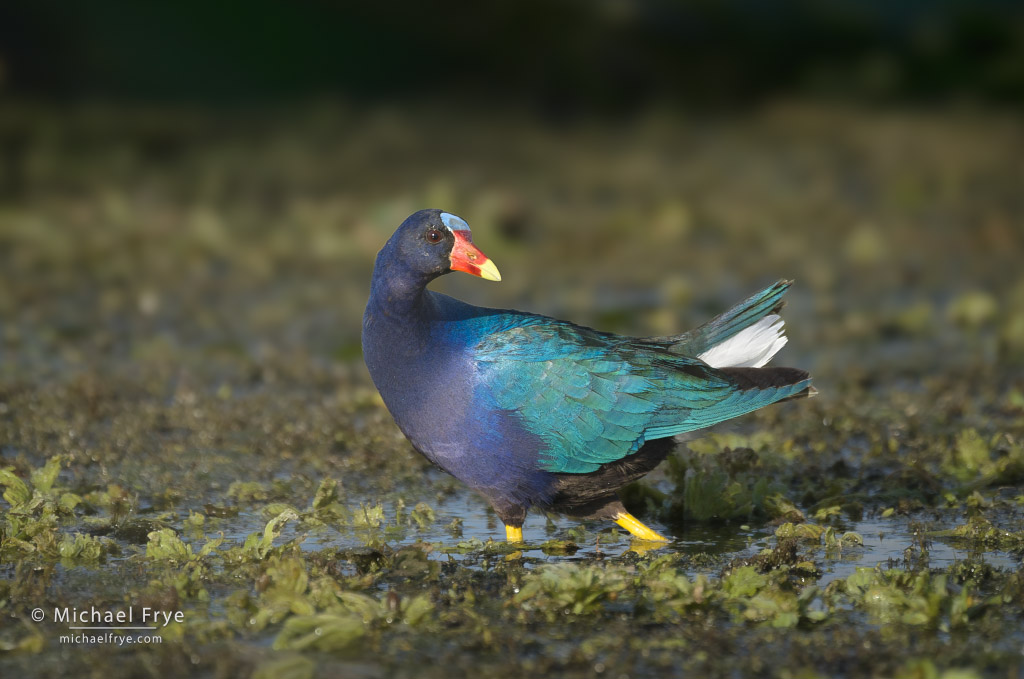
Purple gallinule, Florida. Purple gallinules are related to coots, but much more colorful. In this case the surroundings weren’t that photogenic, so I got down low and close to show the bird’s colors, and waited for a moment with an interesting pose or gesture. 479mm, 1/1000 sec. at f/8, ISO 640.
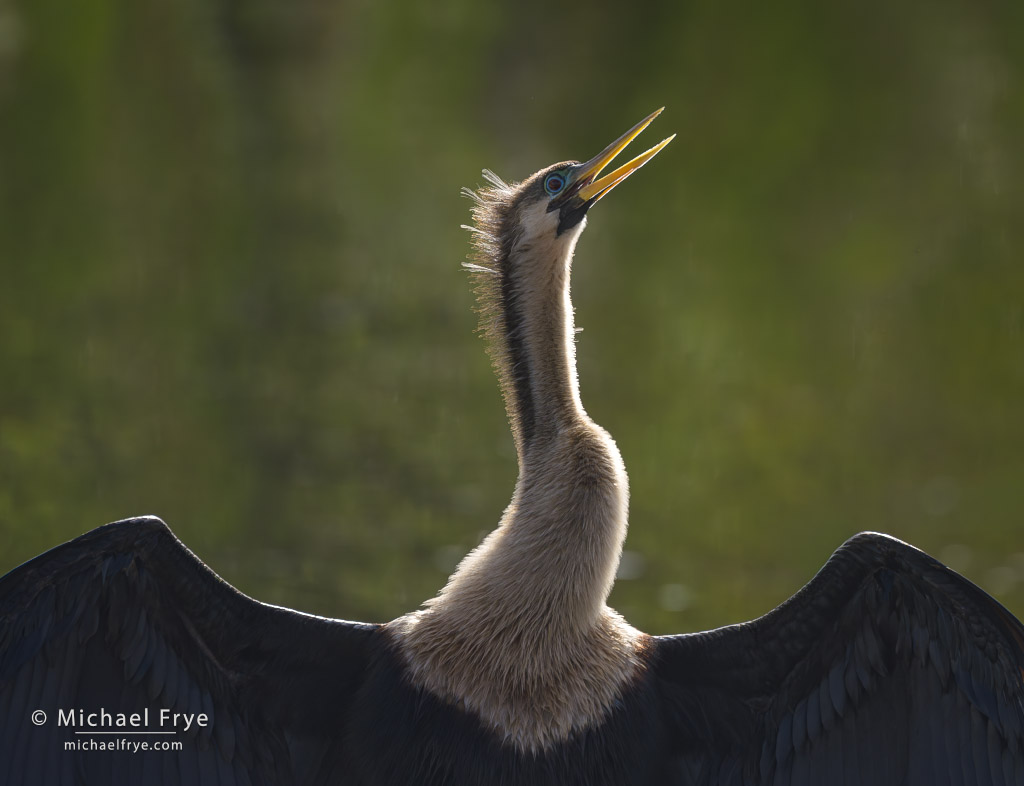
Anhinga, Florida. I liked how the backlight glowed through the anhinga’s feathers and beak, and was able to get close enough to emphasize those elements in the composition. 433mm, 1/1500 sec. at f/8, ISO 500.
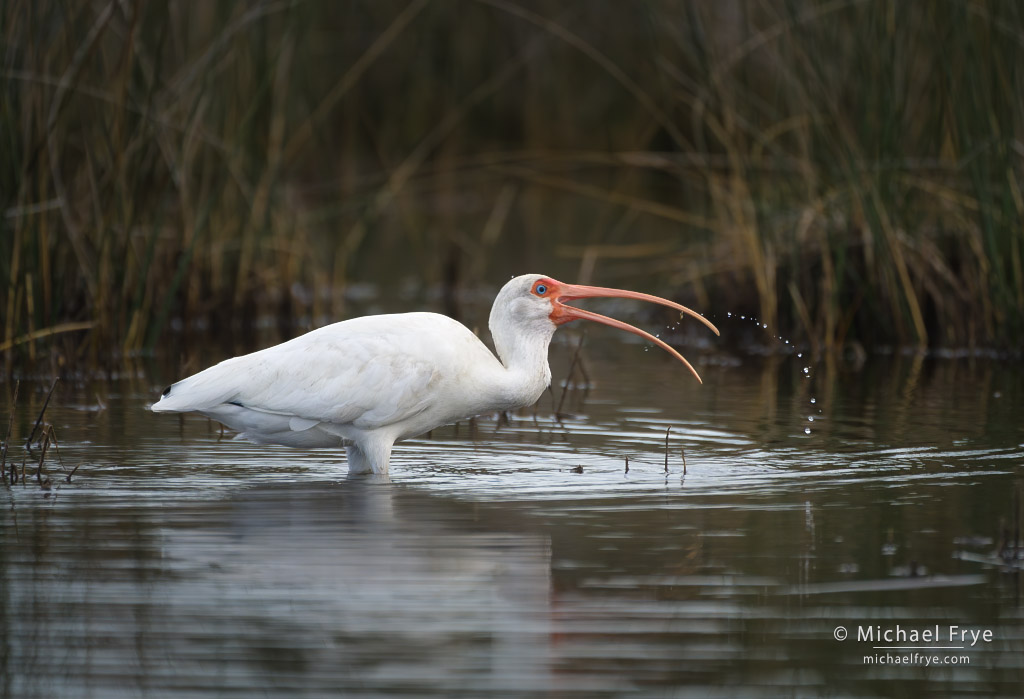
White ibis foraging in a saltwater marsh, Florida. Again, the surroundings weren’t that exciting, so I got low and close and tried to catch an interesting moment. 560mm, 1/1000 sec. at f/8, ISO 1600.
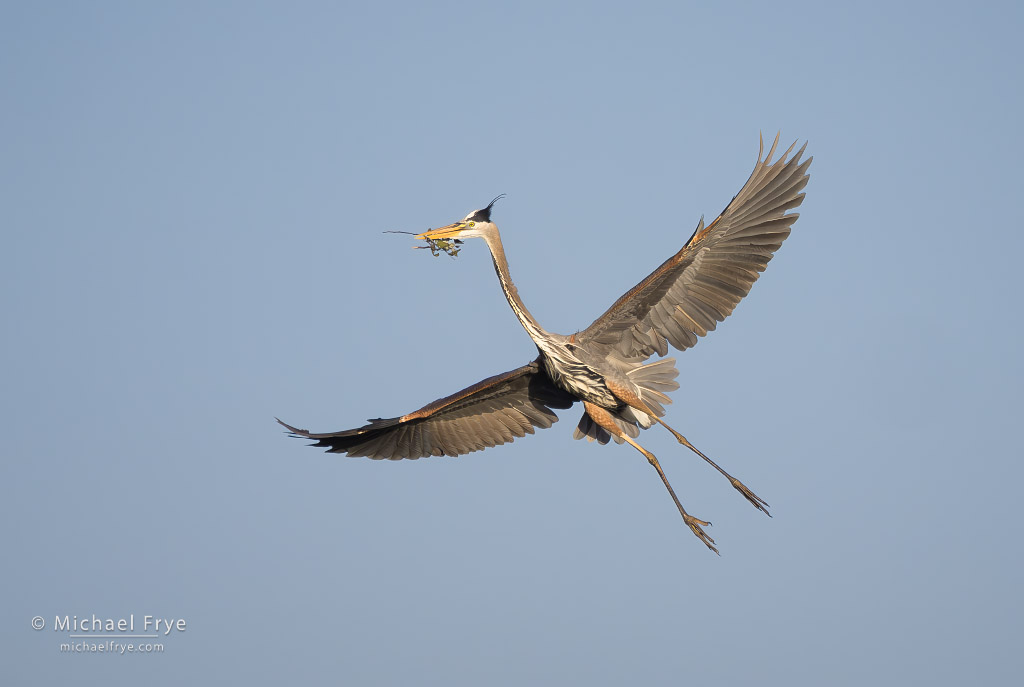
Great blue heron with nesting material, Florida. This was a spur-of-the-moment quick capture as I spotted this heron flying into its nest. Only later did I see that it had nesting material in its beak. 560mm, 1/1500 sec. at f/8, ISO 640.
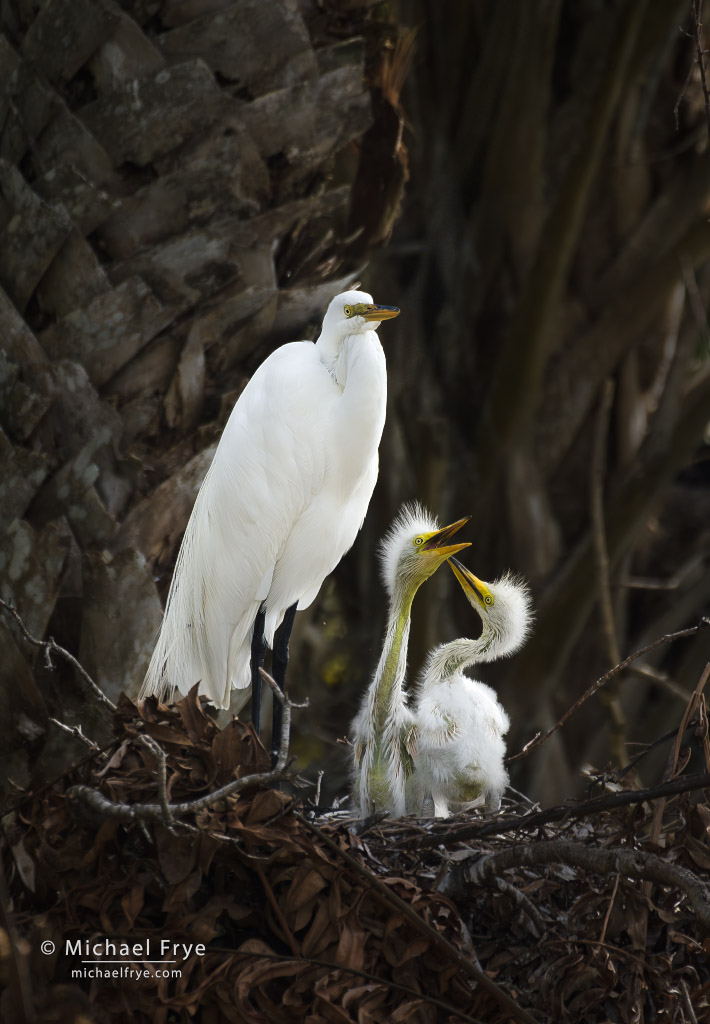
Great egret adult and nestlings, Florida. This nest was in deep shade underneath a saw palmetto, but I liked the soft backlight, and looked for a moment when the nestlings were active. 560mm, 1/1000 sec. at f/8, ISO 400.
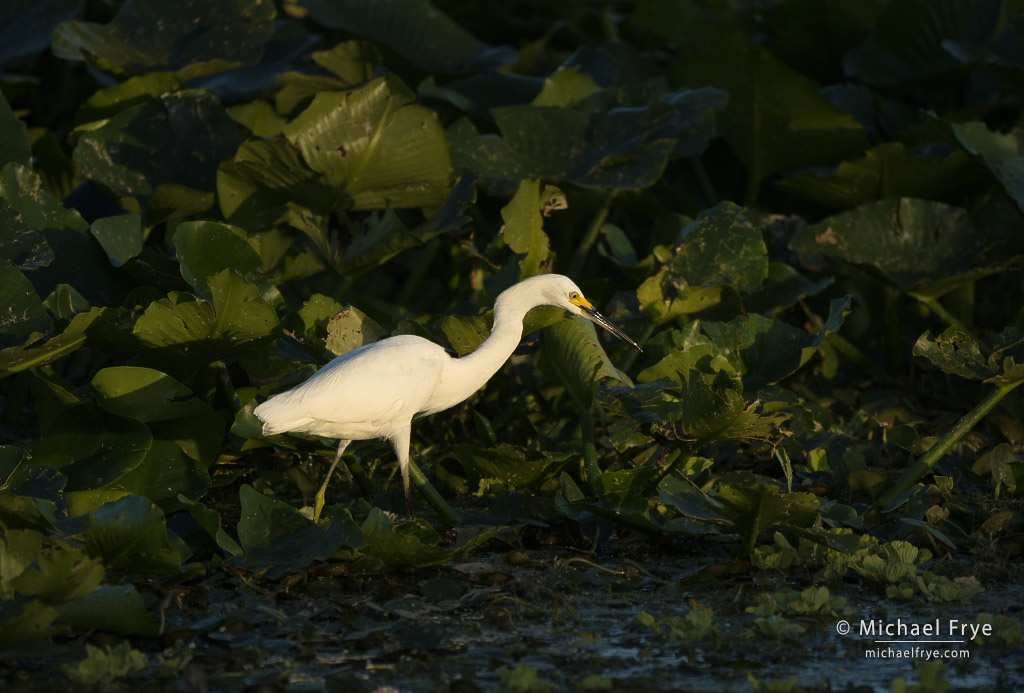
Snowy egret hunting through pond lilies in a Florida marsh. The chiaroscuro light created some drama here, with the pond lilies showing a small slice of characteristic habitat. 400mm, 1/2000 sec. at f/5.6, ISO 640.
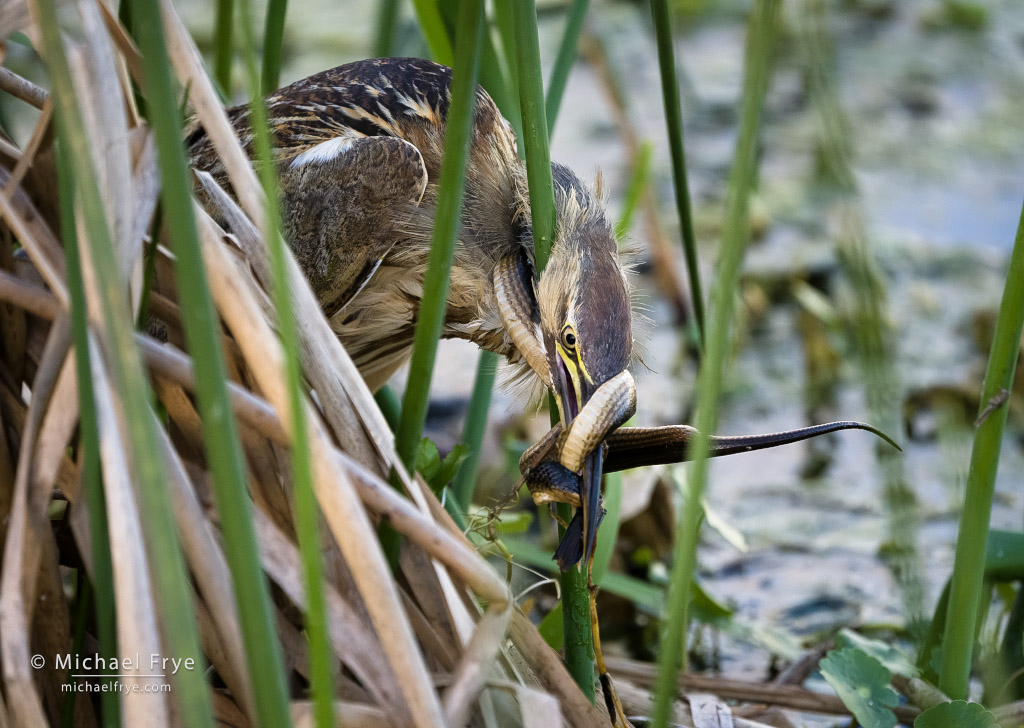
American bittern with a snake in a Florida marsh. I heard a rustle in the reeds near a path, investigated, and found this American bittern with a snake it had caught. The snake had wrapped itself around a reed, as well as the bird’s beak and neck, in an attempt to surive. Eventually the bittern took the snake behind some reeds, out of sight, so I wasn’t able to see how this drama ended, but I assume the bittern prevailed. 400mm, 1/1500 sec. at f/5.6, ISO 5000.
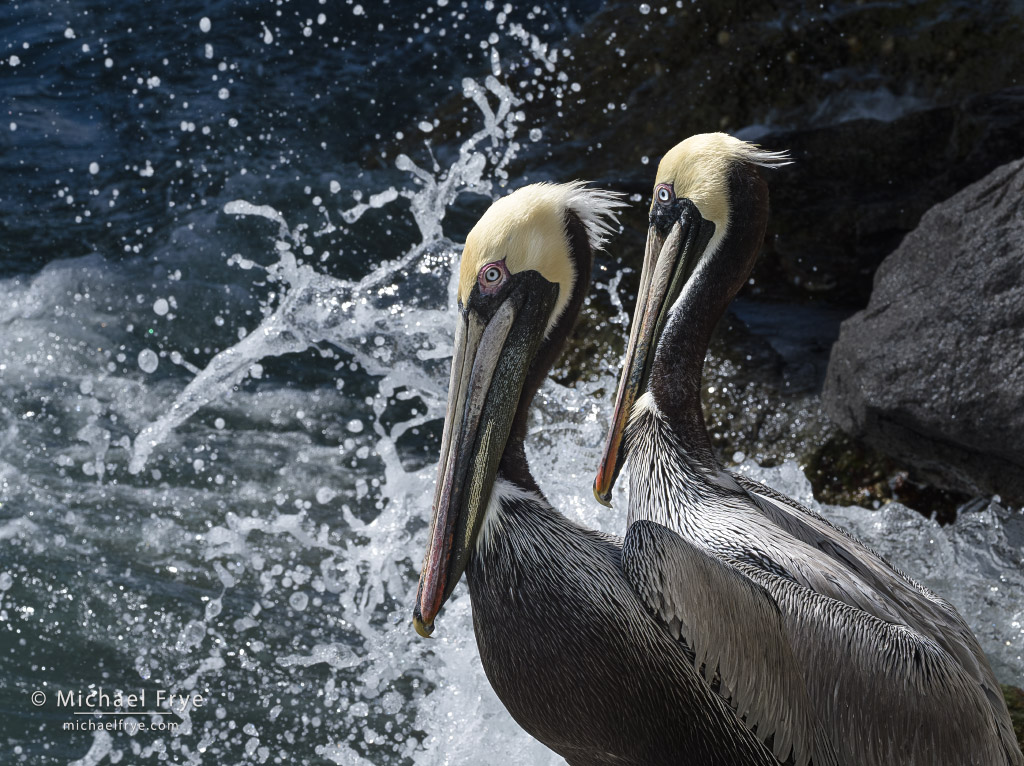
Brown pelicans in breeding plumage roosting on rocks next to the Atlantic Ocean, Florida. This was rather harsh, midday light, but it worked for highlighting these two pelicans and the splashing water. 183mm, 1/1000 sec. at f/16, ISO 400.
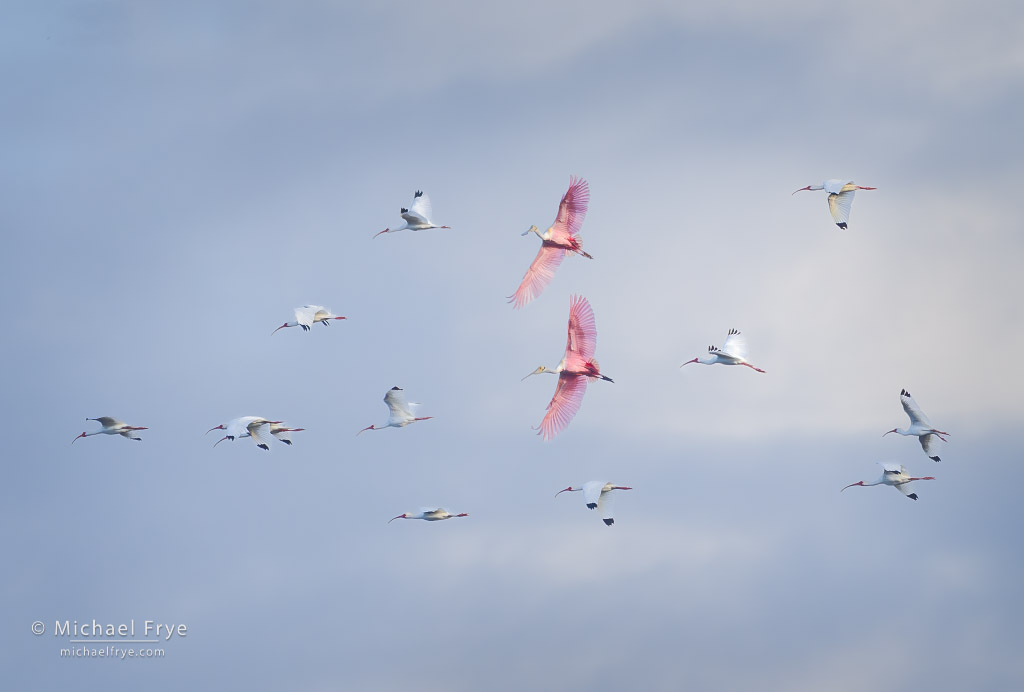
White ibises and roseate spoonbills, Florida. I noticed this flock of white ibises, focused on them, and then two spoonbills banked and joined the flock at just the right moment. 391mm, 1/1500 sec. at f/5.6, ISO 1250.
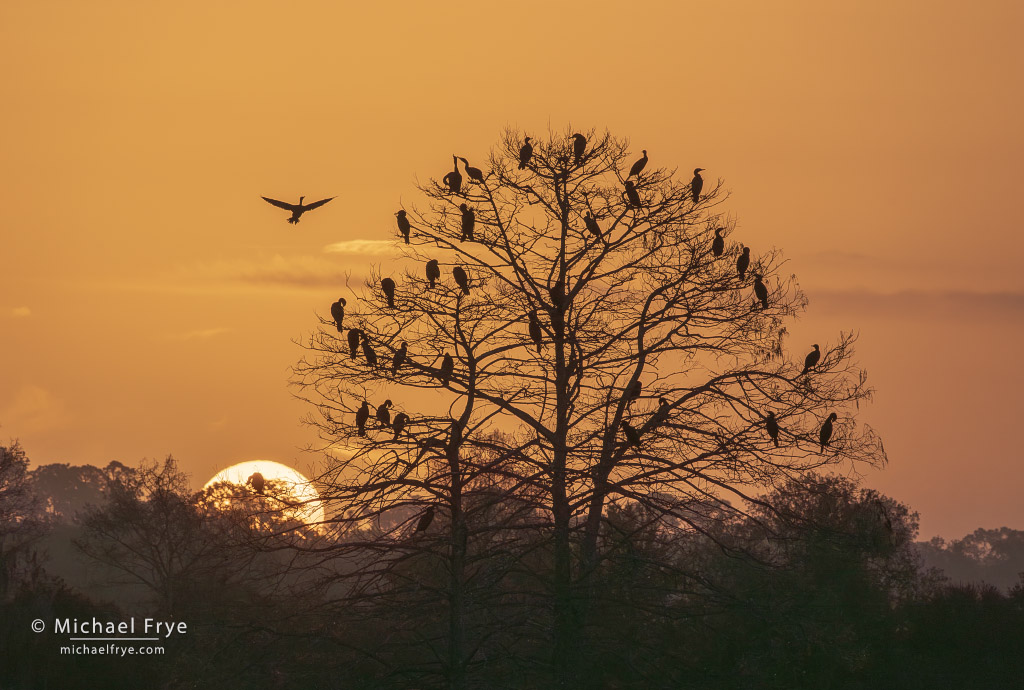
Double-crested cormorants roosting in a tree at sunrise, Florida. Seeing this tree full of roosting cormorants with the sun rising behind them, I realized this was a great opportunity to show birds and some of the Florida habitat with dramatic light. 400mm, 1/1000 sec. at f/11, ISO 100.
Related Posts: Out of Merritt Island Bird Photography Conference; Leaping Penguins
Michael Frye is a professional photographer specializing in landscapes and nature. He lives near Yosemite National Park in California, but travels extensively to photograph natural landscapes in the American West and throughout the world.
Michael uses light, weather, and design to make photographs that capture the mood of the landscape, and convey the beauty, power, and mystery of nature. His work has received numerous awards, including the North American Nature Photography Association’s 2023 award for Fine Art in Nature Photography. Michael’s photographs have appeared in publications around the world, and he’s the author and/or principal photographer of several books, including Digital Landscape Photography: In the Footsteps of Ansel Adams and the Great Masters, and The Photographer’s Guide to Yosemite.
Michael loves to share his knowledge of photography through articles, books, workshops, online courses, and his blog. He’s taught over 200 workshops focused on landscape photography, night photography, digital image processing, and printing.