
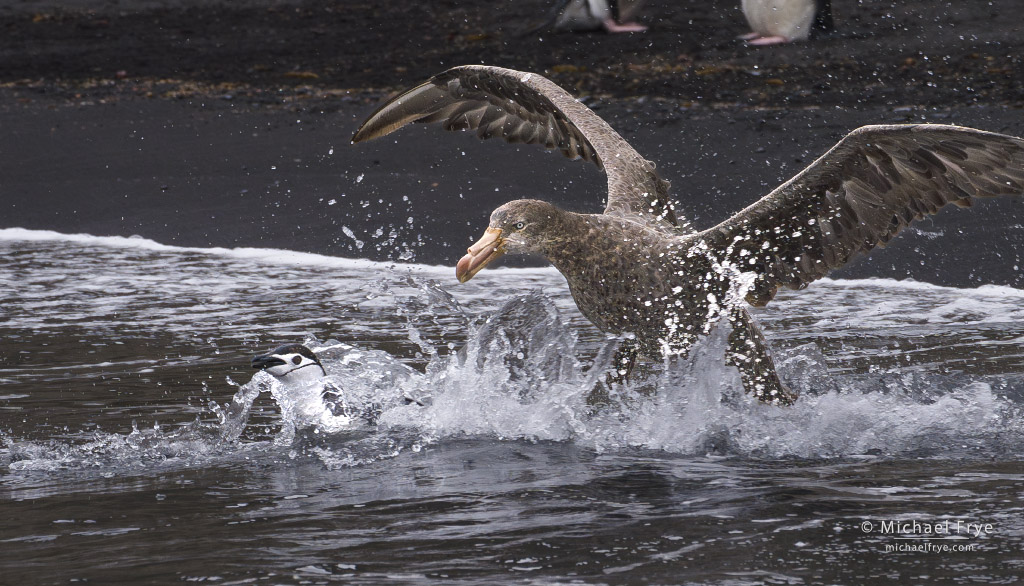
Southern giant petrel chasing a chinstrap penguin, Antarctica (it didn’t catch it)
On one of our zodiac cruises in Antarctica we visited a large chinstrap penguin colony, where penguins gathered on a black-sand beach as they were coming and going. We couldn’t land on this beach due to rough surf and high penguin activity, but our zodiac drivers hovered just offshore, giving us a great view.
The penguins attracted southern giant petrels. As you can see from the accompanying photos and video, giant petrels are big birds – larger than the chinstraps – with a six- to seven-foot wingspan. Petrels are quite aggressive, and will sometimes hunt penguins. They usually can’t catch a healthy adult penguin, but can catch chicks, or a sick or injured adult.
As we watched, we saw an immature petrel hunting penguins, so we tried to photograph this behavior. (Immature giant petrels are all brown, while adults are brown and white.) The photograph above shows this petrel chasing a chinstrap into the water (it didn’t catch it). The petrel walked up and down the beach, sometimes chasing after penguins, but with no success while we watched it. As the petrel patrolled the beach, penguins began to “mob” it, gathering around it and trying to chase it away, as you can see in this next image:
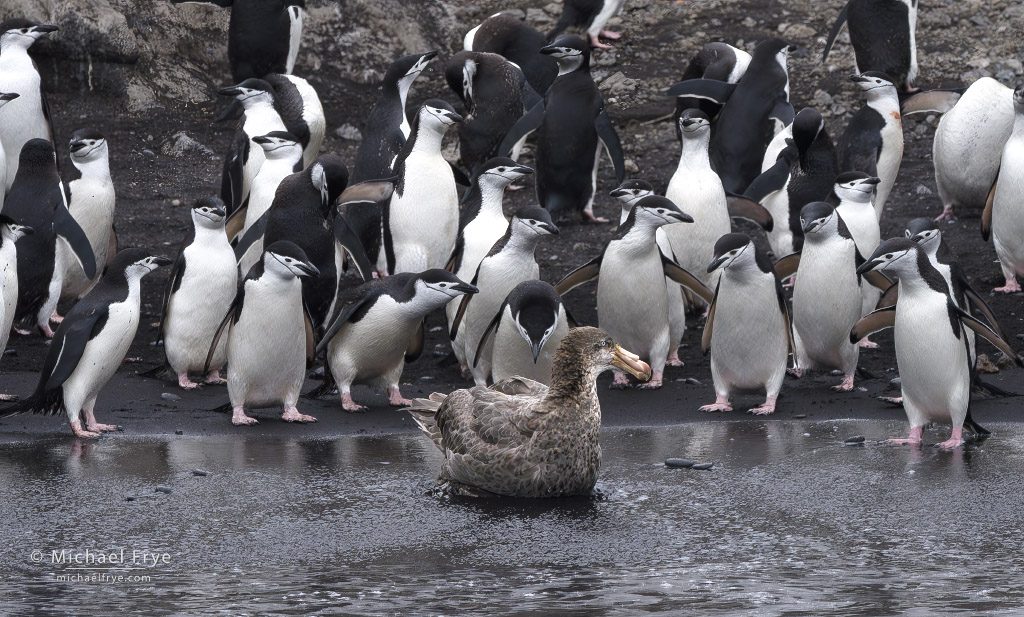
Chinstrap penguins mobbing a southern giant petrel, Antarctica
Eventually this petrel flew off to another part of the beach, and we realized why: apparently another petrel had caught a penguin, and all the nearby petrels gathered and fought over the carcass. This photo shows two petrels fighting:
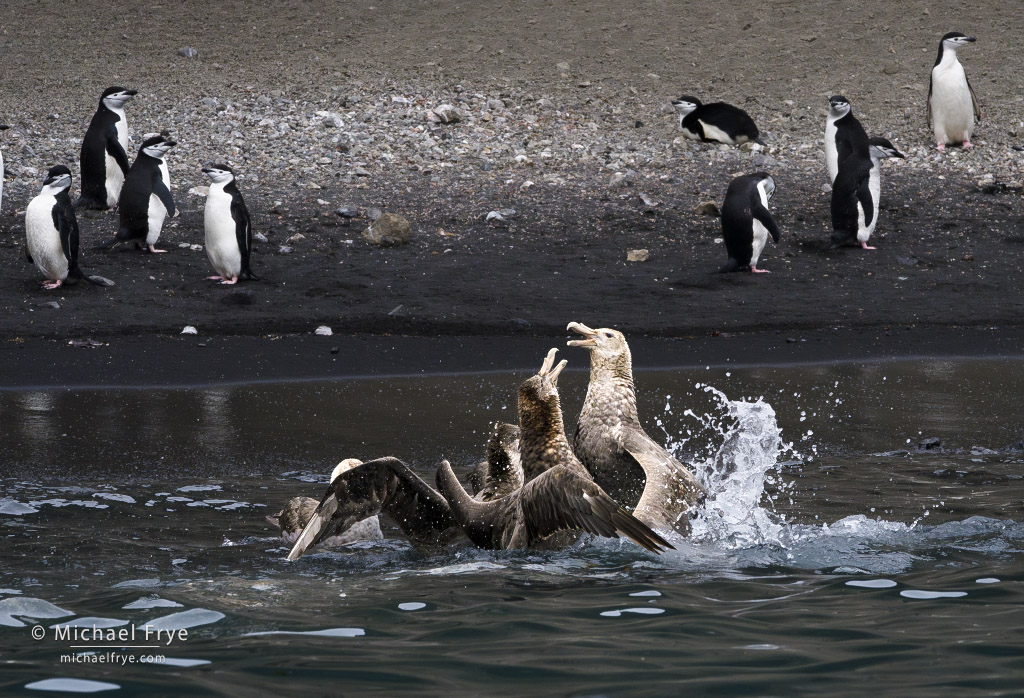
Southern giant petrels fighting over a penguin carcass, Antarctica
As the petrels tussled over the penguin carcass, we also saw them performing dominance displays. Sometimes this just meant raising their tails. Sometimes this involved what biologists call a “sealmaster” posture, where the bird holds its head and wings outstretched, with the head pointing toward its opponent and the wingtips pointed downward.
Claudia made a great video showing the petrels feeding on the penguin in the surf, fighting over the carcass, and making dominance displays, including the “sealmaster” posture, and another display where one of them waves its head from side to side. Watching this video you’ll probably feel sorry for the penguin, as we did, but it’s really interesting seeing the petrel behavior. That’s nature I guess. Here’s Claudia’s video:
Few animals can adapt to Antarctica’s extreme climate, but those that do are remarkable creatures. Penguins have given up the ability to fly in order to increase their aquatic agility. They’re superb swimmers, which allows them to efficiently feed on the abundant marine life in Antarctica (especially krill), yet they can still nest on land in relative safety because there are no land mammals to prey on them. But wherever there’s a potential food source someone will find a way to exploit it, so the giant petrels have learned to hunt penguins, with some success. It was fascinating to watch this in action.
— Michael Frye
Related Posts: Ice Sculptures; Life on Ice
Michael Frye is a professional photographer specializing in landscapes and nature. He lives near Yosemite National Park in California, but travels extensively to photograph natural landscapes in the American West and throughout the world.
Michael uses light, weather, and design to make photographs that capture the mood of the landscape, and convey the beauty, power, and mystery of nature. His work has received numerous awards, including the North American Nature Photography Association’s 2023 award for Fine Art in Nature Photography. Michael’s photographs have appeared in publications around the world, and he’s the author and/or principal photographer of several books, including Digital Landscape Photography: In the Footsteps of Ansel Adams and the Great Masters, and The Photographer’s Guide to Yosemite.
Michael loves to share his knowledge of photography through articles, books, workshops, online courses, and his blog. He’s taught over 200 workshops focused on landscape photography, night photography, digital image processing, and printing.






Great video Claudia! So difficult to hold the camera so steady and keep pointing to the subjects within the frame.
Michael, thanks for sharing your terrific photos and interesting descriptive dialog. Fun to learn more about our planet and living creatures.
Well done Claudia and Michael!Thank you for taking me back to Antarctica.
I remember seeing Giant Petrels in New Zealand, but I didn’t realize how massive they were until shown next to that poor penguin. You blog and images are so informative, and Claudia’s video really captures the drama.