
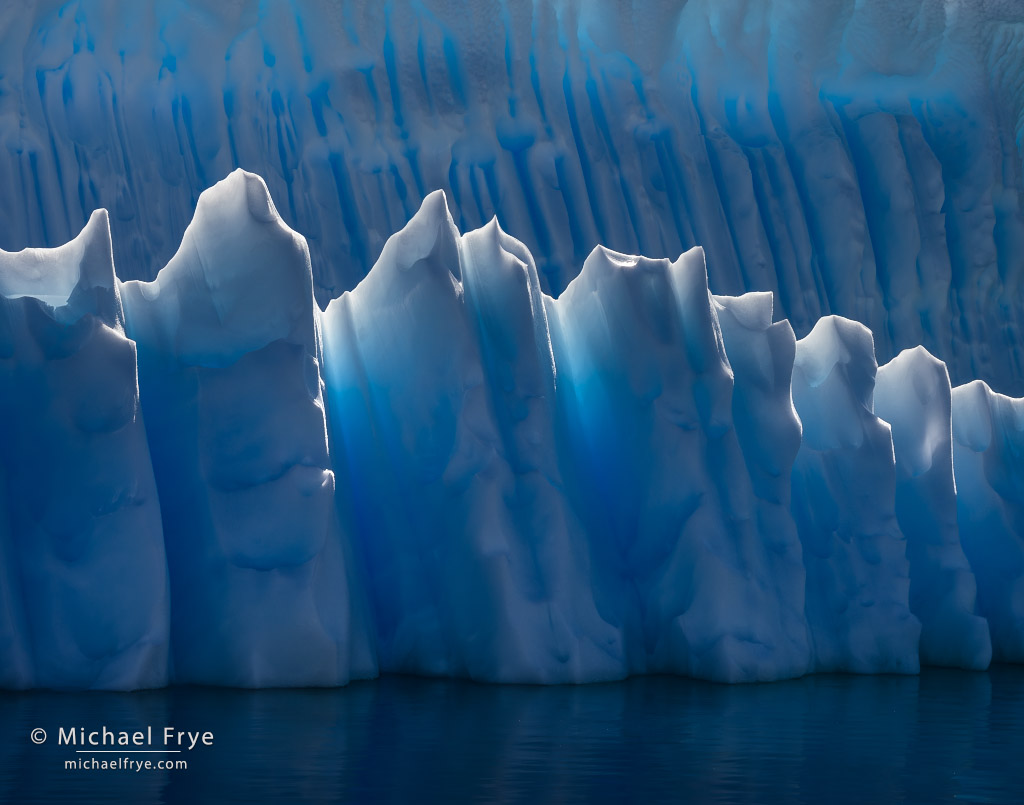
Icy glow, Antarctica. We were lucky to find this beautiful backlight catching the tops of these ice fingers.
Claudia and I just returned from Antarctica. This was our second trip to the bottom of the world, and it was just as amazing and wonderful as the first. On both trips I tried to make photographs that capture something of what it’s like to be there, but even my best images can’t convey the actual experience. It’s truly like traveling to a different planet.
Once again I was teaching for Visionary Wild aboard our small, chartered ship, the Hans Hansson. This time my co-instructor was Visionary Wild founder and owner Justin Black, and we shared the experience with a wonderful, fun group of participants, along with the ship’s small, stellar crew. Most of the crew members were the same as last year, so it was great to see familiar faces, and they couldn’t have been nicer.
Although I’d probably take any opportunity to go back to Antarctica on any ship, I know the experiences aboard the Hans Hansson have spoiled me. We get to spend almost two full weeks in Antarctica, eliminating at least four days (round trip) of rough seas across the Drake Passage by flying to King George Island. Better yet, since we’re the only party aboard the ship, we have great flexibility to modify our itinerary to take advantage of conditions, and make spontaneous detours to interesting icebergs or other things we find. And when we go ashore to a penguin colony it’s just us – no more than 15 people including participants, photography instructors, and a couple members of the ship’s crew as guides. Larger ships can send up to 100 passengers ashore at a time (plus guides). I can’t think of a better way to experience and photograph this place.
On last year’s trip I captured over 35,000 frames. This year, since I’d been to Antarctica before, I figured I would be more selective. Yet somehow I exceeded last year’s number, and came home with over 41,000 new raw files! Again, that’s largely due to the type of photography required. We had a lot of great opportunities for wildlife photography this trip, and photographing animals usually requires taking a lot of frames to get one good one. But in Antarctica you’re also usually photographing landscapes from a moving ship or zodiac, so the scenes and juxtapositions are constantly changing in not-entirely-predictable ways, and, again, you have to take a lot of frames to ensure getting the best angle, or the right foreground-to-background juxtaposition.
In any case, I have a lot of images to sort and process. One thing I really enjoyed on this trip was photographing the tremendous variety of ice formations. I’ve now photographed icebergs on two trips to Antarctica and one trip to Greenland, and have been amazed at how natural processes can sculpt ice into an endless variety of shapes and patterns.
Every iceberg is gradually melting. As it melts, a piece might break off, which upsets the balance, and can cause the iceberg to flip upside down, or tilt at a new angle. When the previously-underwater side of the iceberg gets exposed you often find beautifully-sculpted designs where the water has eroded the ice into flutes, fingers, or scallops. Or you might see an ice arch, probably started by a meltwater tunnel in the glacier the iceberg originated from, then further eroded by wind, rain, and seawater as the iceberg floats across the sea. Every time we cruised through icebergs we seemed to find some new design I’d never seen before.
Antarctica is part of earth, but it really feels like you’re visiting a different planet – an ice planet. Here’s a portfolio of images from our recent trip that shows some of the variety of ice formations we found there.
— Michael Frye
P.S. If you’re interested in joining Justin Black for a private charter aboard the Hans Hansson, he has another trip scheduled for January 2028. And feel free to email me if you have questions about this trip.
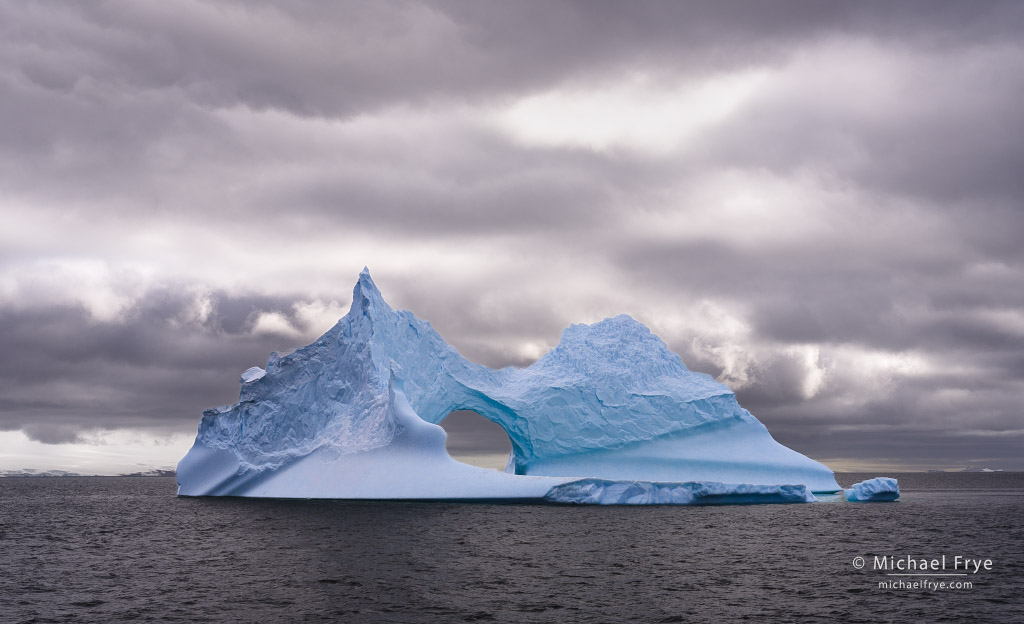
Iceberg, arch, and clouds, Antarctica. We found this iceberg right at the beginning of our trip, just as we cruised away from King George Island. Knowing that we probably wouldn’t find many ice arches this beautiful, we asked the ship’s captain (the wonderful Julian McGale) to circle the berg several times to get all the angles.
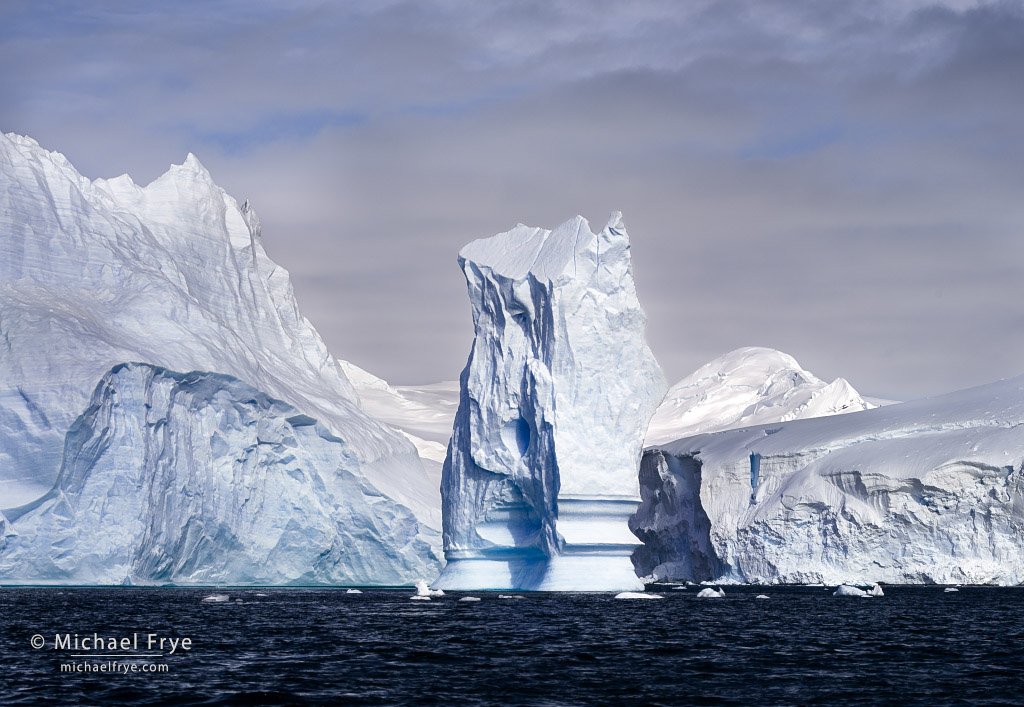
Ice tower, Antarctica. We made a zodiac cruise into this iceberg-filled channel after spotting it the previous evening – even though none of the ship’s crew had ever been to this channel before. It turned out to be a great spot, with some tremendous icebergs, including this tower.
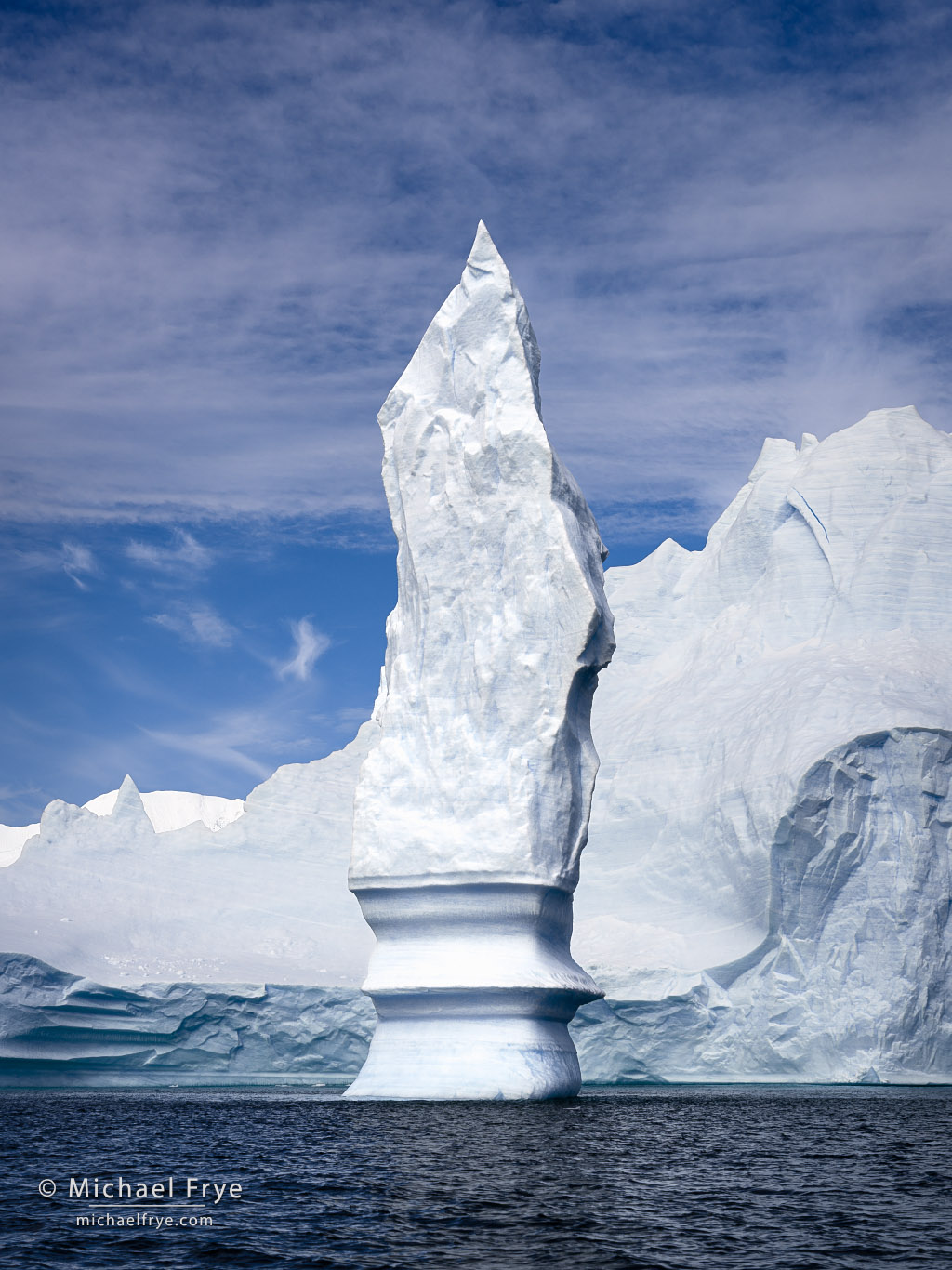
Ice spire, Antarctica. This is the same tower shown in the previous photo, from a different angle. It’s actually an exposed finger of ice connected underwater to the larger berg behind it.
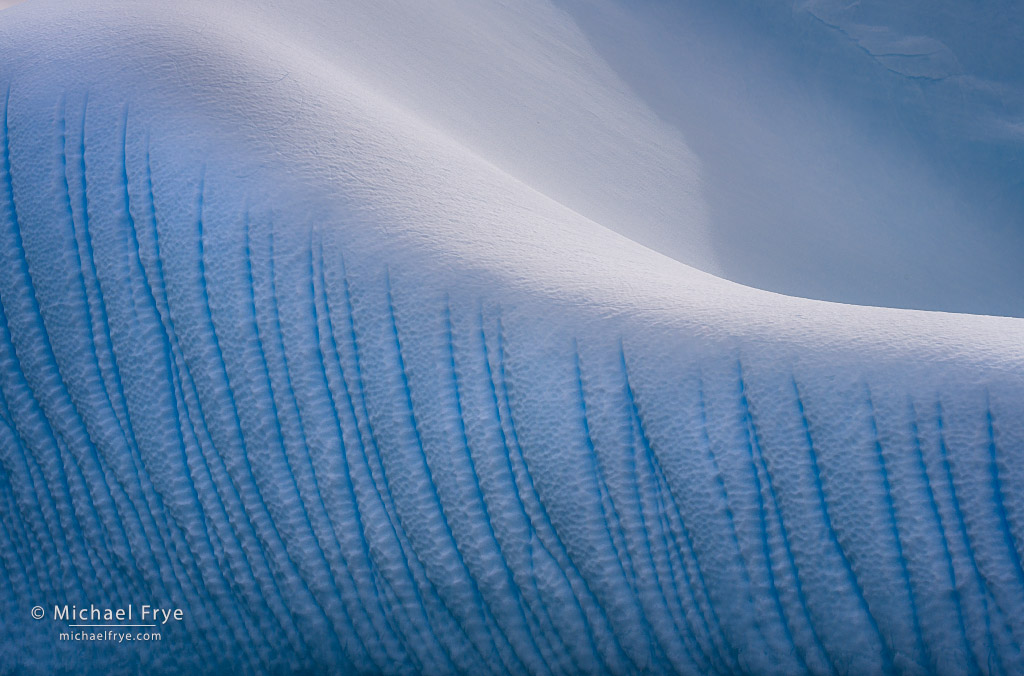
Ice curves, Antarctica. The pattern of curves toward the bottom caught my eye, but then I noticed the juxtaposition with the curved white line of snow above.
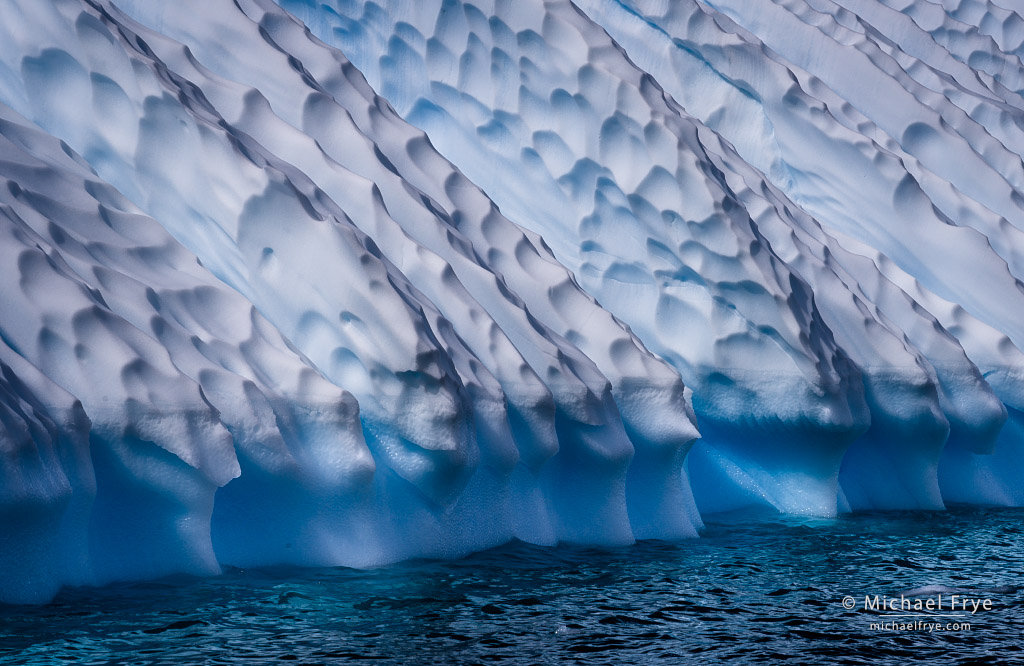
Ice textures, Antarctica. Just some beautifully textured ice, highlighted by sunlight raking across the surface.
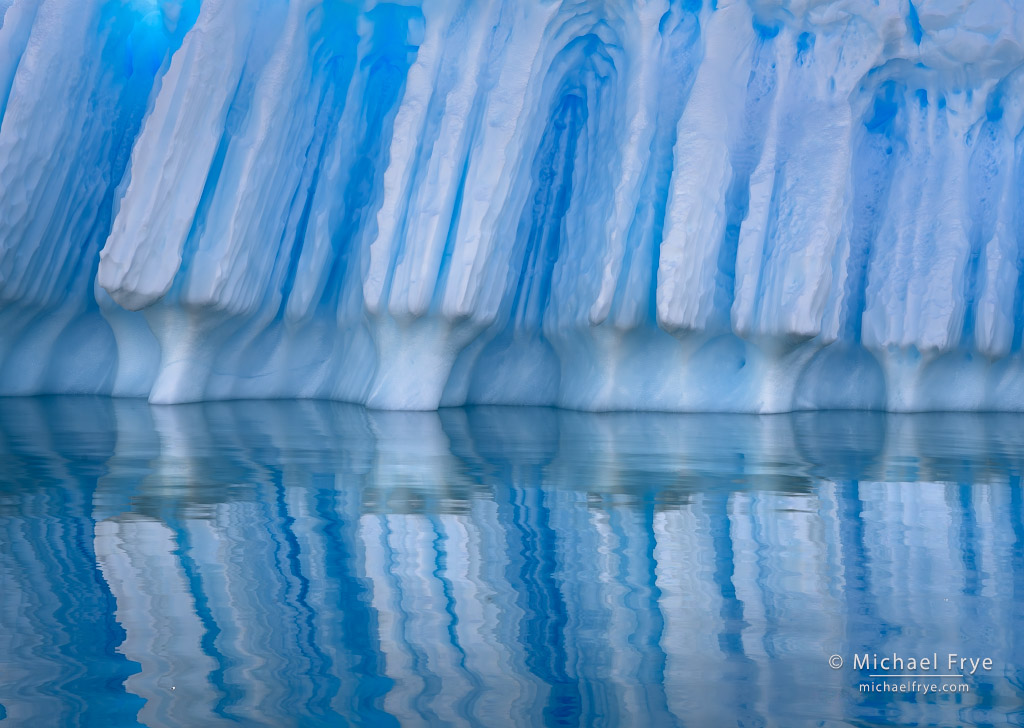
Ice columns and reflections, Antarctica. On a zodiac cruise in an icy bay we photographed humpback whales for awhile at close range. Then we turned our attention to the icebergs, and found some beautiful patterns. This iceberg was next to the one at the top of this post.
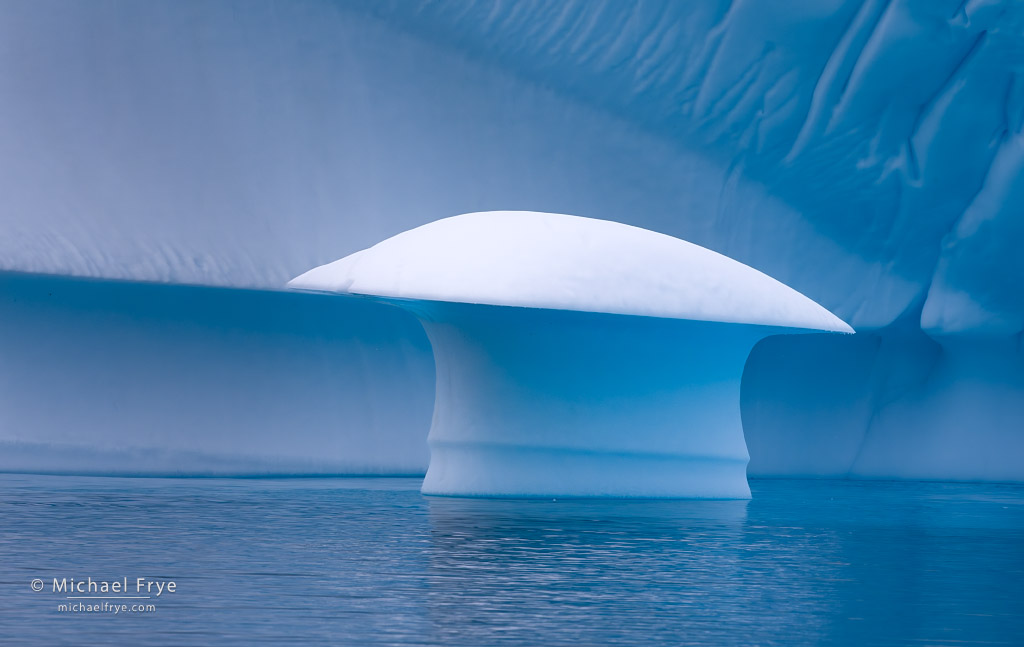
Ice mushroom, Antarctica. This formation had an almost-perfect mushroom shape. You never know what you’ll find.
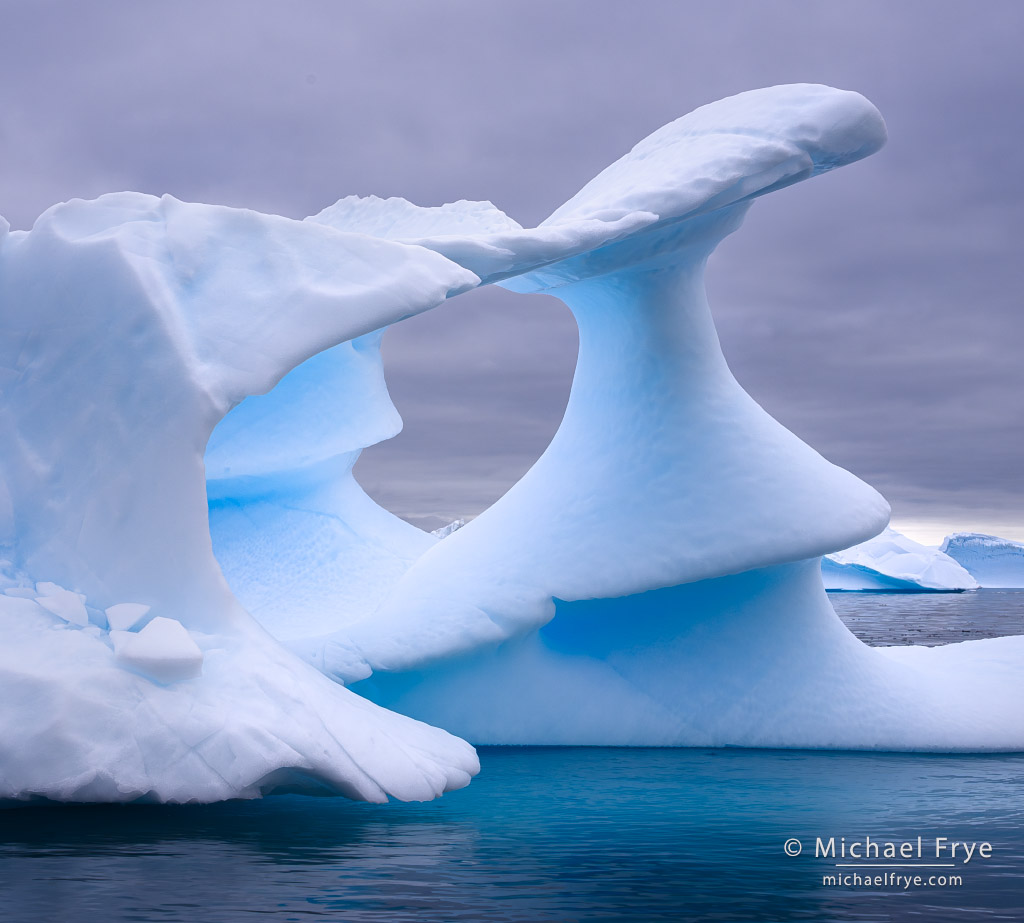
Sculptured ice, Antarctica. Although certain spots are well-known for collecting icebergs (iceberg “graveyards”), winds can cause icebergs to collect in unexpected places, like this area near Palmer Station.
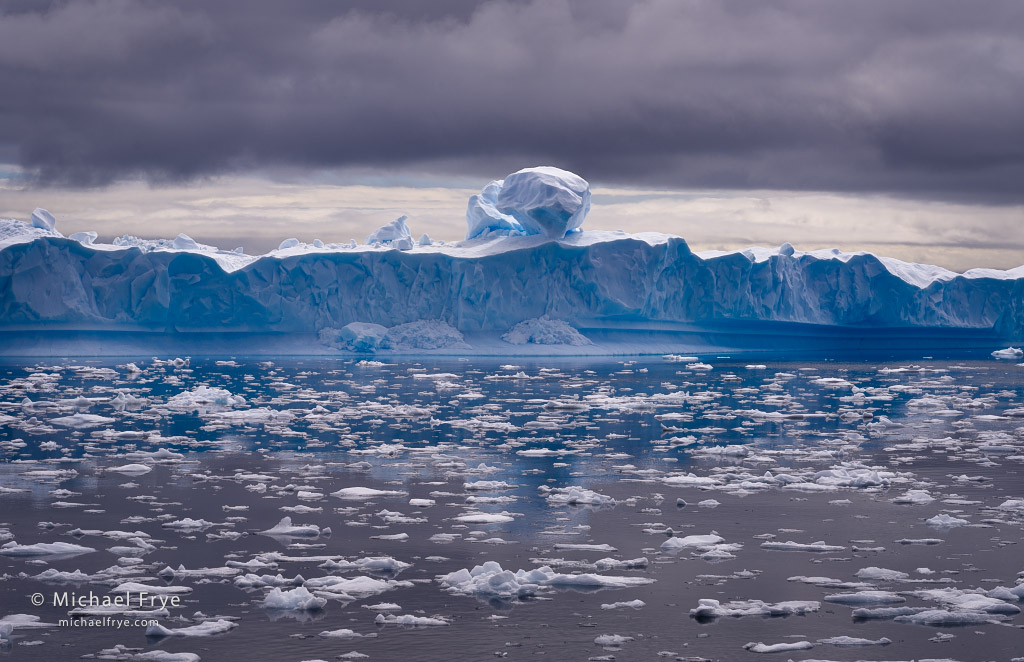
Ice boulder, clouds, and brash ice, Antarctica. We found calm, glassy water while cruising through an icy bay, passing this ice boulder perched on a tabular berg. How did it get there? Probably from an avalanche falling from a steep slope while the ice was still part of a glacier.
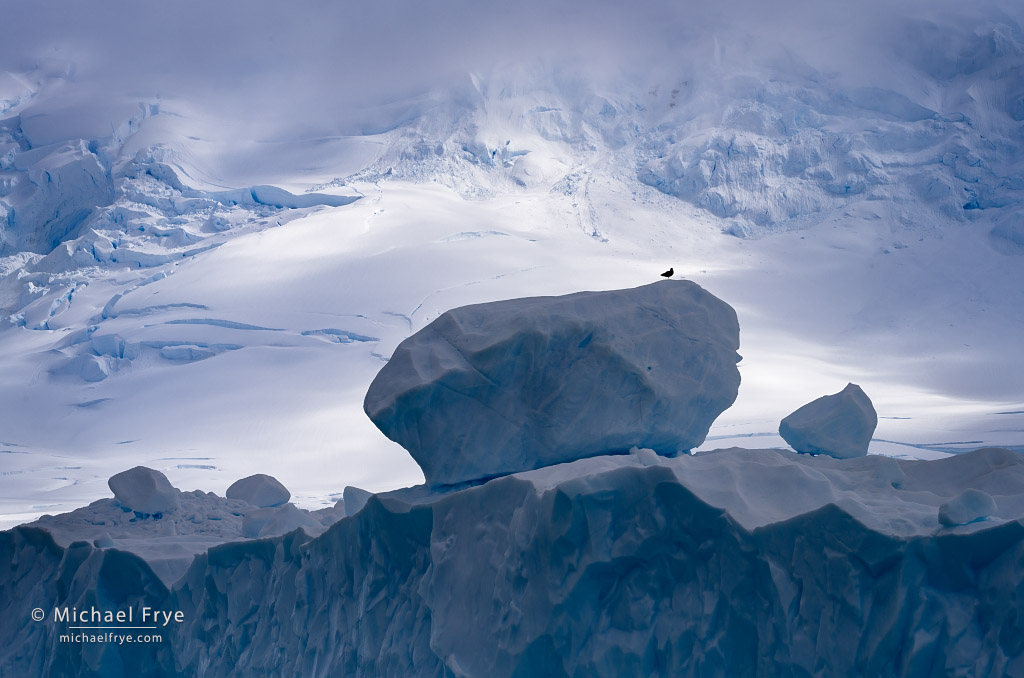
Ice boulders and kelp gull, Antarctica. The same ice boulder as in the previous photo, viewed from a different angle on our way out of the bay, with a kelp gull perched on top.
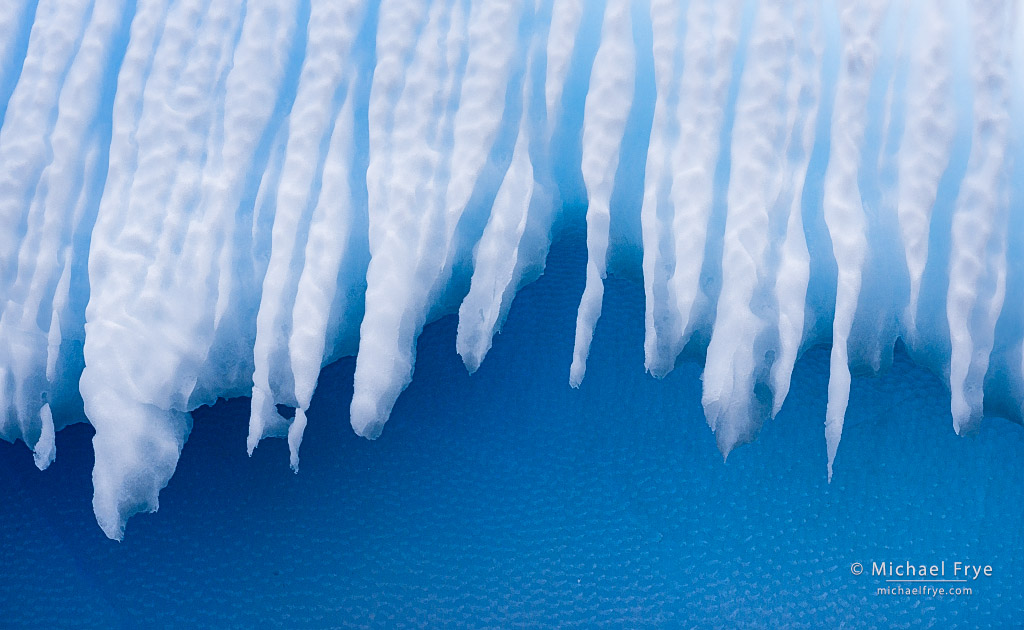
Ice fingers, Antarctica. Another surprising formation – they’re endless.
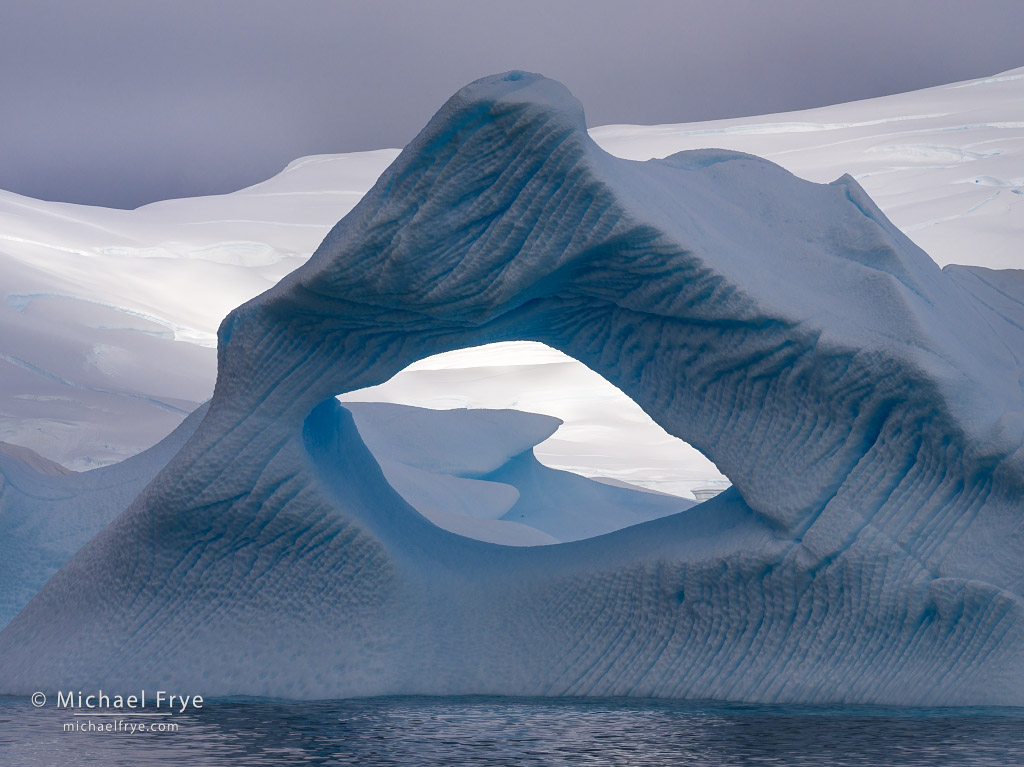
Ice arch, Antarctica. We viewed this arch on zodiacs from both sides, but I liked this angle, with the arch framing a zigzag formation.
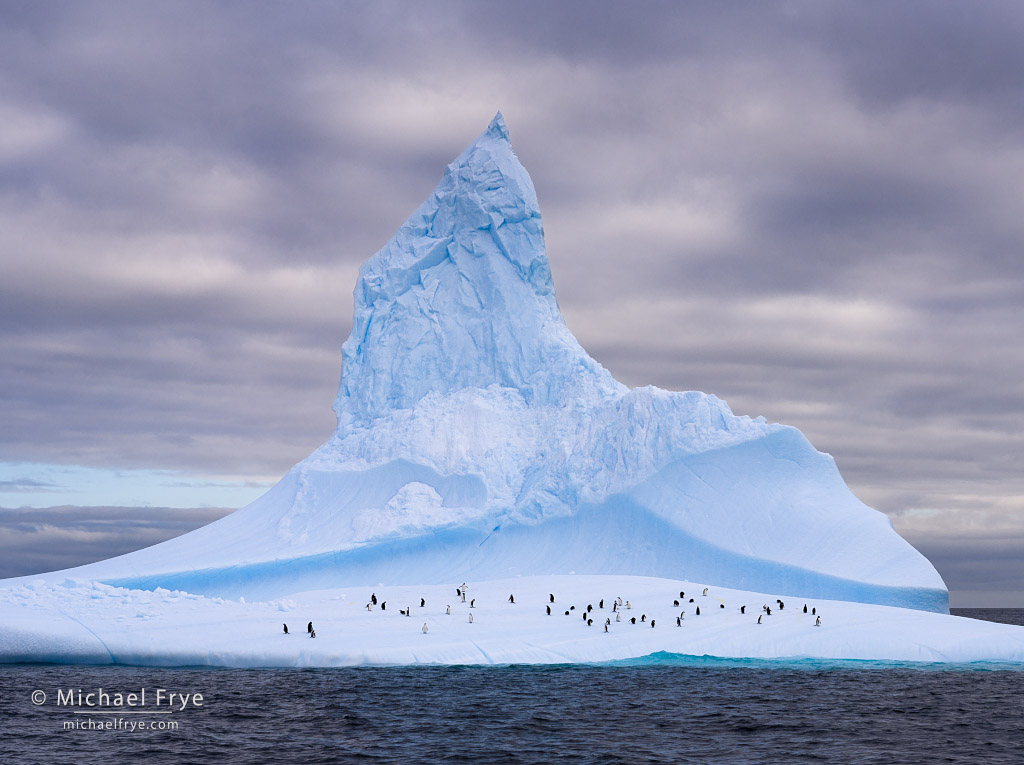
Iceberg with penguins, Antarctica. One of the last icebergs we encountered while sailing back to King George Island. The penguins were on the back side of the berg, so we only spotted them after we had passed it. The captain turned around and circled the berg twice to allow us to capture different angles.
Related Posts: Back in Antarctica; One Day in Antarctica
Michael Frye is a professional photographer specializing in landscapes and nature. He lives near Yosemite National Park in California, but travels extensively to photograph natural landscapes in the American West and throughout the world.
Michael uses light, weather, and design to make photographs that capture the mood of the landscape, and convey the beauty, power, and mystery of nature. His work has received numerous awards, including the North American Nature Photography Association’s 2023 award for Fine Art in Nature Photography. Michael’s photographs have appeared in publications around the world, and he’s the author and/or principal photographer of several books, including Digital Landscape Photography: In the Footsteps of Ansel Adams and the Great Masters, and The Photographer’s Guide to Yosemite.
Michael loves to share his knowledge of photography through articles, books, workshops, online courses, and his blog. He’s taught over 200 workshops focused on landscape photography, night photography, digital image processing, and printing.




WOW! Such incredible ice sculptures, every one of them.
Thanks Judy! They were really fun to photograph.
Amazing and outstanding images, Michael.
Thank you Jack!
Just stunning. The ice spire is so cool, but then the other ones grab my attention as well. Thanks for sharing these. I can’t imagine going through 41000 images 🤯
Thanks Doug! Yes, it’s a daunting task to go through all those photos. It’s not so hard at first, as I’ll just mark the ones that really stand out. It gets harder when you get down to the nitty gritty of choosing whether this one is better than this other very similar one, and deciding what to actually delete.
I love all the ice textures, especially the first photo.
Thanks very much Vivienne!
Great trip! Thanks for all of you excellent advice on improving our own pictures
It was great to have you with us Dan! I look forward to seeing more of your photos from the trip.
Those are amazing! I’ve always found most iceberg photos to be interesting, but not really jaw-dropping. Several of these definitely belong in the latter category, both for shapes and for incredible lighting. Just outstanding! Not even the end of January and you’ve already got a highly impressive Top Ten list for 2026,
Thanks so much William! Some icebergs are definitely more interesting than others. We had the luxury on this trip of being able to make detours when we found a particularly interesting berg, or going iceberg hunting in zodiacs.
Phenomenal & otherworldly. Thank you for “taking us there.”
Looking forward to more posts, especially featuring the wildlife you were able to capture.
Thanks very much Sally! I’ll be posting more wildlife photos at some point, but there are a lot to go through…
Wow, and wow! Thank you for sharing these. Our planet is amazing.
Amazing Michael and welcome back! So spectacular! The pretty blue ice sculptures and arches just blows my mind.
Great job with these photos – I love them all. Have you ever discussed how you deal with the massive number of raw files you capture on a trip? I get overwhelmed with the culling and editing process and often never finish.
Fantastic images! A visual treat