
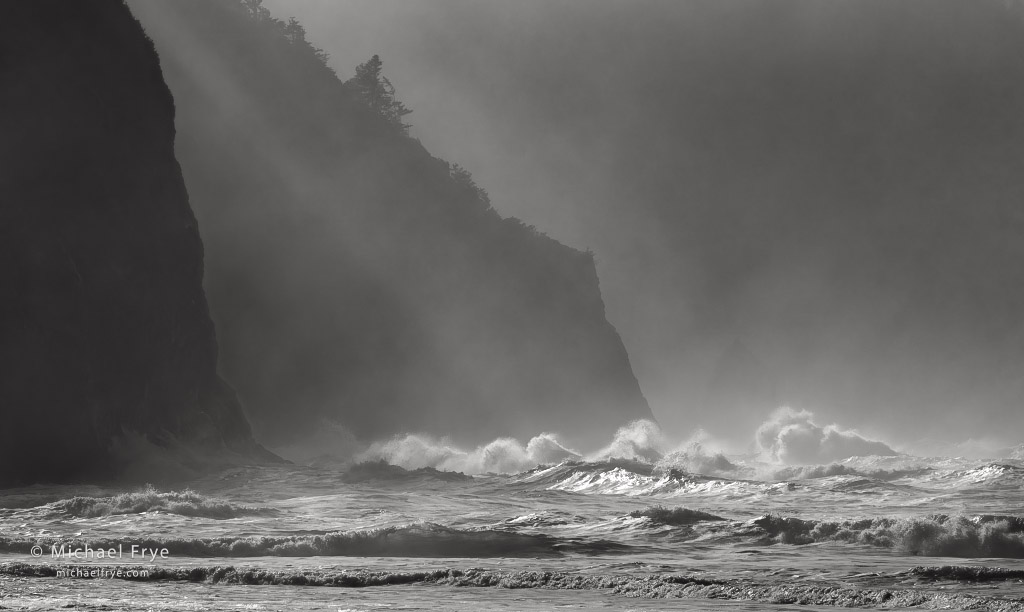
Waves, fog, and sunbeams along the Oregon Coast. I waited for the sun to crest the ridge on the left and light the large waves rolling in, using a fast shutter speed (1/500 sec.) to freeze the motion. I liked this moment, with sunbeams and a series of wave splashes.
Claudia and I just returned from our annual trip to the Oregon Coast. Our workshop went really well, with a small, wonderful group of participants. And we had some beautiful light to work with.
One of the things I told the group was how much I love the variety of light and moods you can photograph along the Oregon Coast. The weather seems to change constantly (in November at least). One day it’s stormy and dramatic, the next day (or minute) it’s foggy and ethereal. Or something else. With the changeable weather, and the shifting tides and waves, it’s a dynamic environment, where you have to be on your toes to capture moments when the light, weather, and waves come together to create something interesting and beautiful.
Those moments are frequent, but fleeting. You need to anticipate when something might happen, or be able to switch gears quickly when things change.
If you haven’t spent much time photographing along the coast, one of the initial challenges can be figuring out shutter speeds, and dealing with neutral-density filters. As I wrote last year, the choice of shutter speed has a big influence on the mood and feeling of ocean photographs. The ability to control the shutter speed is an essential skill for enhancing the mood, and adapting to the varied light, weather, and waves along the coast.
After the first couple of days I think everyone in the group got a better handle on using neutral-density filters and controlling shutter speeds, and then could focus on the rhythms of the waves, and catching a wave splash, or a line of waves, or streaks of foam swirling around their feet, or a moment when the sun broke through clouds. It can be a fun dance when you get into the groove.
And, as I said, the variety of light is wonderful. Backlight on waves, reflections on a wet beach, sunlight reflected on water, a late, post-sunset afterglow, sun breaking through fog… it’s all great. Here’s a selection of images that I think shows some of that diversity, with extended captions describing the lighting situation.
I always have so much fun photographing the weather, light, and moods along the Oregon Coast. I can’t wait to go back!
— Michael Frye
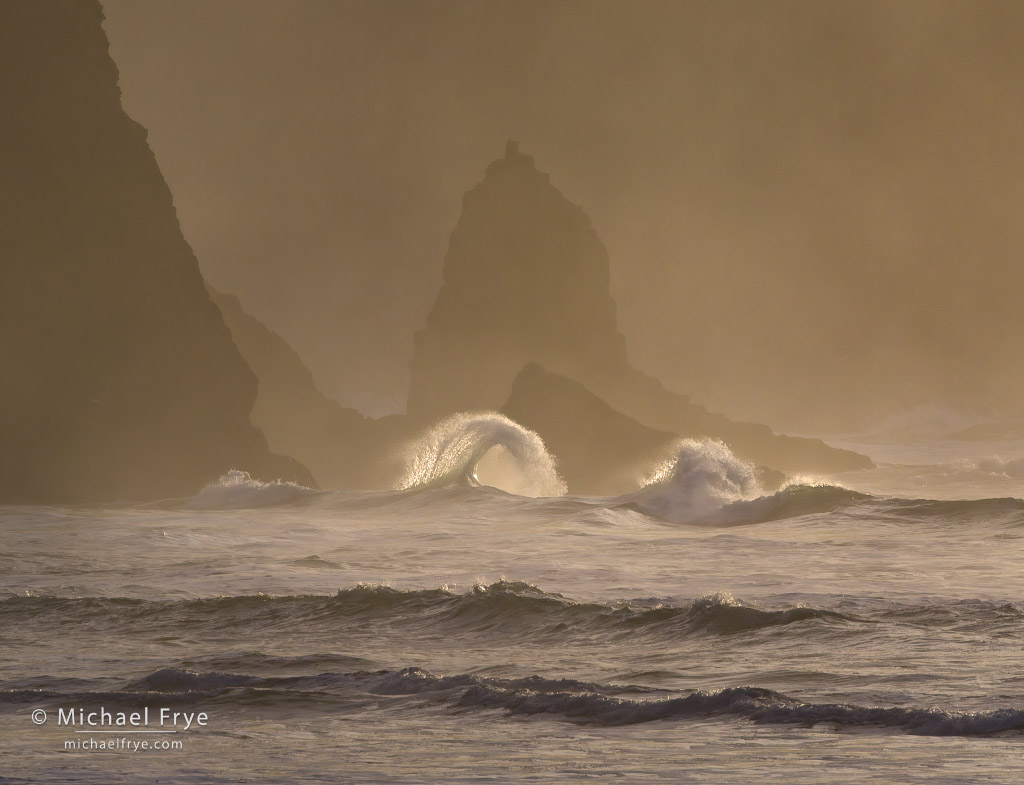
Waves, rocks, and fog, Oregon Coast. Here late-afternoon sunlight cutting through mist backlit the waves. Again I used a fast shutter speed (1/500 sec.) to freeze the motion and try to capture a moment with an interesting wave splash. This reverse-curling wave wasn’t the biggest splash I saw, but had a great shape.
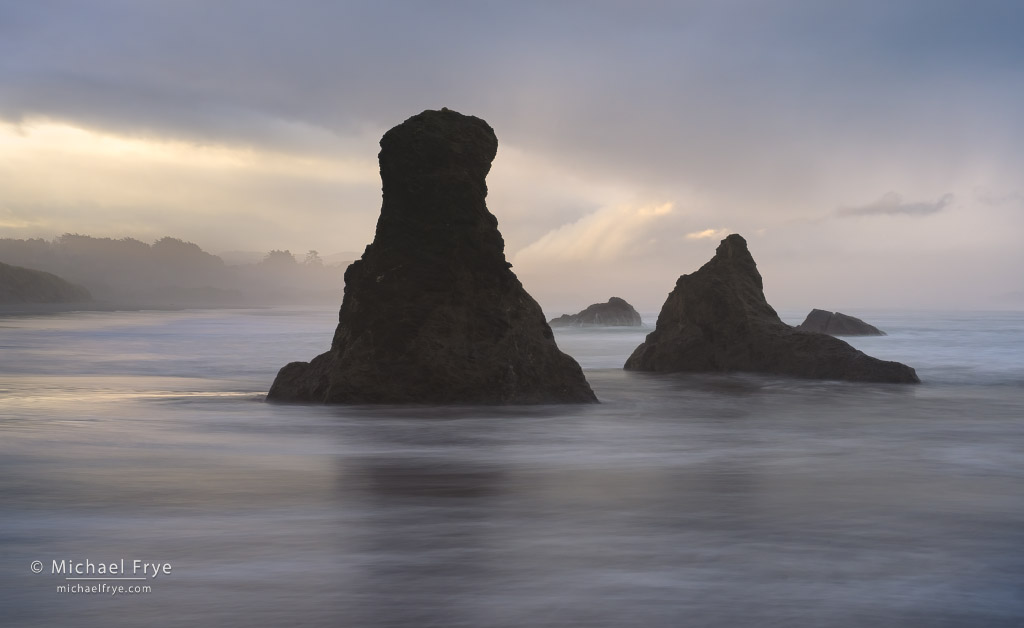
Morning light and fog, Oregon Coast. Early one morning, down on a beach, a rain squall was moving in, but a patch of clear sky to the east (left) lit some of the clouds and created a nice warm-cool color contrast. Here, without any interesting wave action, I opted for a slow shutter speed (6 seconds) to smooth the water, and waited for some larger waves to come in and cover the foreground sand.
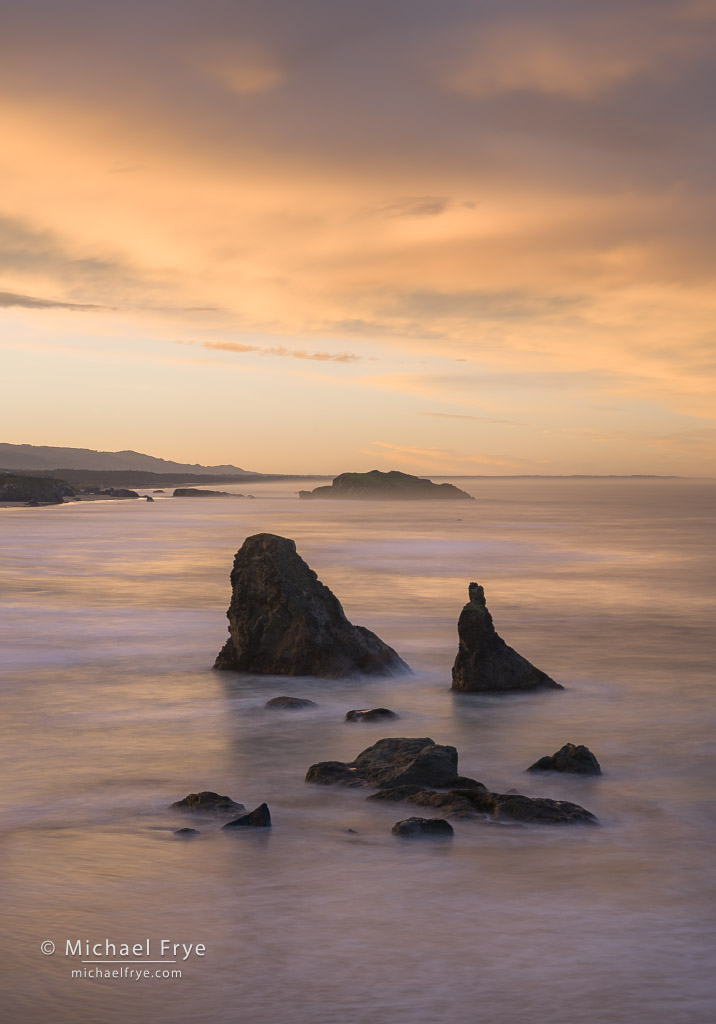
Sea stacks at sunrise, Oregon Coast. It looked like this morning would be overcast, but we got our group out early just in case something unexpected happened – and it did. Again, a patch of clear sky to the east allowed the sun to break through and light the clouds at sunrise. It was still pretty dark, so using a fast shutter speed would have required a high ISO setting, but I preferred a slow shutter speed (15 seconds) for this anyway, as I liked the contrast between the soft, smooth water and hard, craggy rocks.
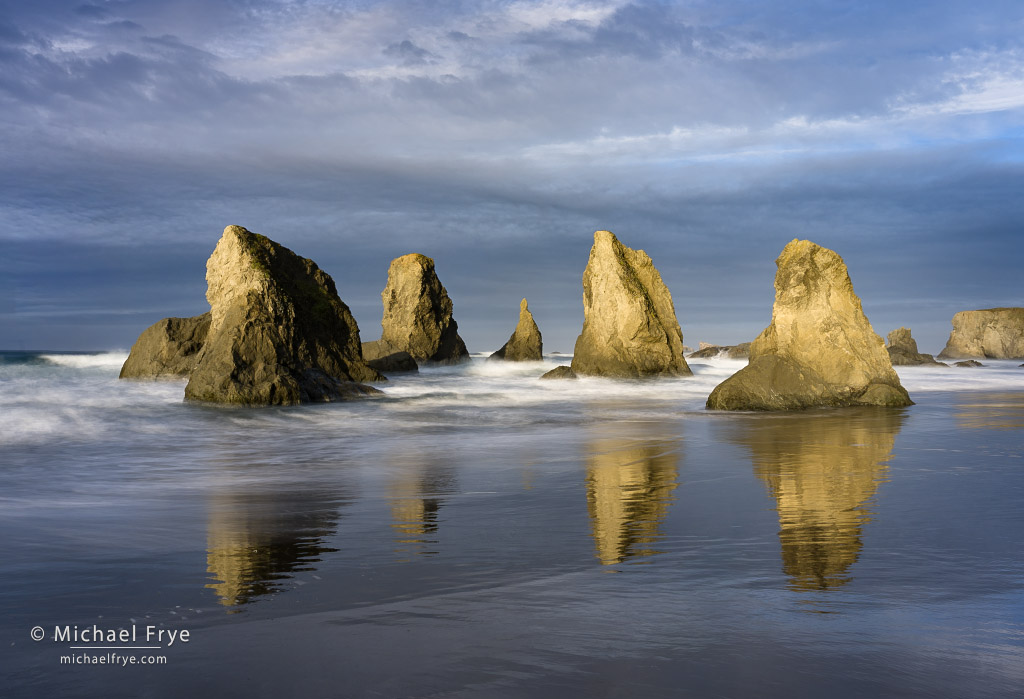
Sea stacks in morning light, Oregon Coast. This scene was almost directly frontlit, which isn’t usually my favorite light, but here the dark clouds in the background added some dramatic contrast. Again I used a slow shutter speed (6 seconds) to smooth the water, but this time waited for the waves to recede and reveal the reflection of the rocks in the wet sand.
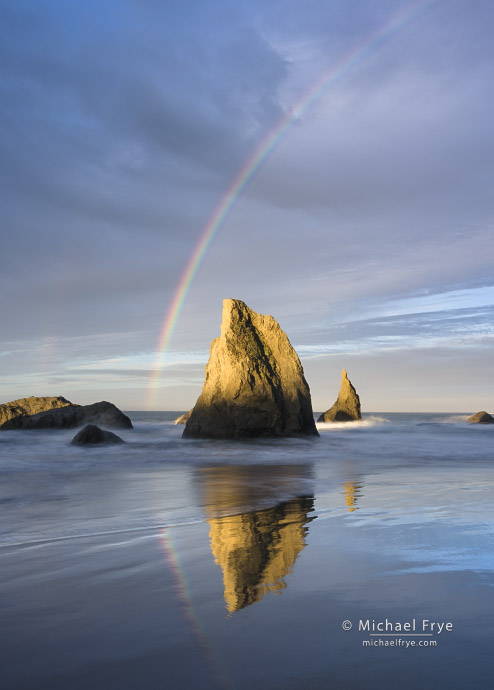
Sea stacks and rainbow, Oregon Coast. This rainbow was completely unexpected, since we never saw or felt any rain. But apparently some virga (rain that doesn’t reach the ground) was falling from the clouds, lit by the sun behind us. I used a six-second shutter speed, with a polarizer to enhance the rainbow.
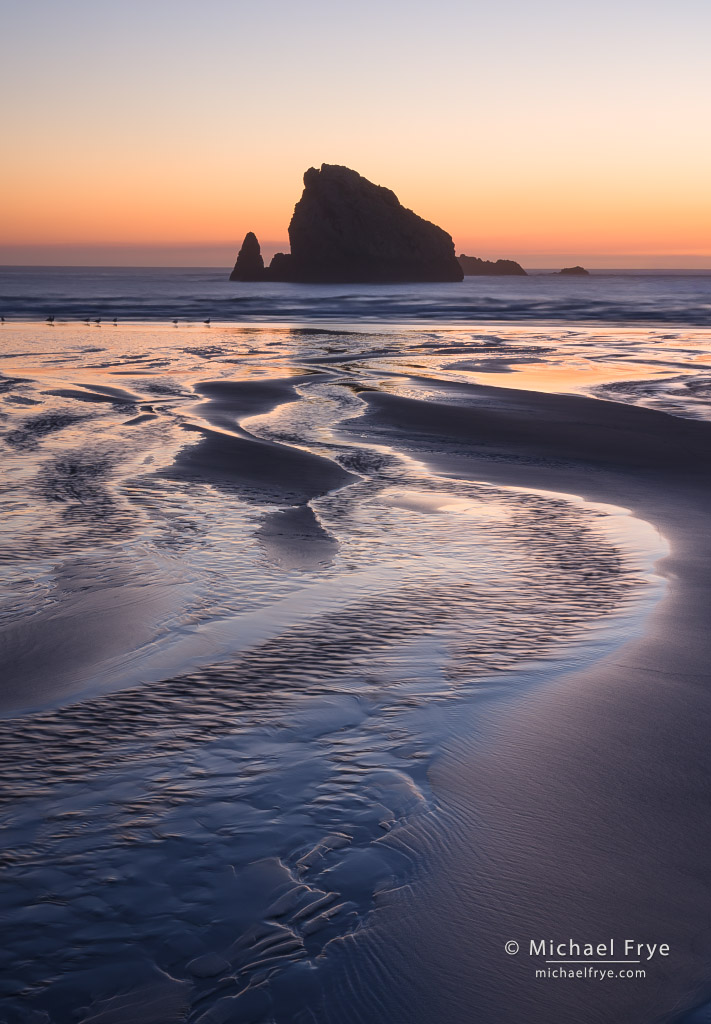
Creek and rocks at sunset, Oregon Coast. There were no clouds on this evening, but we waited until well after sunset to catch the colorful afterglow. A creek fanning out across the beach created some interesting foreground patterns. (4 seconds)
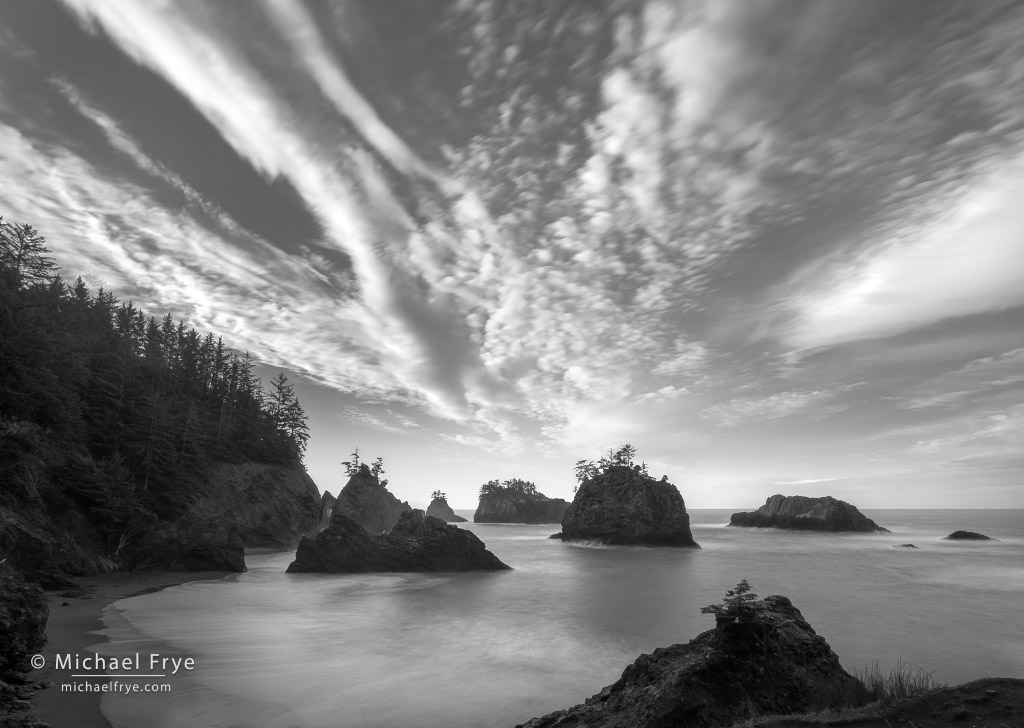
Clouds and sea stacks, Oregon Coast. We photographed a pretty sunrise from this spot, but soon thereafter even more interesting clouds moved in, creating a fan-shaped pattern in the sky. Without any wave action I opted for a slow shutter speed (20 seconds) to smooth the water.
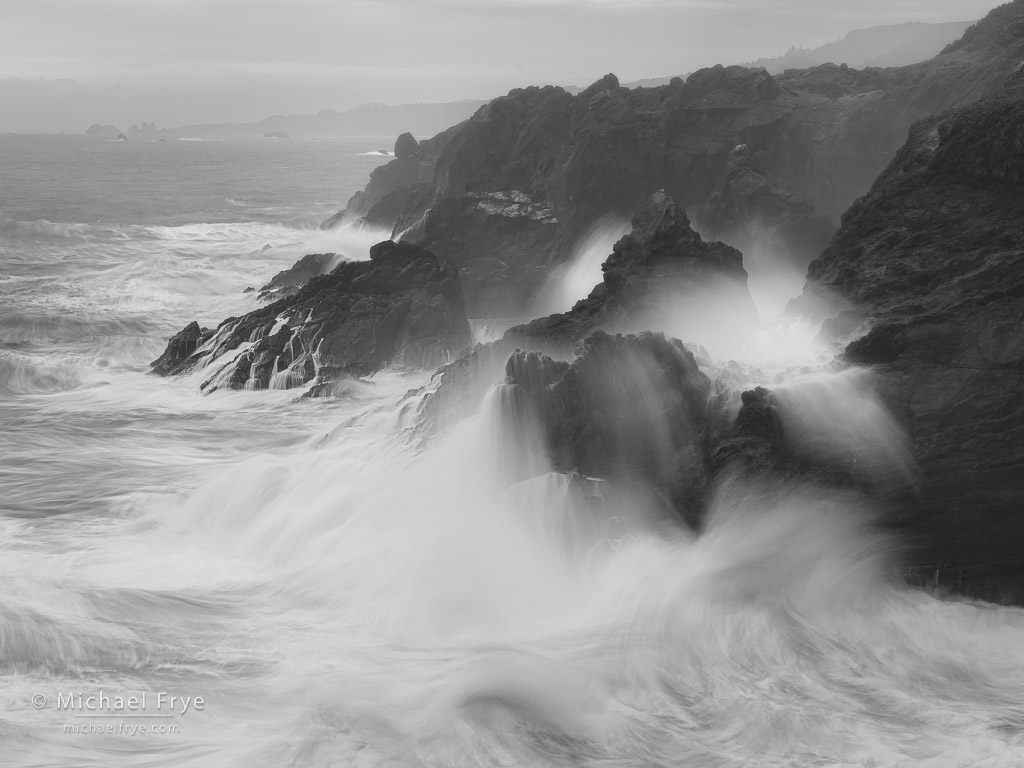
Wave splash, Oregon Coast. This morning we had some large waves (14-17 feet), but overcast light with off-and-on sprinkles. Although I usually use a fast shutter speed for waves splashes, here I decided to try something different and use a slow shutter speed to convey a sense motion. The super-long exposures I used in some of the previous images would have been too slow, creating little definition in the waves, so I used a 1-second shutter speed, which seemed about right – slow enough to create some blur, but fast enough to give the waves some definition.
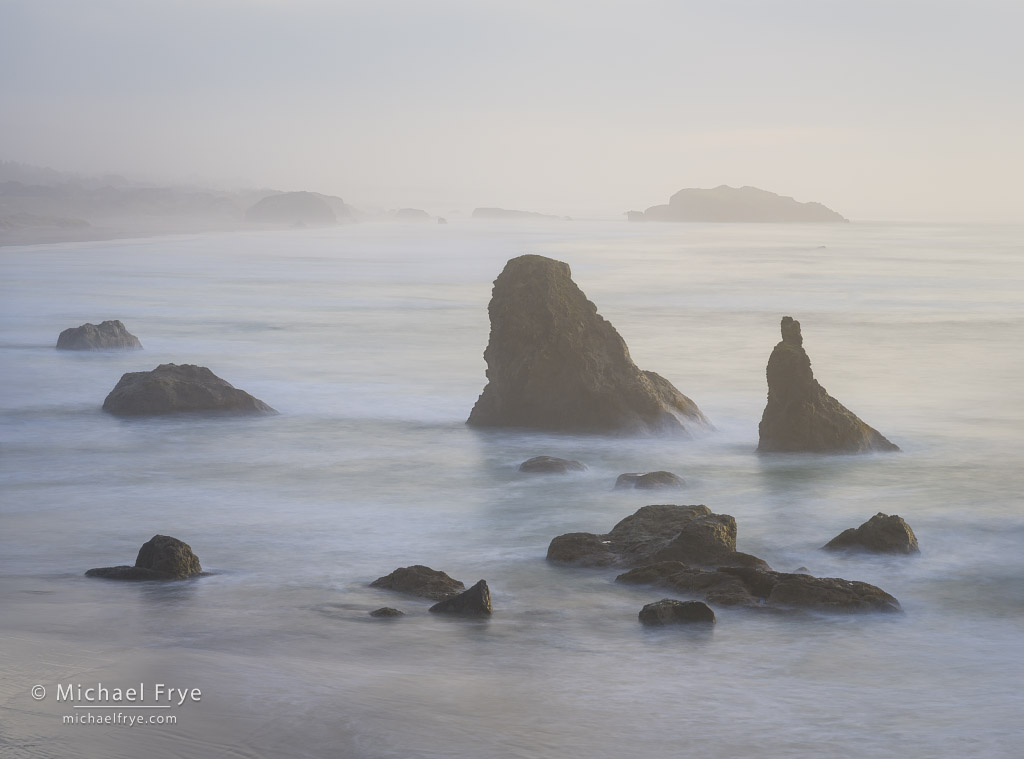
Sea stacks in misty afternoon light, Oregon Coast. There were no clouds on this afternoon, but it was quite misty, with beautiful soft, champagne-colored light filtering through the mist. I used a slow shutter speed (10 seconds) to soften and smooth the water, trying to complement the ethereal mood.
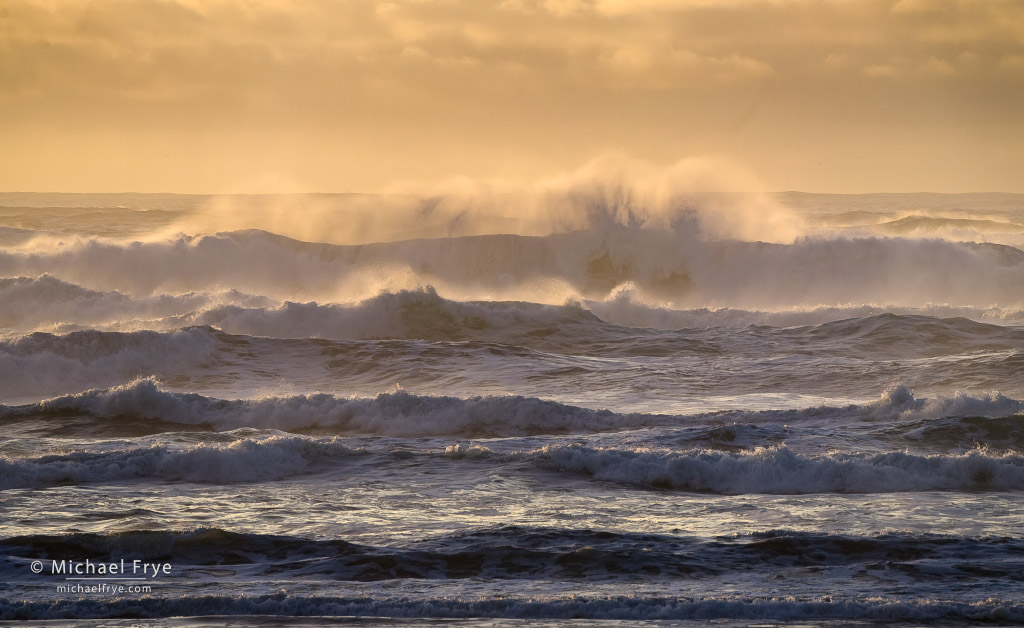
Breaking waves at sunset, Oregon Coast. While photographing waves crashing against the shore I looked out to sea and noticed striking lines of curling breakers, backlit by the setting sun. In this case I opted for a fast shutter speed (1/500 sec.) to freeze the motion.
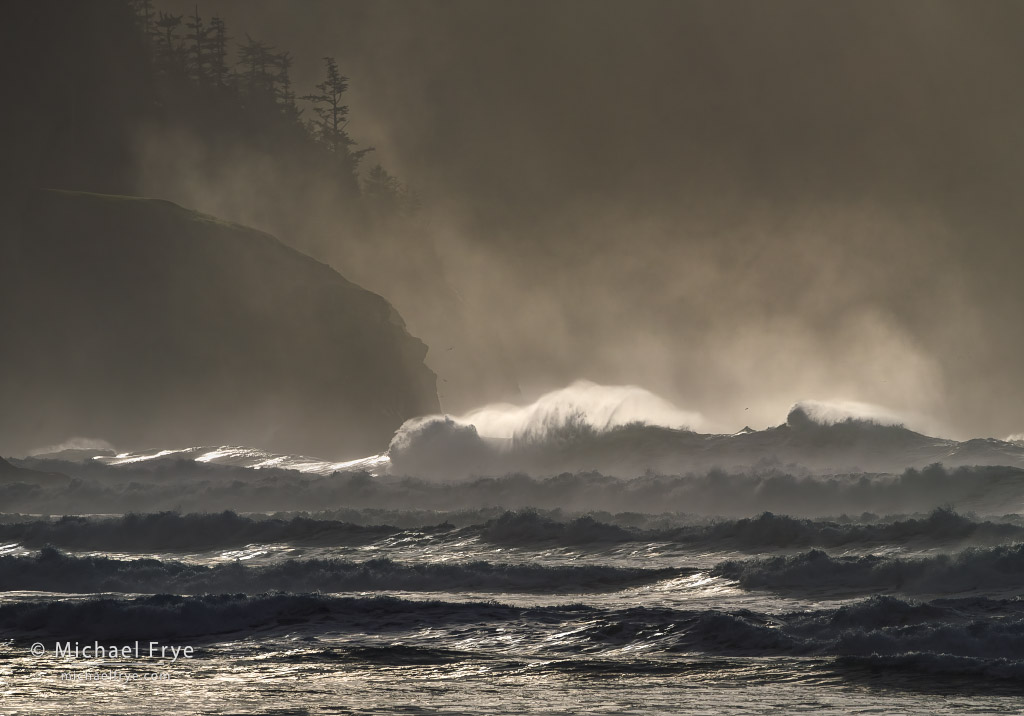
Breaking waves against a misty shoreline, Oregon Coast. I loved how the offshore breeze blew the tops of some of the breakers, so I zoomed in with a long lens (400mm) and used a fast shutter speed (1/500 sec.) to freeze the motion.
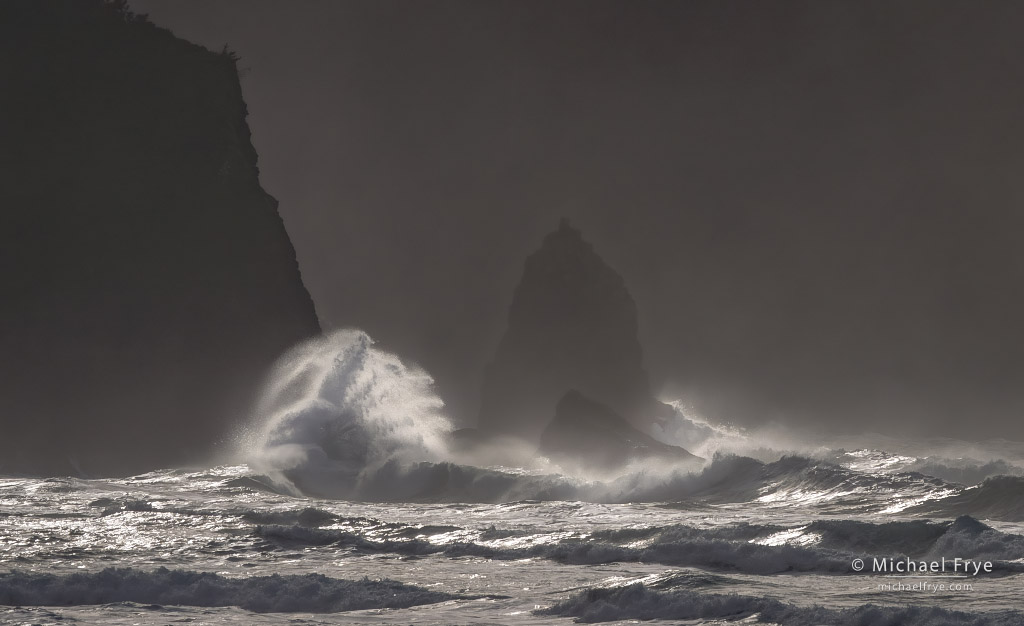
Rocks, fog, and wave splash, Oregon Coast. This scene was almost directly backlit, with sunlight reflecting off the water and highlighting the waves splashes. Again I used a long lens (300mm) and fast shutter speed (1/2000 sec.), and fired off hundreds of frames to try to catch some interesting wave splashes.
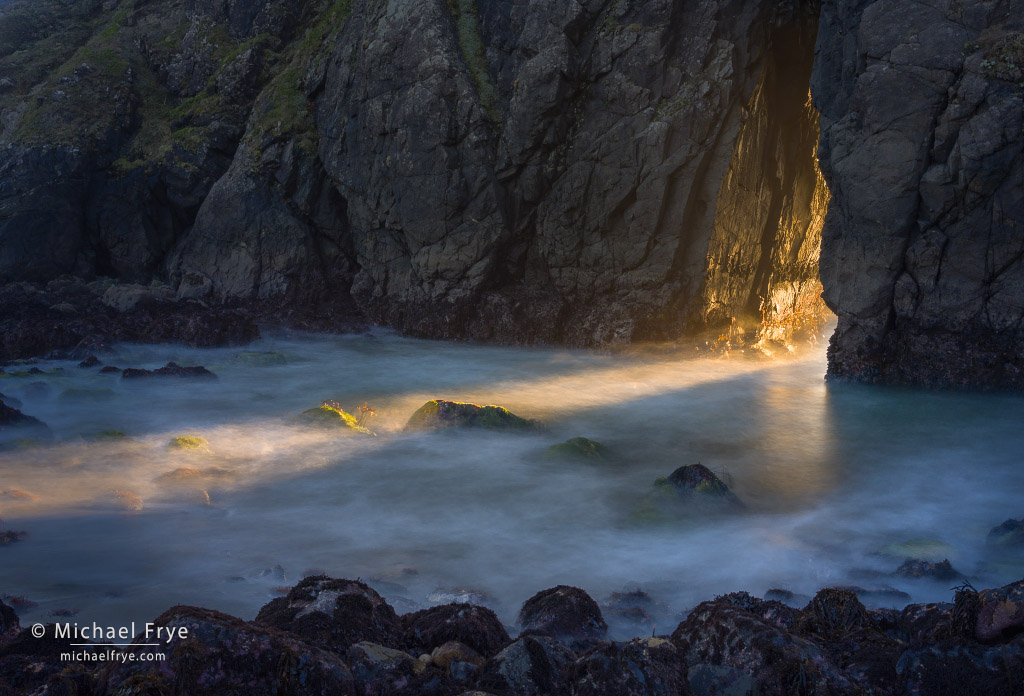
Shaft of light through a natural bridge, Oregon Coast. With a clear, cloudless sunset, we decided to try photographing the sun setting through this natural bridge. Although I also tried photographing the setting sun directly through the opening, I thought this side view, with a shaft of sunlight shining through the bridge, was more evocative. A slow shutter speed (30 seconds) eliminated distracting water texture, and emphasized the light shaft more.
Related Posts: Shutter Speeds and Mood; Light and Weather Along the Oregon Coast
Michael Frye is a professional photographer specializing in landscapes and nature. He lives near Yosemite National Park in California, but travels extensively to photograph natural landscapes in the American West and throughout the world.
Michael uses light, weather, and design to make photographs that capture the mood of the landscape, and convey the beauty, power, and mystery of nature. His work has received numerous awards, including the North American Nature Photography Association’s 2023 award for Fine Art in Nature Photography. Michael’s photographs have appeared in publications around the world, and he’s the author and/or principal photographer of several books, including Digital Landscape Photography: In the Footsteps of Ansel Adams and the Great Masters, and The Photographer’s Guide to Yosemite.
Michael loves to share his knowledge of photography through articles, books, workshops, online courses, and his blog. He’s taught over 200 workshops focused on landscape photography, night photography, digital image processing, and printing.




Hi Michael! In my curiosity, do you use ND square glass or the screw on type? I am not asking the name brand but I do have both. I have the ND filter+ Polarizing filter 2in1 which I don’t use often. I am not sure if this is a good way to use the 2in1filter. Oregon coastline looks gorgeous.
Wow! Too bad we can’t vote all of these for #1 at the end of the year. I so enjoyed looking at each one.
All of these images are great. That was a wonderful workshop and I learned a lot from you. Thanks!
Thanks Rhonda, and it was great having you with us in Oregon! Fun times.