In the Moment:
Michael Frye's Landscape Photography Blog
by Michael Frye | Jul 18, 2022 | Announcements
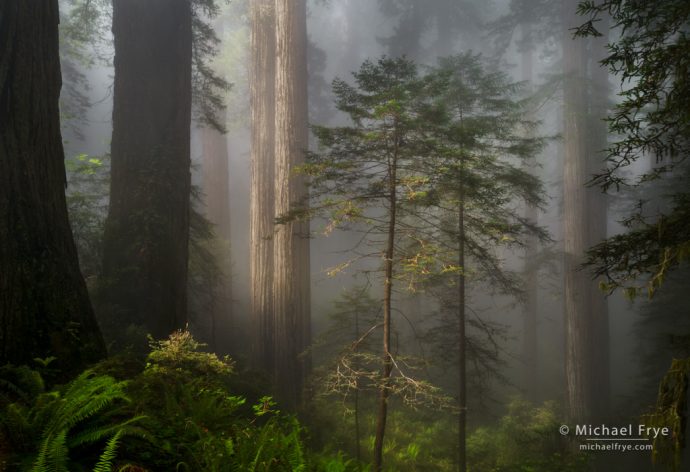
“Twins” – sun breaking through fog in a redwood forest, northern California
I’m thrilled to announce that I’ll be receiving the Fine Art in Nature Photography Award for 2023 from the North American Nature Photography Association (NANPA).
The award “honors photographers who create fine art nature imagery and/or who educate/instruct other nature photographers about the techniques critical to fine art imagery.” It’s a relatively new award; the only previous recipients were Ron Rosenstock and Art Wolfe from 2021, and I’m very honored to be in such good company.
Frank Gallagher has written a blog post on NANPA’s website about the award, including some of my thoughts about how nature photographers can affect positive change. Also, along with this award I’ll be doing a keynote presentation at the NANPA Summit on May 4th, 2023.
What an honor! Thanks very much to the NANPA Awards Committee!
— Michael Frye
(more…)
by Michael Frye | Jul 5, 2022 | Travels and Stories
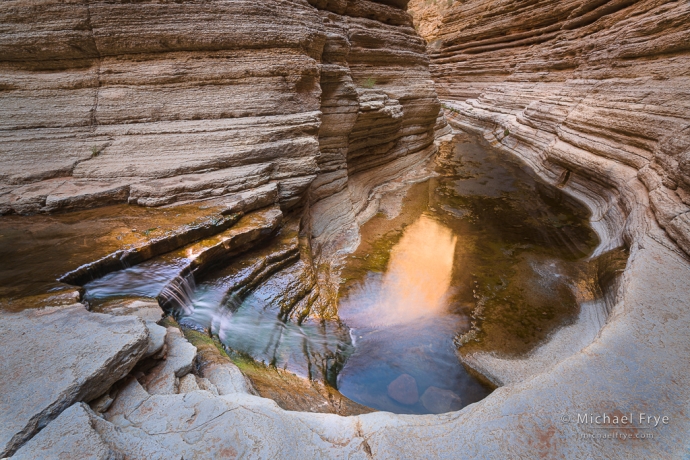
Reflections in a limestone canyon, Grand Canyon NP, Arizona
Between the rim and the river in Grand Canyon lies a vast wilderness. A few trails traverse this region, but most of it is trail-less, and seldom visited by people. This immense, empty land contains innumerable side canyons filled with treasures to discover: waterfalls, narrow, twisting slots, fern-filled grottos, Ancestral Pueblo ruins, rock art, sculptured rock terraces, and on and on.
The easiest way to access many of these side canyons is from the river, and we got to visit some of them on our journey down the Grand Canyon in April. I wish we’d had time to explore each and every side canyon, but of course that’s not possible on a ten-day trip. In the winter of 1976 a party of six people set off from Lee’s Ferry, and pulled out 103 days later – the longest Grand Canyon rafting trip ever, as far as we know. That’s enough time to truly immerse yourself – to explore as many side canyons as you want, or just relax and enjoy a spot for awhile. I’d love to do something like that (though unfortunately the Park Service doesn’t allow trips of that length anymore).
(more…)
by Michael Frye | Jun 26, 2022 | Light and Weather
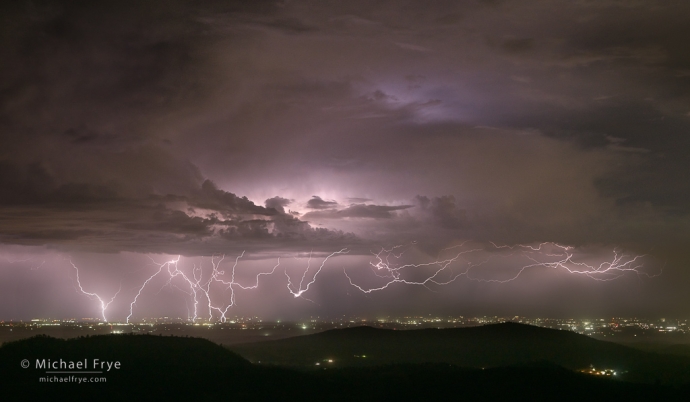
Thunderstorm over the Central Valley, California. I blended a series of frames, taken over the course of about 40 minutes, to create this image. Each frame was 20 seconds at f/5.6, ISO 400, and the focal length was 50mm.
Last Wednesday subtropical moisture pushed up from Mexico into California, triggering thunderstorms in parts of the state that rarely see them.
I kept my eye on these storms, but more out of curiosity than with any particular photographic ambitions. That night, as Claudia and I got into the hot tub on our deck (a nightly ritual), we could see an almost continuous series of distant lightning flashes to the southwest. This got me thinking about where I could find a view of this thunderstorm. We got out of the tub, and I took a close look at radar images. One thunderstorm south of Merced looked to be dissipating. But another cluster of cells over Fresno and Madera seemed to be strengthening and moving north, towards us.
I hemmed and hawed a bit. Did I really want to go out in the middle of the night chasing thunderstorms? What if they dissipated before I could photograph them?
(more…)
by Michael Frye | Jun 21, 2022 | Light and Weather
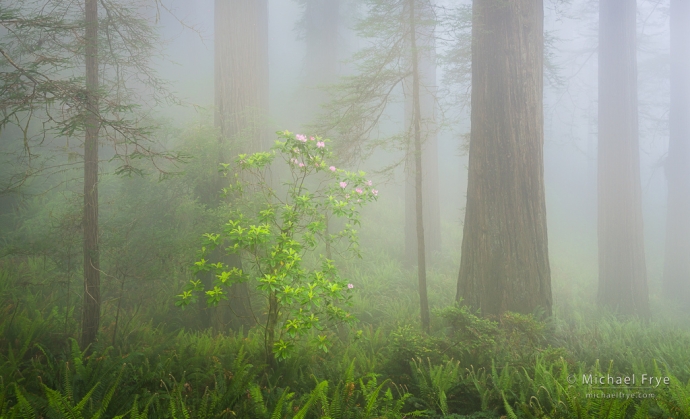
Redwoods and rhododendrons in fog, northern California. Some dense coastal fog helped simplify this forest scene and add a soft, ethereal mood. 35mm, 1.5 seconds at f/16, ISO 200.
I half-jokingly refer to our redwoods workshop as the “Chasing Fog” workshop. The northern coast of California is definitely fog-prone (though there are never any guarantees). And fog can add so much to photographs of the redwood forests, or scenes of the meadows, rivers, or coast, so I try to take advantage of fog whenever and wherever I find it.
But fog is also fickle stuff. We’ve been going up to this corner of California every year since 2011 (except 2020), and every year I see the fog behave in new ways. Sometimes the fog will get into a pattern for a few days in a row, but inevitably that pattern gets disrupted by something – high pressure, low pressure, a cold front, a wind shift – and the pattern changes, or the fog disappears completely.
(more…)
by Michael Frye | Jun 12, 2022 | Composition, Light and Weather
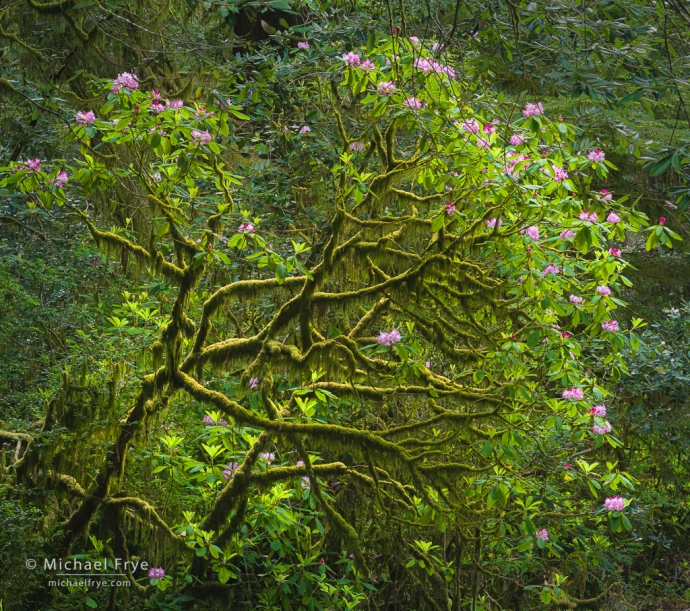
Lichen-covered rhododendron, Northern California. This was an overcast day, and the soft, even light helped simplify this complex scene, and emphasize the color contrasts between the pink rhododendrons and various shades of green. I used a long lens to isolate the rhododendron against a dark, leafy background. Moving closer with a shorter lens would have required looking up at the top of the tree, forcing me to include bright, distracting patches of sky. 159mm, 1/4 sec. at f/16, ISO 800, polarizing filter to cut reflections on the leaves.
Forests can be challenging to photograph. They’re beautiful, but cluttered, and often visually chaotic.
Creating order out of that chaos requires finding ways to simplify things. That’s one of the reasons fog is so helpful for these scenes: it obscures the background, reducing the clutter. (It also lends a wonderful atmosphere to the photographs.)
During our recent workshop in the redwoods we did get some fog, and even sunbeams. I’m sure I’ll post some of those photos down the road.
But there were also many occasions before, during, and after the workshop when we didn’t have fog, and I was photographing forests in soft light, or with sunlight filtering through the trees. What then?
(more…)