In the Moment:
Michael Frye's Landscape Photography Blog
by Michael Frye | May 8, 2014 | Travels and Stories
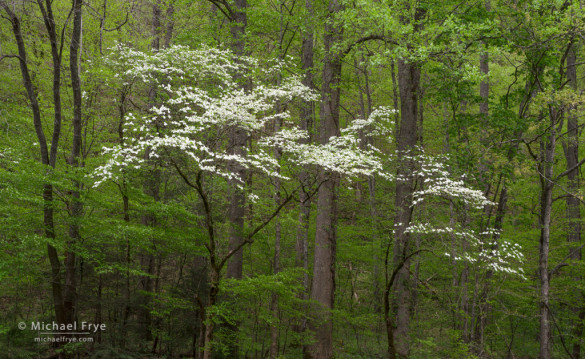
Dogwoods, Great Smoky Mountains NP, NC, USA
The last two weeks have been a whirlwind, with back-to-back workshops and two cross-country flights. But Claudia and I had a great time during our visit to the mountains of North Carolina, South Carolina, and Georgia. We got to see some beautiful country, and experience lots of that famous southern hospitality.
Now I’m back home, catching up on sleep and processing photographs. I made this dogwood image near the Oconaluftee Visitor Center in Great Smoky Mountains National Park. We just caught the tail end of the dogwood bloom, and it was nice to photograph eastern dogwoods in their native habitat.
While the dogwood bloom was almost over, the sarvis were just getting started. I had never heard of these trees until just before our trip, I found them to be highly photogenic. I’ll post more images of sarvis, waterfalls, and many other things soon.
— Michael Frye
(more…)
by Michael Frye | Apr 27, 2014 | Yosemite Photo Conditions
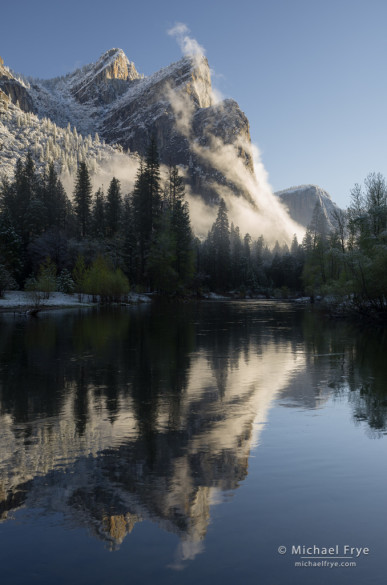
Three Brothers after a spring snowstorm, Saturday morning
We had great conditions during my Yosemite workshop for The Ansel Adams Gallery this past week. The dogwoods were blooming, there were lots of fresh, green leaves everywhere, and we had some interesting weather. It rained all day Friday, but Saturday morning we found clearing skies and an inch of new snow. This photograph of Three Brothers was made as the sun hit the rock faces and generated copious quantities of mist; you’ll find a couple of other images from the week below.
The dogwoods are still in good shape, and should be photogenic for at least another week or so. And the dogwoods at higher elevations (along highways 41 and 120, and in the Tuolumne Grove of giant sequoias) are just getting started, and should last for two to three weeks.
I’m off to North and South Carolina tomorrow, and I’m looking forward to photographing eastern dogwoods, waterfalls, and whatever else we find!
— Michael Frye
(more…)
by Michael Frye | Apr 22, 2014 | Yosemite Photo Conditions
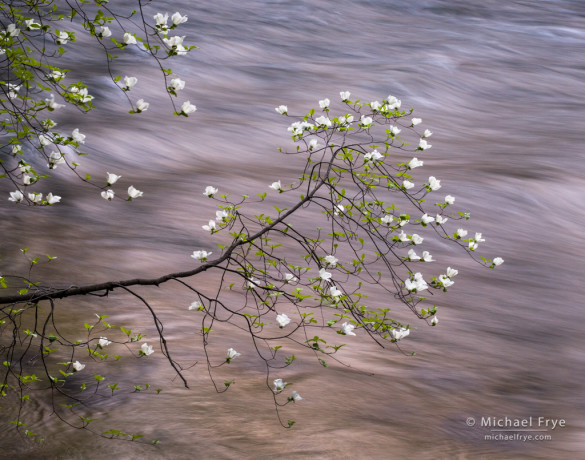
Dogwoods over the Merced River at sunset, from last spring
The last time I was in Yosemite Valley was just over a week ago, and only a few dogwood blossoms had appeared by then. I returned to the valley yesterday, and found that the dogwoods had fully emerged already. This is one of the earliest blooms I can remember, but that’s not terribly surprising with the warm and dry spring we’ve had.
Although the flowers will last a couple of weeks, they’re most photogenic when new and fresh, so they’re near peak now. The valley is quite beautiful, with lots of fresh, bright-green leaves everywhere, the waterfalls flowing – and of course the dogwoods. The waterfalls will peak early this year, probably by early May, if not sooner, but for the moment it seems like a pretty normal spring.
Meanwhile, there are still some nice poppy displays in the eastern end of the Merced River Canyon, near El Portal, but they’re fading fast and will probably be mostly gone by next weekend. It’s been a great year for poppies though – one of the best I’ve seen. There will be a variety of other flowers blooming in the canyon for awhile, but these typically aren’t found in big patches, so they’re more suited to closeups rather than broader views.
I start a five-day workshop with The Ansel Adams Gallery today, and then will be heading to North and South Carolina right after that, but I wanted to give you a quick update first. I’ll post further updates and photos when I can! This is one of my favorite dogwood images from last spring.
— Michael Frye
(more…)
by Michael Frye | Apr 18, 2014 | Reviews
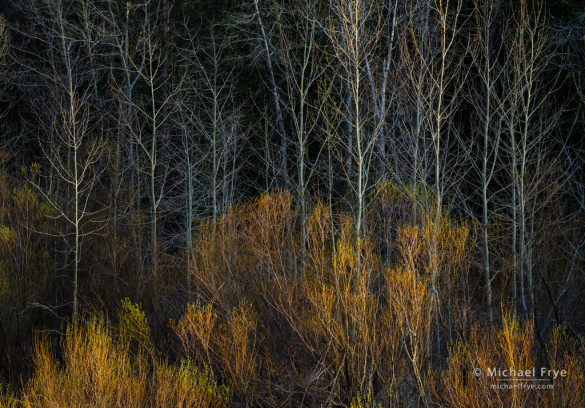
Willows and cottonwoods in late-afternoon light, Yosemite. The outstanding resolution of the Sony A7r allowed me to make a 40×60-inch print that captures all the fine detail of this image.
I don’t review or even talk about equipment very often, but I reviewed the 36-megapixel Nikon D800E last summer because I think it’s such an important, game-changing camera for landscape photography, with exceptional resolution and low noise. Like many Canon users, I’ve been waiting for Canon to offer a competitor to the D800 and D800E. Rumors keep circulating about a 40-megapixel Canon camera, but so far nothing more substantial than a rumor has appeared.
Then last fall Sony announced their new full-frame, mirrorless Alpha A7 and A7r cameras – the A7 with 24 megapixels, and the A7r with 36 megapixels. The A7r uses essentially the same sensor as the Nikon D800E (though Sony says they’ve improved it). For a Canon user like me, the A7r was intriguing because some readily-available adapters could be used to mount my Canon lenses on it. The short distance between the sensor and the A7r’s lens mount makes it possible fit an adapter between Canon or Nikon lenses and the camera, and still be able to focus at infinity. So I could potentially get the resolution and noise control of the D800E without having to make a large investment in new glass. And the A7r seemed reasonably priced at around $2300 (though adding an adapter and battery grip brings it close to $3000).
But I had some big questions. The A7r is a mirrorless camera, so would I miss a real, optical viewfinder? How well would my Canon lenses function with the adapters? And what about “shutter-shake,” and other potential problems that I’d read about online?
(more…)
by Michael Frye | Apr 17, 2014 | Night Photography
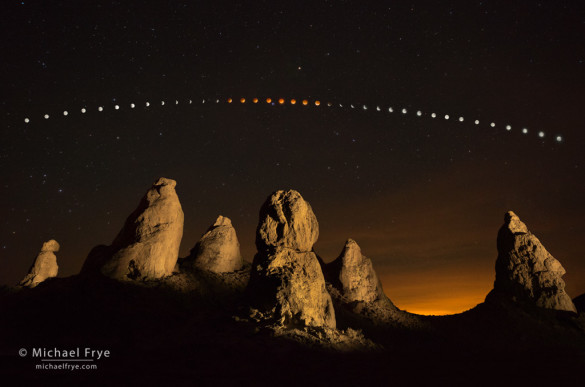
Lunar eclipse sequence, April 14th and 15th, Trona Pinnacles, CA, USA
Monday night’s lunar eclipse didn’t seem to line up well with any of Yosemite’s features, so I started looking for other locations – preferably someplace with clear, dark skies, and an interesting foreground. Death Valley came to mind, but then I thought of the Trona Pinnacles, near Ridgecrest. I’d never been there, but it seemed like an appropriately “lunar” landscape – so much so that the pinnacles have frequently been used to represent alien landscapes in sci-fi movies, including Star Trek V and Planet of the Apes.
Claudia and I drove down there on Monday and arrived about an hour before sunset. And what a great spot! I wondered why it had taken me so long to visit this striking landscape. The pinnacles are actually ancient tufa towers, like those at Mono Lake, left high and dry by the evaporation and shrinking of Searles Lake.
(more…)