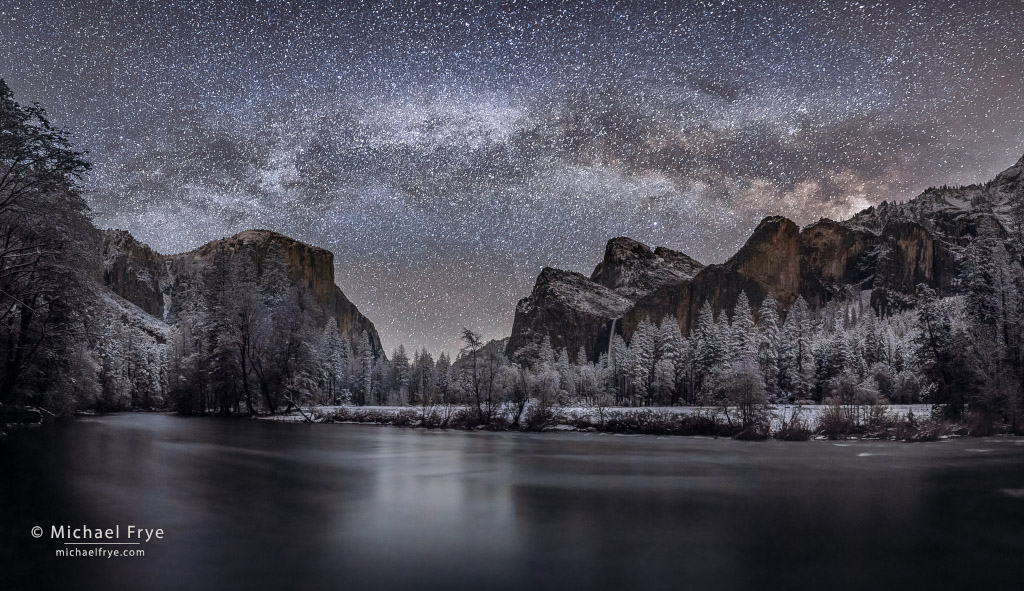
Milky Way over Yosemite Valley, Yosemite NP, California
There are many approaches to creating successful photographs. Some images are meticulously planned. Others are entirely spontaneous. But I think there’s a large middle ground where there’s some planning and some degree of serendipity. And most photographs probably fall somewhere in that middle.
Even if the idea is as basic as “I’m going to walk down this trail and see what I find,” that’s still a rudimentary plan. And if you plot out every detail of a photograph in advance, well, you know what they say about the best-laid plans. It’s rare that a pre-conceived idea goes exactly as you imagined. You almost always have to adapt and change. Sometimes it’s a small change, like moving the camera position or composition slightly. Sometimes conditions force you to completely scrap your original idea and pivot to something else.
The photograph above is an example of that middle ground. It was April (of 2018), and a spring storm had dropped a few inches of snow on Yosemite Valley. I drove up to the Valley in the dark, hoping to photograph a clearing storm by starlight with fresh snow.
When I arrived in the Valley at around 11:00 p.m. I found snow, but no mist. It’s that mist wrapping around the cliffs that creates the awesome clearing-storm look in Yosemite Valley, so I was a bit disappointed. But I was there, on a beautiful snowy night, so what else could I photograph?
It occurred to me that sometime in the wee hours the Milky Way would rise to the east, and I might be able to capture a panorama of the Milky Way from Gates of the Valley (aka Valley View) with fresh snow on the ground. How did I know this? Because I knew the area, knew something about the gyrations of the Milky Way throughout the year, and had considered this idea before.
So this photograph was partly spontaneous, since my original idea (to photograph a clearing storm) didn’t work, and I had to pivot to something else. But it was also somewhat pre-planned, since I had thought of photographing the Milky Way from this spot before, and had used photo planning apps to figure out when it might work. My brain just needed to put a couple of different ideas together: current conditions (clear skies, no moon, fresh snow, time of year), plus, oh yeah, this is a good time of year to photograph the Milky Way from Gates of the Valley. Then I used The Photographer’s Ephemeris 3D to confirm that the idea would work, and determine the best time to be there that night.
Many of my favorite photographs were created using a similar mix of planning and serendipity. For example, I had thought about photographing Upper Yosemite Fall with backlight from the moon for years before I made this photograph:
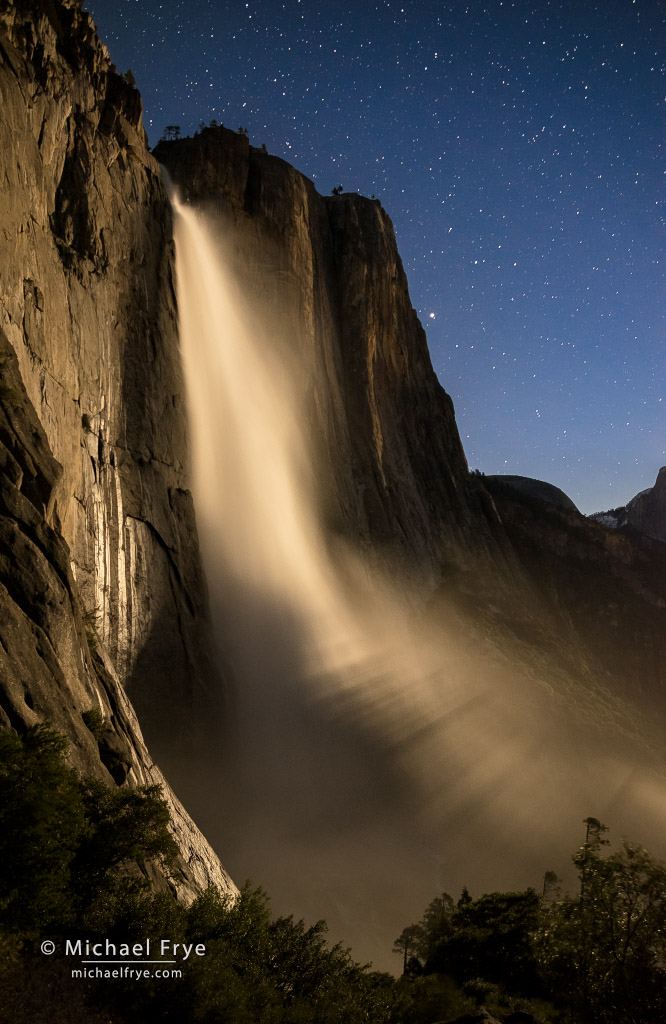
Upper Yosemite Fall illuminated by the rising moon, Yosemite NP, California
And I had used PhotoPills (this was before The Photographer’s Ephemeris 3D or Planit Pro existed) to figure out when the moon might be in the right position, at a time of year when there could be enough water in the fall. It turns out that this only happened in late winter or early spring, when the moon was about half full.
One day in early February of 2015 I went up to Yosemite Valley, and ended up photographing Horsetail Fall. After sunset I was thinking about driving home when it occurred to me that this might be the perfect night to photograph the upper fall backlit by the rising moon. A recent rainstorm had made water levels unusually high for that time of year, and the moon was about half-full. I checked PhotoPills, and sure enough, the moon would be in the right position. So instead of heading home I had dinner in the Lodge cafeteria, hiked up the Upper Yosemite Falls Trail, and waited for the moon to rise and illuminate the waterfall. Once again an idea that had been percolating in the back of my mind met with the right conditions, and I made a spur-of-the-moment decision to try it.
This photograph of Comet NEOWISE from Death Valley is another example. Although I used The Photographer’s Ephemeris to figure out when dim moonlight would illuminate the dunes, upon arrival I found the dunes weren’t shaped the way I expected. Apparently the most recent windstorm had come from the south, so as I looked northwest toward the comet I saw rounded dunes instead of the sharp ridges I had hoped for. So I had to pivot. I found this view, with some beautiful ripples in the foreground, and rounded dunes in the distance, and thought it could work. I still kept looking for other potential foregrounds, and for the sharp sand ridges I had originally envisioned, but felt myself getting drawn back to this spot. And in the end I think I like this better than my original idea:
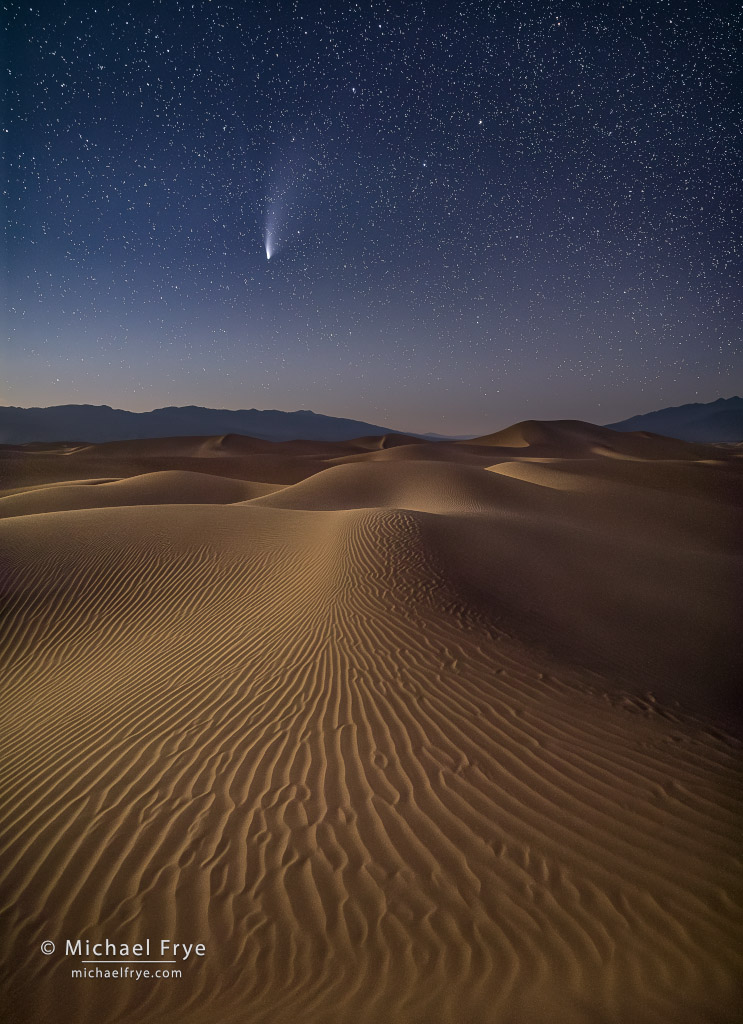
Comet NEOWISE over moonlit sand dunes, Death Valley NP, California
The serendipitous part of all this is hard to teach. You just have to keep an open mind, and pay attention to things that catch your eye, or little thoughts that pop into your head.
But the planning part is something anyone can learn. Unfortunately many of the planning apps are densely complex, which makes their learning curves steep. But you don’t have to master all the intricacies of these apps to make effective plans. 99% of the time I use just a few simple tools to figure out where the sun will set, where the moon will rise, what position the Milky Way will be above the landscape, or how a scene will be illuminated at a certain time.
Since so many photographers struggle with learning the intricacies of these apps, I’ll be conducting a webinar on February 21st that covers the essentials of photo planning – and only the true essentials. At the end of this webinar you’ll know how to use a few simple tools to easily and accurately predict the movements of the sun, moon, and Milky Way (or any celestial object) in relation to any scene, and visualize how the sun (or even the moon!) will illuminate the landscape.
And we’re offering an early-bird discount! You can use the code PHOTOPLAN20 to get 20% off until December 29th. Click this link to sign up or learn more:
Photo Planning Made Simple: A Landscape Photography Webinar
February 21st, 2026
And yes, if you can’t attend live, the webinar will be recorded for later viewing.
Happy Solstice Everyone!
— Michael Frye
P.S. Claudia and I will be winging our way to Antarctica on New Year’s Eve, so I’ll be posting my nominees for my best photos of 2025 early this year – this Tuesday, December 23rd. Look for that post to cast your votes!
Related Posts: Milky Way over Yosemite Valley; Yosemite Falls by Moonlight; Comet Fever
Michael Frye is a professional photographer specializing in landscapes and nature. He lives near Yosemite National Park in California, but travels extensively to photograph natural landscapes in the American West and throughout the world.
Michael uses light, weather, and design to make photographs that capture the mood of the landscape, and convey the beauty, power, and mystery of nature. His work has received numerous awards, including the North American Nature Photography Association’s 2023 award for Fine Art in Nature Photography. Michael’s photographs have appeared in publications around the world, and he’s the author and/or principal photographer of several books, including Digital Landscape Photography: In the Footsteps of Ansel Adams and the Great Masters, and The Photographer’s Guide to Yosemite.
Michael loves to share his knowledge of photography through articles, books, workshops, online courses, and his blog. He’s taught over 200 workshops focused on landscape photography, night photography, digital image processing, and printing.