Advanced Techniques
by Michael Frye | Feb 19, 2026 | Advanced Techniques, Night Photography
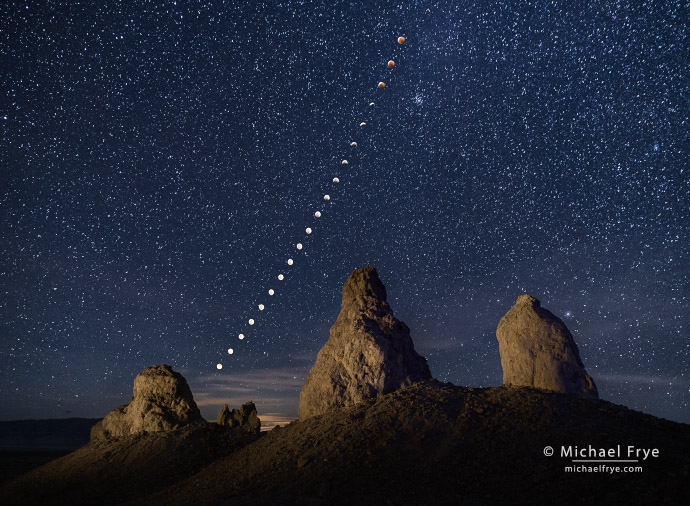
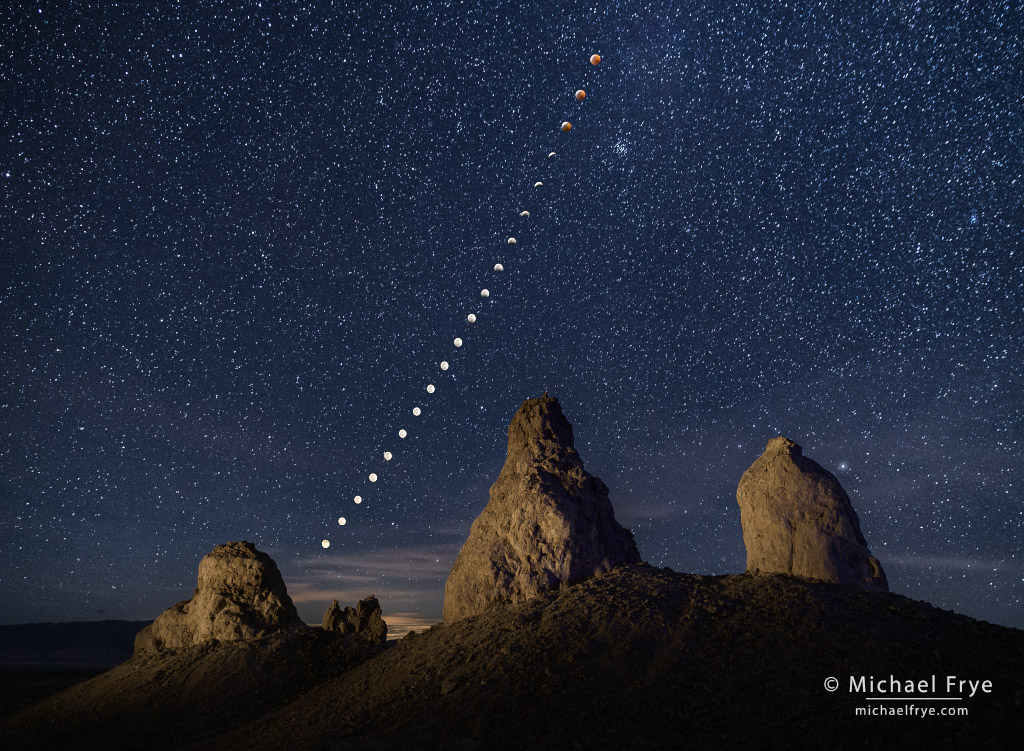
Lunar eclipse sequence, Trona Pinnacles, California, January 20th, 2019
On March 3rd people in many parts of the world (including most of North America, Eastern Asia, Australia, and New Zealand) will be able to see a total lunar eclipse. This page shows where the eclipse will be visible, as well as the timing of the event.
Here in the U.S. the eclipse will occur during the wee hours of the morning on March 3rd. So photographing the eclipse will require losing some sleep, but the fully-eclipsed moon will be fairly low in the sky, making it easier to line up the eclipse with an interesting foreground.
(more…)
by Michael Frye | Jul 27, 2025 | Advanced Techniques, Vision and Creativity
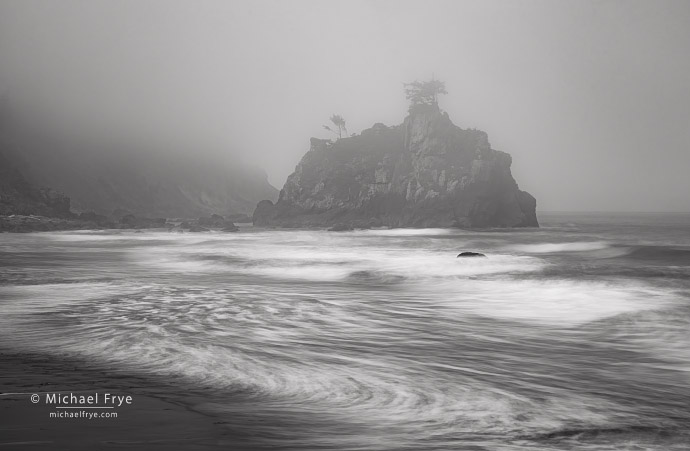
Sea stack and swirling waves, Northern California coast. 55mm, 3 seconds at f/16, ISO 200, ND filter. Timing was vitally important in making this photograph. I made 92 exposures with this exact same composition and camera settings, but only one had this zigzag wave.
Back in early June, before, during, and after our redwoods workshop in Northern California, we had many days with low fog along the coast. That’s somewhat unusual up there. It’s more typical to see the fog layer rise up a bit, where it looks like a low overcast at sea level, but if you can climb higher you might be able to get into the clouds, and into the fog.
That higher stratus deck usually works better for finding fog in redwood groves, since redwoods don’t grow at low elevations near the shore (there’s too much salt spray for them). But I love photographing low fog along the coast, with sea stacks and rock outcrops looming out of the mist. Fog is so common in these coastal areas that photographing these scenes in fog actually seems more characteristic, more typical, than photographing them on a sunny day, or even with a great sunset. I think of these shores as brooding and mysterious, so I like working with weather that enhances that mood.
(more…)
by Michael Frye | Dec 15, 2024 | Advanced Techniques, Composition
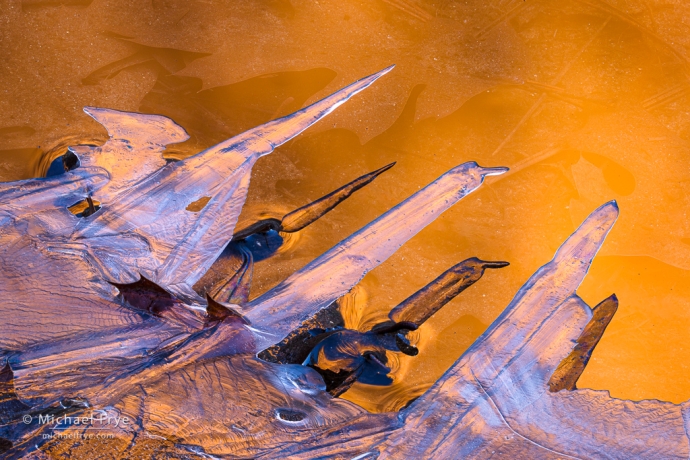
Ice fingers, Yosemite NP, California. 400mm, 1 second at f/16, ISO 100; 18 focus-stacked frames blended with Helicon Focus Pro. I needed to photograph this detail at an angle to get the orange reflections, requiring focus-stacking to get everything sharp. (It’s a reflection of a cliff lit by the setting sun.)
Last Thursday, Friday, and Saturday two smaller storms moved through the Sierra, bringing rain and higher-elevation snow. But for a couple of weeks before that it had been dry and warm – reaching the upper 60s at our house in Mariposa.
Early last week, as we were starting our workshop in Yosemite Valley, temperatures cooled off a bit, allowing ice to form along the banks of the Merced River. It’s always fun to photograph ice like this, with its beautiful patterns, designs, and colors. But it can be challenging, both technically and creatively.
(more…)
by Michael Frye | Nov 16, 2023 | Advanced Techniques, Vision and Creativity
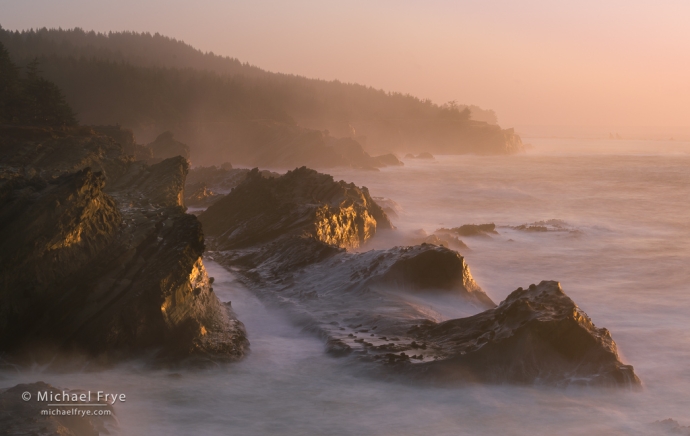
Misty sunset on the Oregon Coast. 73mm, 8 seconds at f/16, ISO 100, ND filter.
Claudia and I have been spending a lot of time in the Pacific Northwest this year, which is great, as I love this part of the world. We just finished a workshop along the Oregon Coast, and now we’re making our way to Bellingham, Washington, to visit our son and daughter-in-law, and stopping to see friends along the way.
The workshop was a lot of fun. A great group of people, and we saw some beautiful light, as well as big waves crashing against the shore.
(more…)
by Michael Frye | Feb 17, 2022 | Advanced Techniques, Vision and Creativity
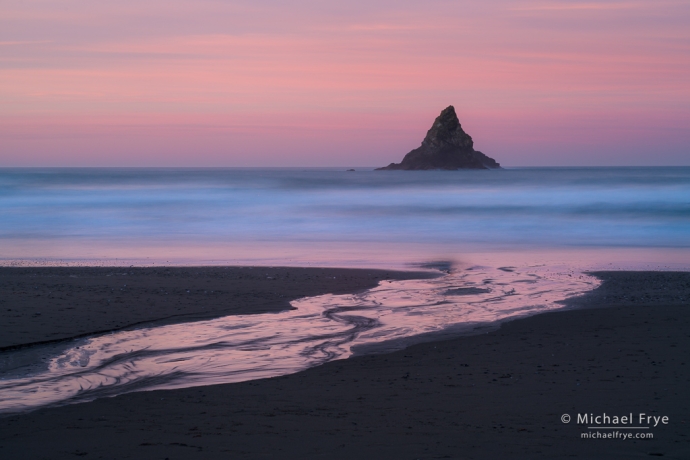
Creek and sea stack, sunrise, Oregon Coast. I used a slow shutter speed (30 seconds) to smooth the waves, which simplified the scene by eliminating texture in the water, and helped create a more ethereal quality to the image.
In one of my posts about Yellowstone last fall I talked about my attraction to dynamic landscapes. And Yellowstone is certainly dynamic, with its ever-changing array of spouting geysers and steaming vents.
But seascapes might be even more dynamic. In addition to the usual variables of landscape photography – light and weather – there’s the ocean itself. Tides, wave height, wave direction, and wind all have big effects on the way a scene looks. And no two waves are the same, so one moment will often look quite different from the next.
(more…)
by Michael Frye | Nov 8, 2020 | Advanced Techniques, Travels and Stories
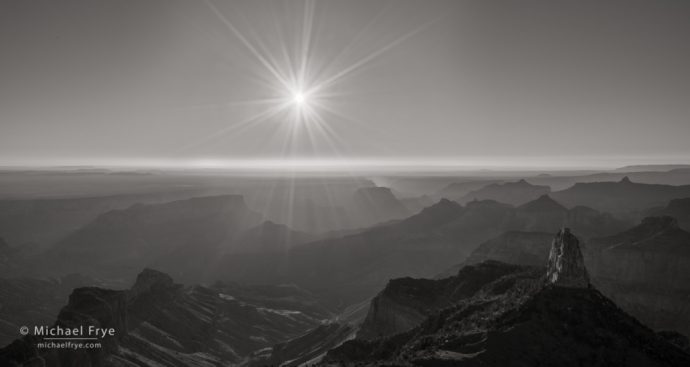
Morning sunlight from the North Rim of the Grand Canyon, Arizona. I used the “thumb technique” to reduce flare in this image; see the post for more details.
On our road trip last month Claudia and I found ourselves in Kanab, Utah. We cooked breakfast at a picnic table in a small park in town, and discussed our next move. There are a lot of options from Kanab. Should we head to Zion? Detour east toward the Paria River area? Drive the Cottonwood Canyon Road?
And then I thought, we’re pretty close to the North Rim of the Grand Canyon. And neither of us had ever been there. So the North Rim it was.
(more…)