Posts Tagged ‘Yosemite Valley’

A Beautiful Week in Yosemite

Tuesday, April 30th, 2013

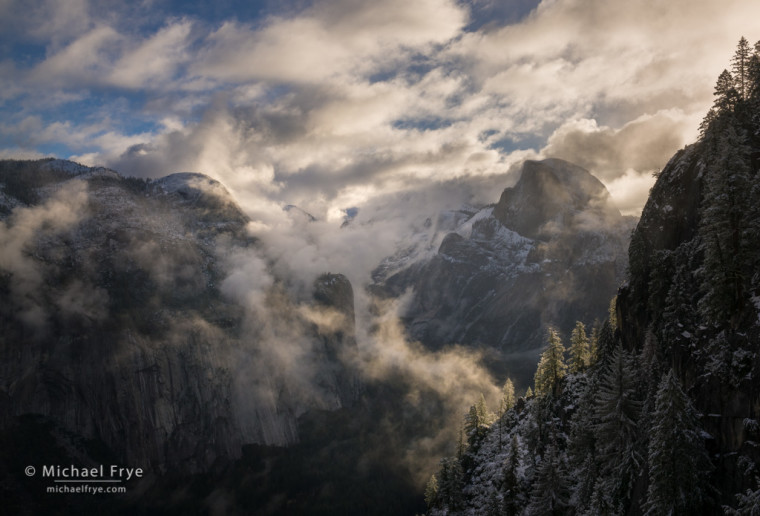
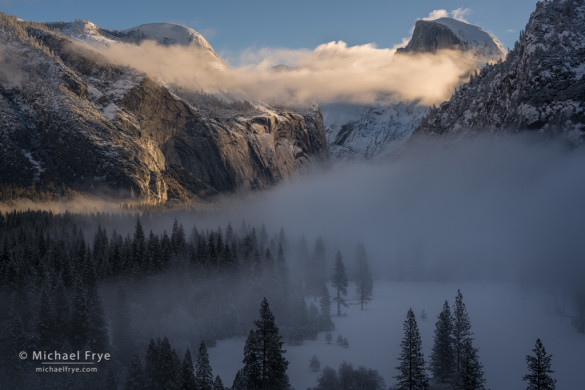
Storm clouds over Yosemite Valley from Tunnel View, Yosemite NP, CA, USA

Storm clouds over Yosemite Valley from Tunnel View, Yosemite NP, CA, USA

Yosemite Valley has been exceptionally pretty lately. Last Wednesday some dramatic clouds rolled in, and it’s been a great year for dogwoods.

The dogwoods in Yosemite are pretty consistent performers. They always bloom, regardless of how wet or dry the previous winter has been. But some years are better than others, and this is one of the better ones I’ve seen recently, as most of the trees have more blossoms than usual. The dogwoods arrived early this year, and all of them are now leafing out, but the flowers were still fresh-looking yesterday. In another week or so they’ll start to look bedraggled in the valley, though they should just be starting to bloom at higher elevations along highways 41 and 120, and in the Tuolumne Grove of giant sequoias.

(more…)

Dogwoods and Lunar Rainbows

Thursday, April 18th, 2013

Dogwood blossoms and reflections in the Merced River, from May 2012

Dogwood blossoms and reflections in the Merced River, from May 2012

The dogwoods are just starting to come out in Yosemite Valley. I was up there Tuesday, and saw that perhaps 30 percent of the dogwoods had new, green blossoms. A couple of trees even had fully white – though small – blossoms. Also, the cottonwoods are leafing out with those beautiful new bright-green leaves.

You want to catch the dogwoods early. The flowers last for several weeks, but they start to look ragged after awhile, and they don’t stand out as much after the trees leaf out. With the weather predicted to warm up this weekend I expect the dogwoods will progress rapidly, and many, perhaps even most, will be in full bloom a week from now. Next week or the following weekend might be the best time this year.

Also, there will be a full moon next Thursday, so let the lunar rainbow madness begin! You can visit Don Olson’s web site to see his predictions for when lunar rainbows will be visible from Cook’s Meadow and from the bridge below Lower Yosemite Fall. You can read my tips about photographing lunar rainbows here, and see what it’s like to spend a moonlit evening in Cook’s Meadow with 200 other photographers here.

Spring has arrived!

— Michael Frye

Related Posts: Tips for Photographing Lunar Rainbows; Lunar Rainbow Images, and the Upcoming Annular Eclipse

Michael Frye is a professional photographer specializing in landscapes and nature. He is the author and photographer of The Photographer’s Guide to YosemiteYosemite Meditations, and Digital Landscape Photography: In the Footsteps of Ansel Adams and the Great Masters, plus the eBooks Light & Land: Landscapes in the Digital Darkroom, and Exposure for Outdoor Photography. He has written numerous magazine articles on the art and technique of photography, and his images have been published in over thirty countries around the world. Michael has lived either in or near Yosemite National Park since 1983, currently residing just outside the park in Mariposa, California.

Proposed Changes to Yosemite’s El Capitan Meadow

Tuesday, April 16th, 2013
El Capitan after an autumn snowstorm from El Capitan Meadow, Yosemite NP, CA, USA

El Capitan after an autumn snowstorm from El Capitan Meadow, Yosemite NP, CA, USA

I know many of my readers have a close connection with Yosemite, so I thought you would want to know about some proposed changes to El Capitan Meadow. In most of the proposed alternatives for the park service’s Merced River Draft Management plan, fencing and signs would be installed to keep visitors from trampling the meadow.

John Sexton wrote a thoughtful post on Facebook about this issue, which I recommend reading. El Capitan Meadow has long been a favorite spot for photographers in Yosemite. Ansel Adams made his Oak Tree, Snowstorm photograph from there. Galen Rowell captured one of his most famous images, Clearing Storm Over El Capitan, from this meadow. John posted one of his wonderful photographs on his Facebook post. El Capitan Meadow is certainly a favorite place of mine too, and I’ve made many images there, including all the ones included here.

I know that the park service has a difficult job. They have to balance preservation with public use and enjoyment of the parks. Meadows are fragile, and are easily damaged by too much foot traffic, and the easiest way to prevent that damage is to fence off the meadow.

On the other hand, what makes Yosemite Valley so wonderful, so extraordinary, is the juxtaposition of soaring cliffs with the serenity of the meadows and meandering river on the valley floor. There are other places with magnificent cliffs. There is no other place with an idyllic valley surrounded by such high walls. The quintessential Yosemite experience is to wander out into a meadow, stare up at the cliffs and waterfalls, and soak up the tranquility. I would hate to see that experience taken away. There has to be a better solution than fencing and “Keep Out” signs for the valley’s meadows.

(more…)

A Harebrained Idea

Thursday, April 11th, 2013
Rainbow over Yosemite Valley from near Old Inspiration Point, Yosemite NP, CA, USA

Rainbow over Yosemite Valley from near Old Inspiration Point, Yosemite

It was a harebrained idea, but sometimes harebrained ideas work.

On Easter Sunday the forecast called for showers and thunderstorms, with a 100% chance of rain. So I decided it would be a great day to hike 6 miles and climb over 2,000 feet up to Old Inspiration Point.

I could have just gone to Tunnel View. Tunnel View is a wonderfully photogenic spot, where I could have waited out any rain showers in the car, then walked 50 feet to the viewpoint if something interesting happened. And if the light didn’t cooperate, well, no big deal – it wouldn’t be the first time I’ve struck out at Tunnel View, and it wouldn’t take much effort to come back and try again.

On the other hand, I have lots of photographs from Tunnel View, and every other easily-accessible viewpoint in Yosemite Valley, but I’d never been to Old Inspiration Point. And I was in the mood for an adventure. I asked Claudia if she wanted to come with me (carefully explaining what she might be in for, I swear), and she said sure. She’s always up for a hike.

(more…)

Surprising Wildflowers

Tuesday, March 19th, 2013

Oaks, lupine, and poppies in the Merced River Canyon near El Portal, CA, USA

Oaks, lupine, and poppies in the Merced River Canyon near El Portal, CA, USA

Claudia and I drove up the Merced River Canyon west of Yosemite Sunday afternoon on a scouting mission, looking for wildflowers that were rumored to be blooming. And we did find some flowers – despite our dry winter. The redbuds are coming out all along the canyon; most are just budding, but we found some in full bloom, and the rest should get there within the next week or so.

Redbuds have deep roots, so they’re not affected by drought as much as some other flowers. But the poppies in this area are annuals, and dependent on winter rains, so I was surprised to see quite a few poppies blooming up and down the canyon. The display doesn’t approach last year’s, or the even more spectacular bloom in 2009, but any flowers at all seem like a miracle after our dry winter. And who knows – maybe the show will get better.

Right now the most eye-catching hillside of poppies is about a mile east of Savage’s Trading Post on the opposite side of the river. You can reach the base of this hill by driving to the end of Incline Road and continuing on foot for about a mile down the old railroad bed. But getting up among the poppies requires climbing a very steep hillside. (There are directions to Incline Road in my Photographer’s Guide to Yosemite, which most of you probably have, but if not the road is easy to find. Just cross the bridge at Foresta Road, about four miles east of Savage’s, then turn left along the river on Incline Road.)

(more…)

A Rare Storm Approaching Yosemite

Tuesday, March 5th, 2013

Winter sunrise from Tunnel View, Yosemite NP, CA, USA

Winter sunrise from Tunnel View. With the right conditions Tunnel View can be great in the morning as well as the afternoon

January and February are the wettest months of the year in Yosemite. The average precipitation for January is 6.5 inches, while for February it’s 6.7 inches, which makes 13.2 inches for the two months combined.

But this year Yosemite received only a tenth of that: 1.33 inches total for January and February. The Sacramento Bee says it’s the driest January and February on record for the northern Sierra Nevada.

Since storms have been so rare lately, any forecast that calls for precipitation is big news, and we’ve got just such a forecast this week. Meteorologists are predicting a medium-sized storm to reach Yosemite tonight and tomorrow, with lingering showers on Thursday and Friday. The timing is hard to predict from the current forecast, but it’s likely that we’ll see clearing storm conditions either late Wednesday, Thursday or Friday. With the showery weather there may be several clearing-storm events during that time.

(more…)

Hoping for Snow

Friday, February 22nd, 2013

Half Dome and clouds, Yosemite NP, CA, USA

Half Dome and clouds, Yosemite NP, CA, USA

Many people, including me, had high hopes for the snowstorm that came through Yosemite on Tuesday. The forecast called for six to twelve inches of snow, so it sounded like we would see some beautiful snow scenes, and maybe even get to photograph a clearing storm. And some moisture might help revive Horsetail Fall.

Around sunset on Tuesday it started snowing at my house in Mariposa — first lightly, then heavily. In no time we had three or four inches of snow, and eventually got six inches, which is a lot for our 2700-foot elevation.

But the storm looked very compact on radar, and the precipitation didn’t seem to be reaching Yosemite. I called my friend Kirk Keeler, who lives in Yosemite Valley, and he told me that they had received only half an inch of snow.

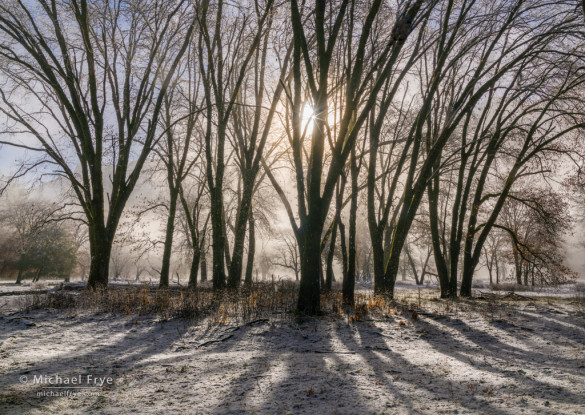
Wednesday morning Claudia and I cleared the snow off our car and drove up to Yosemite Valley. We found an inch or two of snow — not a lot, but enough to highlight every tree branch. I saw many beautiful scenes with trees etched in snow, including the pattern of cottonwood branches below.

The morning was clear, but later some evaporation clouds started to appear, and they kept building. By the end of the day all the cliffs were hidden by clouds. But between 4:00 to 4:30 in the afternoon Half Dome and the clouds put on a great show. Half Dome would vanish completely, then reappear, wrapped in clouds and speckled with sunlight. I made the photograph above just before Half Dome disappeared for good.

(more…)

A Quick Horsetail Fall Update

Saturday, February 16th, 2013
Horsetail Fall at 5:34 p.m. yesterday

Horsetail Fall at 5:34 p.m. yesterday

It’s been quite dry in Yosemite since December, but there’s still some snow on top of El Capitan, and I thought that the warming weather over the last few days would melt some of that snow and increase the water flow in Horsetail Fall. But the flow is still disappointingly meager. I had a chance to photograph Horsetail last night, and I would say the water level is about the same as last year. The accompanying photograph was made from the Southside Drive area at about 5:30 p.m. yesterday. What water there is gets nicely highlighted when the light is just right, especially near the bottom of the fall, but… I wish the flow was better.

With low water like this I think the Southside Drive spot (Location 10 in my Photographer’s Guide to Yosemite book and iPhone app) works a little better than Rowell’s View near the El Capitan picnic area along Northside Drive (Location 1). From Southside Drive you’re a little further away, and you can see a bit more of the bottom of Horsetail Fall, which is the part that shows up best with conditions like this.

It’s supposed to be warm again today, so that might help increase the flow, but then temperatures are expected to trend downward tomorrow and Monday. On Tuesday forecasters are predicting the arrival of a snowstorm, which is expected to leave even colder air in its wake. The bad news is that the colder temperatures will slow down the flow in Horsetail Fall. The good news is that… a snowstorm is coming! And that, of course, brings the possibility of photographing snowy trees and cliffs, and maybe a clearing storm.

(more…)

Latest Horsetail Conditions

Wednesday, February 13th, 2013
Horsetail Fall and clouds on a March afternoon, Yosemite NP, CA, USA

Horsetail Fall and clouds on a March afternoon, Yosemite NP, CA, USA

I’m happy to be up and running after dealing with some computer issues, and can give you a quick report on Horsetail Fall. During a private workshop on Monday I had a chance to check out the water flow. I’d say it’s a little below average for mid-February, but definitely better than last year. Despite six weeks of mostly dry weather there’s still some snow on top of El Capitan to feed the waterfall, and temperatures are supposed to rise a bit this week, which should help melt that snow and increase the water volume.

The window of best light for Horsetail Fall starts this weekend and lasts about a week to ten days. If our dry spell continues we should see some clear skies at sunset during that time — an essential requirement for the Horsetail light show. But the long-range forecast calls for precipitation next Tuesday and Wednesday, so we’ll see.

As a reminder, I’ll be at the reception for my exhibit at The Ansel Adams Gallery this Saturday from noon to 2:00 p.m., and also at the Yosemite Renaissance opening reception the following Friday, February 22nd, from 5:30 to 7:30 p.m. at the Yosemite Museum. I hope to see you at one of those events if you’re in the area!

— Michael Frye

Related Posts: Horsetail Fall Questions; The Best Time to Photograph Horsetail Fall, Revised

Michael Frye is a professional photographer specializing in landscapes and nature. He is the author and photographer of The Photographer’s Guide to YosemiteYosemite Meditations, and Digital Landscape Photography: In the Footsteps of Ansel Adams and the Great Masters, plus the eBooks Light & Land: Landscapes in the Digital Darkroom, and Exposure for Outdoor Photography. He has written numerous magazine articles on the art and technique of photography, and his images have been published in over thirty countries around the world. Michael has lived either in or near Yosemite National Park since 1983, currently residing just outside the park in Mariposa, California.

Horsetail Fall Questions

Thursday, January 31st, 2013
Horsetail Fall at sunset, Yosemite NP, CA, USA

Low water, but ideal light on Horsetail Fall, February 20th, 2012

It’s almost February, so naturally I’ve been getting a lot of questions about Horsetail Fall. My thoughts about the best time to photograph Horsetail haven’t changed since I wrote this post last year: basically it’s February 16th to 23rd, or maybe a little beyond that.

This window was confirmed by my observations in 2012. There wasn’t much water in the fall last year, but we had a string of clear days, which allowed me to closely watch the light, and I think that February 16th to 23rd window is about right. You can, of course, take good photographs before or after that window; I’m talking about ideal light.

That ideal light requires clear skies to the west at sunset, something no one can predict at this point. And for good photographs the waterfall has to be flowing. Overall we’ve had a lot more rain and snow than last year, and Horsetail is flowing now. January, however, has been pretty dry, and there’s no precipitation in the forecast until at least next Wednesday. I think Horsetail will have more water this year than last, regardless of what happens over the next couple of weeks, but it would be nice to get some more snow on top of El Capitan soon to help feed Horsetail.

(more…)