In the Moment:
Michael Frye's Landscape Photography Blog
by Michael Frye | Jul 2, 2013 | Light and Weather, Vision and Creativity, Workshops
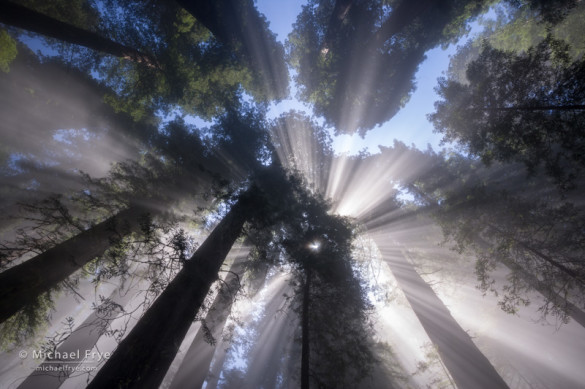
Sunbeams through the redwood canopy, Del Norte Coast Redwoods SP, CA, USA
Weather always plays a big role in landscape photography. I study the weather so that I can put myself – and my workshop students – in the right place at the right time. But a little luck always helps.
During my recent workshops up in the redwood country we found some wonderful juxtapositions of fog and sunlight. One morning, during the second week, we pulled up to a trailhead and everyone immediately got out their cameras because we saw beautiful godbeams right from the parking area. But, as it turns out, we didn’t need to rush. Usually these sun-breaking-through fog moments are fleeting, but it turns out that we were right at the top of a relatively stable fog bank, so the mixture of sun and fog lasted for hours along parts of the trail. The photograph above is just one of many sunbeam photographs I made that morning, and everyone in the group came away with some great images from that day.
(more…)
by Michael Frye | Apr 11, 2013 | Light and Weather, Travels and Stories
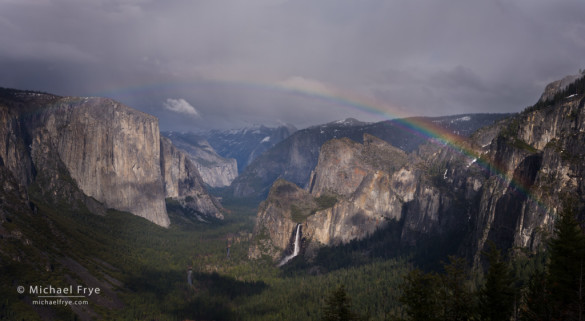
Rainbow over Yosemite Valley from near Old Inspiration Point, Yosemite
It was a harebrained idea, but sometimes harebrained ideas work.
On Easter Sunday the forecast called for showers and thunderstorms, with a 100% chance of rain. So I decided it would be a great day to hike 6 miles and climb over 2,000 feet up to Old Inspiration Point.
I could have just gone to Tunnel View. Tunnel View is a wonderfully photogenic spot, where I could have waited out any rain showers in the car, then walked 50 feet to the viewpoint if something interesting happened. And if the light didn’t cooperate, well, no big deal – it wouldn’t be the first time I’ve struck out at Tunnel View, and it wouldn’t take much effort to come back and try again.
On the other hand, I have lots of photographs from Tunnel View, and every other easily-accessible viewpoint in Yosemite Valley, but I’d never been to Old Inspiration Point. And I was in the mood for an adventure. I asked Claudia if she wanted to come with me (carefully explaining what she might be in for, I swear), and she said sure. She’s always up for a hike.
(more…)
by Michael Frye | Mar 14, 2013 | Light and Weather, Vision and Creativity
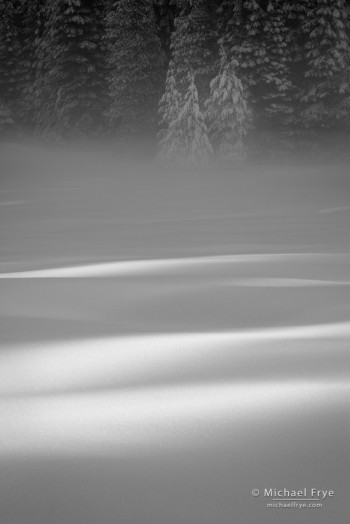
Sunlight slanting across Crane Flat Meadow, Yosemite NP, CA, USA
A Trip to Crane Flat
Yosemite got some much-needed precipitation last week – over an inch total. I kept checking the radar and satellite images online, looking for an opportunity to photograph a clearing storm. Friday morning seemed promising, so I drove up to Yosemite Valley early, but found no snow. It looked like the snow level had been around 5,000 feet, higher than forecast. Worse, from a photographic perspective, the skies were clear and there was no mist.
Shortly after sunrise I noticed light striking a ridge near the tunnels on Highway 120, and on a whim decided to drive up to Crane Flat. I thought Crane Flat would at least have some fresh snow, since it’s at 6,000 feet.
Indeed there was fresh snow – over a foot of it. I parked at the Tuolumne Grove trailhead and walked along the plowed road. The sun had just reached parts of the main meadow, and I found some interesting small subjects to photograph, like tree-shadows on the snow.
Some shafts of sunlight slanting across the snow caught my attention, and then some mist began rising near the edge of the meadow, behind the shafts of light. I immediately recognized the potential to make an image that went beyond an abstract study of shadows – a photograph that had a mood.
(more…)
by Michael Frye | Mar 5, 2013 | Yosemite Photo Conditions
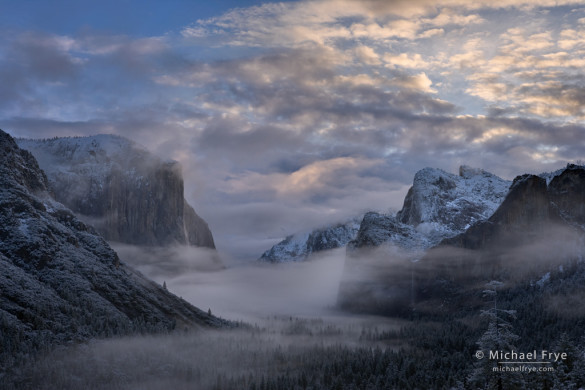
Winter sunrise from Tunnel View. With the right conditions Tunnel View can be great in the morning as well as the afternoon
January and February are the wettest months of the year in Yosemite. The average precipitation for January is 6.5 inches, while for February it’s 6.7 inches, which makes 13.2 inches for the two months combined.
But this year Yosemite received only a tenth of that: 1.33 inches total for January and February. The Sacramento Bee says it’s the driest January and February on record for the northern Sierra Nevada.
Since storms have been so rare lately, any forecast that calls for precipitation is big news, and we’ve got just such a forecast this week. Meteorologists are predicting a medium-sized storm to reach Yosemite tonight and tomorrow, with lingering showers on Thursday and Friday. The timing is hard to predict from the current forecast, but it’s likely that we’ll see clearing storm conditions either late Wednesday, Thursday or Friday. With the showery weather there may be several clearing-storm events during that time.
(more…)
by Michael Frye | Feb 22, 2013 | Yosemite Photo Conditions
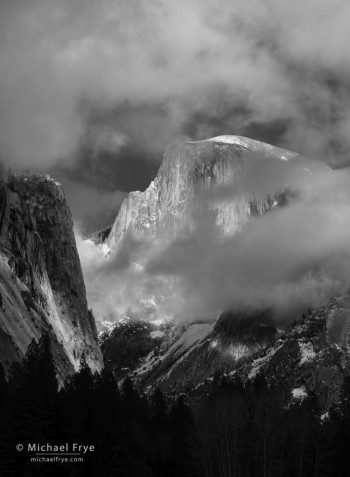
Half Dome and clouds, Yosemite NP, CA, USA
Many people, including me, had high hopes for the snowstorm that came through Yosemite on Tuesday. The forecast called for six to twelve inches of snow, so it sounded like we would see some beautiful snow scenes, and maybe even get to photograph a clearing storm. And some moisture might help revive Horsetail Fall.
Around sunset on Tuesday it started snowing at my house in Mariposa — first lightly, then heavily. In no time we had three or four inches of snow, and eventually got six inches, which is a lot for our 2700-foot elevation.
But the storm looked very compact on radar, and the precipitation didn’t seem to be reaching Yosemite. I called my friend Kirk Keeler, who lives in Yosemite Valley, and he told me that they had received only half an inch of snow.
Wednesday morning Claudia and I cleared the snow off our car and drove up to Yosemite Valley. We found an inch or two of snow — not a lot, but enough to highlight every tree branch. I saw many beautiful scenes with trees etched in snow, including the pattern of cottonwood branches below.
The morning was clear, but later some evaporation clouds started to appear, and they kept building. By the end of the day all the cliffs were hidden by clouds. But between 4:00 to 4:30 in the afternoon Half Dome and the clouds put on a great show. Half Dome would vanish completely, then reappear, wrapped in clouds and speckled with sunlight. I made the photograph above just before Half Dome disappeared for good.
(more…)